


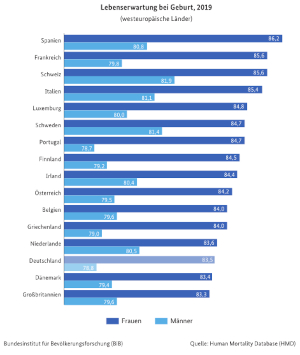
Life expectancy: Germany is among the worst in Western Europe
11.05.2023 13:38
When compared to Western Europe, Germany only ranks lower in terms of average life expectancy. This is the conclusion of a new study published by researchers from the Federal Institute for Population Research (BiB) and the Max Planck Institute for Demographic Research.
Among 16 Western European countries, the Federal Republic ranks 15th among men and 14th among women. The leaders among women are Spain and France, and among men Switzerland and Sweden. The main reason for the backlog is an increased number of deaths due to cardiovascular diseases. This is the conclusion of a new study published by researchers from the Federal Institute for Population Research (BiB) and the Max Planck Institute for Demographic Research in the “European Journal of Epidemiology”.
Too many deaths from cardiovascular disease
For the study, deaths by cause of death in Germany were compared with six selected countries. Compared to pioneering countries in extending life expectancy such as Japan, Spain, Switzerland and France, Germany performs poorly, especially when it comes to cardiovascular diseases. When comparing by age, men's life expectancy lags behind those of pioneer countries as early as the age of 50. Compared to Switzerland, Germany alone is losing almost a year in life expectancy due to the increased number of deaths between the ages of 50 and 65. In the case of women, however, the gap is largely explained by increased mortality in people over 65 years of age. “The fact that Germany is significantly behind in cardiovascular diseases is cause for concern, as these are now considered largely preventable,” says mortality researcher Pavel Grigoriev from BiB, explaining the results.
Better prevent illnesses medically and through a healthy lifestyle
The findings suggest that there are deficits in the prevention of cardiovascular diseases in particular. Late diagnoses also make successful treatment more difficult. “Our analyzes illustrate the need for Germany to catch up in this area,” says Sebastian Klüsener, Research Director at BiB. “Better prevention of illnesses can not only save health costs, but also increase the well-being of the population.” The federal government has also recognized the need for action, as the numerous measures to improve prevention in the coalition agreement make clear. “It’s not just the state that’s involved in this issue, it’s all of us,” says Sebastian Klüsener. “For example, by eating healthier and exercising more.”
Lower life expectancy despite high healthcare costs
The study results may seem surprising given Germany's cost-intensive healthcare system with high technical standards. “Great economic strength and an efficient health system that is easily accessible to the majority of the population are in contrast to a Western European position at the bottom when it comes to life expectancy,” says Pavel Grigoriev.
The contradiction between the high investments in health care and the results in life expectancy should also be seen as a warning signal for the sustainability of the health system - after all, the health challenges will increase even more in the next few years due to the aging of the baby boomers.