


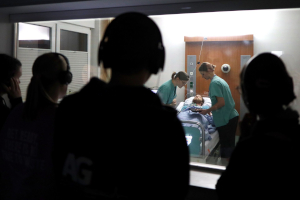
Medical emergencies during the late shift – medical students experience simulated stressful situations.
23.07.2025 14:26
Working at unusual hours and in various multidisciplinary teams can be challenging for aspiring doctors, but it's part of hospital work. Therefore, for the past two years, the lecturers at the Department of Anesthesiology, Surgical Intensive Care and Pain Therapy at UKM (University Hospital Münster) have been developing a multi-day elective course for medical students at the University of Münster – the "Interdisciplinary Late Shift" course – in collaboration with the AGN (Working Group for Emergency Medicine).
Using seven realistic case studies, course participants experience the problems and needs of their simulated patients, the collaboration within the medical and nursing team, and above all, themselves.
At 10:00 p.m., the hospital corridors are quieting down, some patients are already asleep, and at this late hour the number of ward staff is correspondingly reduced – when the on-duty doctors receive a call: "A patient is suffering from acute shortness of breath and complains of severe chest pain." Now, concentration and teamwork are crucial to determine the cause as quickly as possible and initiate appropriate treatment. How do doctors, especially at the beginning of their careers, cope with being largely on their own, and how can they best prepare for this?
In the elective course "Interdisciplinary Late Shift," 16 medical students from the University of Münster can experience firsthand what it's like to treat medical emergencies from 5:00 p.m. to 1:00 a.m., applying their newly acquired knowledge. Seven emergency scenarios are acted out by medical students from the AGN (Association for the Promotion of Clinical Nursing). As soon as the students are informed of an acute emergency, a pair of students rushes off to find a diagnosis. One of the four nurses present from the UKM (University Hospital Münster) assists the team with the treatment. Physicians from the UKM and the AGN team are also active in the background. During the approximately 20-minute treatment period, diagnoses are made and the simulated patients receive appropriate care. All simulated cases are evaluated on-site before the next emergency is addressed.
The staged emergencies are used not only for the practical application of specialist skills but also to promote soft skills. "Besides the technical aspects, the students probably learn the most about themselves – how they react in stressful situations, how they react when they are tired, but also how they come across to their colleagues, both the students and the nursing staff," emphasizes Jan Landwehrt, specialist physician and lecturer at the Department of Anesthesiology and Intensive Care Medicine. Since 2022, the lecturers, together with the AGN (Association of German Anesthesiologists), have been organizing the three-day elective course for medical students in their 8th to 10th semesters. "The students receive feedback here that is actually unique in their studies," Landwehrt underlines. "Furthermore, it gives us the opportunity to receive feedback from the participants and thus further develop the seminar." The project, which has received an award from the German Society of Anesthesiology, is intended to continue giving more students insight into the practical workflows of a late shift.