


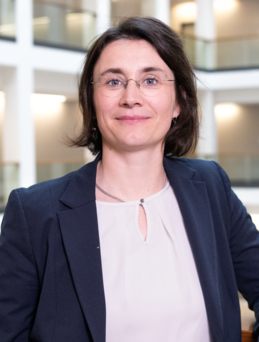
Freia De Bock takes over the management of the Institute for Medical Sociology and Rehabilitation Science
04.03.2025 13:38
We fundamentally know a great deal about how to care for people and keep them healthy for as long as possible—we just don't put this knowledge into practice enough, says German-Belgian public health expert Prof. Freia De Bock. She has now taken over the professorship for medical sociology and thus the directorship of the Institute for Medical Sociology and Rehabilitation Science at the Charité – Universitätsmedizin Berlin.
Their goal: to consider and utilize prevention and health services research from childhood through the lifespan. One way to achieve this is to develop health care models that reach people as early as possible. One prerequisite: better networking between stakeholders and services with citizen participation.
How do social influences affect the development, progression, and cure of diseases, or the maintenance of health? These are core topics of medical sociology, as is the quality of preventive, medical, and nursing care. Freia De Bock's research focuses on promoting and protecting the health of children and adolescents, including children with chronic illnesses, and their cross-systemic care. At the Charité, she now succeeds medical sociologist and aging researcher Prof. Adelheid Kuhlmey, under whose leadership the Institute for Medical Sociology and Rehabilitation Science specialized in older people and other vulnerable groups and their care for the past 22 years.
Freia De Bock aims to combine existing research fields, which include health care, training, and rehabilitation research, with a new focus: prevention and health care research for children, adolescents, and families. What serves to promote health in all phases of life should be more intensively researched and promoted in people's daily lives. Challenges such as social disadvantage and migration will be part of the considerations.
Bridge builder between different worlds
The pediatrician has many years of clinical experience and is also a health services researcher with training in public and population health at the international universities of Harvard, Boston, and Erasmus, Rotterdam. In her academic career to date, Freia De Bock has led working groups and research consortia whose goals have included better reaching groups of people with social stress or improving the care of chronically ill children and children with disabilities. For her, developmental and social pediatrics and public health have always belonged together. "For example, children with chronic illnesses or developmental risks depend on a wide range of support in school, the social system, and the family in order to live healthy lives. In reality, boundaries between the individual social sectors and health care systems make it difficult to support, reintegrate, and prevent affected children and adolescents. These hurdles must be overcome, in the care of young people, just as they do in other phases of life," emphasizes Freia De Bock.
The recently launched PEDNET-LC project, in which the Charité is involved, among others, with Freia De Bock, and which is supported by the Federal Ministry of Health, aims to demonstrate how this can work. It aims to pave the way for timely, tailored, and sustainable care for children and adolescents with long-COVID-like illnesses of varying severity. For this purpose, 20 specialized, interdisciplinary, and multi-professional care centers are being established nationwide, working closely with each other and with other stakeholders, such as schools.
Prevention instead of accepting illness: Change in healthcare
Keeping people healthy and preventing diseases before they break out is the credo of future healthcare. However, preventive transformation is only possible if different levels and systems are addressed simultaneously, says Freia De Bock: "Preventive care can only succeed through interdisciplinary, cross-sectoral, and cross-system collaboration between the relevant stakeholders within a specific region." Therefore, under her leadership, for example, an interdisciplinary research-practice network for preventive care for children and adolescents is to be created, integrating the fields of health, education, and social services.
"Our research aims to advance preventive measures, develop new care models, implement them, and test their effectiveness," says the physician. "Specifically, we are thinking of models that connect specific living environments, such as schools or urban neighborhoods, with clinical facilities such as hospitals or regional care centers." Freia De Bock and her team also want to establish a citizens' council with an integrated children's council for health and care research. In this way, everyday and practical experiences will be incorporated into research.
Prevention as basic medical knowledge
When it comes to promoting healthy development across the board, early prevention is crucial – Freia De Bock has repeatedly confirmed and implemented this insight in her previous work. She intends to share her experiences, particularly in teaching: "We are planning joint lectures for students of various healthcare professions, delivered by an interdisciplinary team of faculty from clinical and public health settings, as well as stakeholders from community practice and the public," says the health services researcher.
Prevention and preventive care should be more firmly embedded as cross-cutting competencies in medical studies so that future physicians are equipped with optimal knowledge and competencies regarding preventive measures at the individual and societal levels. After all, they are the ones who will implement the preventive transformation of the healthcare system, together with other stakeholders in the healthcare system, health-promoting institutions, and the school and social systems.
Short CV
Freia De Bock studied human medicine at the universities of Heidelberg, Ghent, and New Orleans. In 2005, she received her doctorate in Heidelberg in cooperation with the Max Planck Institute of Psychiatry in Munich. In the following years, De Bock turned to public health and health services research at the Harvard School of Public Health in Boston and the Erasmus University Rotterdam. She completed her master's degree in Rotterdam in 2012. In the same year, she successfully completed her training as a specialist in pediatrics. Two years later, she obtained her habilitation at the Mannheim Medical Faculty and the University of Heidelberg. Her work focuses on children's physical activity and nutritional behavior and the influence of intervention programs in kindergartens. In 2017, De Bock was awarded an adjunct professorship at the Mannheim Medical Faculty and also led a working group on pediatric health services research at the University Medical Center Mainz. As head of a department at the Federal Center for Health Education (BZgA), she advocated for effective, evidence-based health communication from 2018 to 2022. From 2022, as an appointed professor of health services research at the Medical Faculty of Heinrich Heine University Düsseldorf, De Bock returned to the topic of prevention, but this time primarily for people who were already ill, i.e., from a clinical perspective. Here, she examined interventions in the areas of exercise, nutrition, and stress regulation, as well as their benefits for various physical and psychosocial risk factors or illnesses. The health services researcher is a member and leading scientist at the German Center for Mental Health (DZPG), which has links to the German Center for Child and Adolescent Health (DZKJ) at the Charité. Since March 1, 2025, Freia De Bock has headed the Institute for Medical Sociology and Rehabilitation Science at the Charité.