


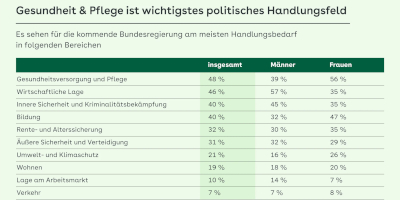
Forsa poll on the 2025 federal election: Health and care is the most important area of action for the new government for Germans.
15.01.2025 15:56
A representative survey conducted by forsa on behalf of the AOK Federal Association shows that Germans consider health and care (48 percent) to be the most important political area for action for the next federal government – ahead of the economic situation (46 percent), internal security and crime prevention (40 percent), education (40 percent) and pensions and old-age security (32 percent).
Dr. Carola Reimann, CEO of the AOK Federal Association, says: „In the current election campaign, the issue of health and care has so far played a subordinate role – but in light of the forsa results, this is completely unjustified. The parties must prioritize this issue much more highly.“ Although health and care were identified by respondents as the most important area of action, only seven percent stated that they were well-informed about the positions and plans of the various parties in this field.
According to Reimann, one reason for this is that the public debate on health and long-term care in the current election campaign has been severely narrowed and dominated by populist, ad hoc demands, such as unpaid sick leave or the abolition of sick leave certificates issued over the phone. Reimann stated: "Such knee-jerk reactions don't get us anywhere, distract from the real efficiency problems in the healthcare system, and completely ignore the concerns and wishes of voters. The goal is to improve the functioning of the health and long-term care system while simultaneously preventing further increases in the financial burden on individuals and the economy." The AOK (General Local Health Insurance Fund) group presented proposals on this topic in a position paper earlier this week.
According to a forsa survey, the most important measures for the coming years are combating the shortage of skilled workers in nursing and elderly care (79 percent), followed by access to medical care also in disadvantaged regions (72 percent) and improving working conditions in hospitals, especially for nursing staff (70 percent).
Dissatisfaction with the quality of healthcare, especially in the East
When asked about their satisfaction with the quality of healthcare, only ten percent of respondents said they were very satisfied. Forty-five percent were somewhat satisfied, while 34 percent were less satisfied and eleven percent were not at all satisfied. Dissatisfaction is particularly high in eastern Germany: a total of 53 percent said they were less than satisfied or not at all satisfied, compared to only 44 percent in the western German states. Reimann commented: "Satisfaction surveys regarding the German healthcare system have yielded better results in the past."„
The respondents' assessment of future medical care is even more negative: only four percent have very high confidence that Germany will succeed in ensuring high-quality and affordable healthcare for all citizens in the future. Thirty-six percent have high confidence, while 50 percent have rather low confidence and ten percent have no confidence at all. According to the head of the AOK (a German health insurance company), this is also alarming.
Reimann: „Health and care are important issues for social cohesion and, beyond that, a key economic factor. A functioning and affordable health and care system attracts investment and promotes the establishment of new businesses in the regions. Against this backdrop, the issue must be given much greater political focus and not treated as a side issue.“
background
The survey was conducted nationwide by forsa from December 16-18, 2024, among 1,003 adults aged 18 and over.