


Statutory health insurance: Strong increase in contributions in 2025
17.10.2024 12:54
The Advisory Board at the Federal Office for Social Security (BAS) published its 2025 financial forecast for statutory health insurance on October 16. Insured members will face significant increases in statutory health insurance contributions next year. This will also increase employers' non-wage labor costs, thus burdening the competitiveness of jobs.
The German healthcare system is currently facing particularly high cost increases: Causes include inflation, medical-technological advances, and the increasing use of medical services. Added to this are political expansions of services and an increasing shifting of the costs of government-run tasks onto statutory health insurance contributors in the form of non-insurance-related services. The consequence: insured persons will face significantly higher contributions starting in 2025.
The sharp rise in costs, particularly for hospitals and pharmaceuticals, affects both private and statutory health insurance: Therefore, most privately insured individuals will also experience higher costs in 2025. According to the results of the official estimation group, it is now clear what they will have to prepare for starting January 1, 2025.
Highest contribution jump in history
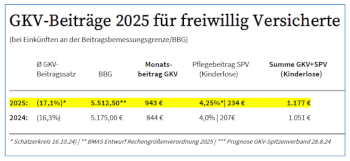
The average additional contribution in statutory health insurance is expected to rise by 0.8 percentage points to 2.5 percent in 2025—the largest contribution increase in history. This will increase the total contribution rate in statutory health insurance to 17.1 percent. In addition, the GKV-Spitzenverband (National Association of Statutory Health Insurance Funds) forecasts an increase of 0.25 contribution points in long-term care insurance.
In addition to the contribution rates, the contribution assessment ceiling is often also crucial for the individual statutory health insurance contribution. This value defines the income level up to which contributions to statutory health and long-term care insurance must be paid. It is set annually by legal regulation based on income trends. The draft of this regulation from the Federal Ministry of Labor is significant: It stipulates that the contribution assessment ceiling will rise from €5,175 to €5,512.50 monthly gross income in 2025 (+6.5% increase). This represents an increase of €4,050 per year, on which additional social security contributions must now be paid.
Highly qualified professionals are particularly affected
For employees, this means significant premium increases. Highly qualified professionals earning at the contribution assessment threshold will be particularly hard hit. Combined with the new contribution rates, this means they will pay €943 per month for statutory health insurance alone starting January 1, 2025. This represents an increase of 11.7 percent.
In addition, long-term care insurance contribution rates will also increase, expected to be at least 0.25 percentage points. For employees at the assessment threshold (without children), this means an increase in monthly contributions of approximately 13 percent, to up to €234 for long-term care insurance. This means that the combined monthly contributions for health and long-term care insurance at the assessment threshold in 2025 will be €1,177.
720 euros statutory health insurance contribution for average earners
For insured persons with an average income (according to the Federal Ministry of Labor, this will be €4,208 gross per month in 2025), the statutory health insurance contribution will increase to €720 per month (+17 percent) and up to €179 for long-term care insurance. (The even higher percentage increase than for income at the assessment threshold is due to the particularly sharp increase in average income according to BMAS statistics.)
Increase in social security contributions puts a strain on jobs
However, the higher contributions burden not only employees but also their employers, as they must contribute half of the higher contributions through additional wage costs. The Confederation of German Employers' Associations (BDA) expressed alarm at the estimation panel's findings:
"The challenges for companies are becoming increasingly greater. Only by reliably limiting social security contributions will Germany be able to remain competitive in the long term. Policymakers must finally deliver." For years, statutory health insurance has not had a revenue problem, but rather a spending problem. "We urgently need structural reforms in the healthcare system."