


Millions of children experience twice as many hot days each year as their grandparents
15.08.2024 12:14
UNICEF has compared the 1960s with the average for the years 2020 to 2024 and warns urgently about the speed and extent with which extremely hot days – defined as days with temperatures above 35 degrees Celsius – are increasing, endangering the lives and health of children worldwide.
„"The hottest summer days now seem normal," said UNICEF Executive Director Catherine Russell. "Extreme heat is increasing, affecting children's health, well-being, and daily lives."“
Worldwide, children in African countries are exposed to the most extremely hot days, and the number of hot days has also increased most sharply there. 123 million children in West and Central Africa—or 39 percent of children in the region—now experience temperatures above 35 degrees Celsius for an average of more than a third of the year (at least 95 days). In some countries, children spend an average of more than half the year in these extremely hot temperatures: in Mali, the average is up to 212 days, in Niger 202 days, in Senegal 198 days, and in Sudan 195 days.
In Latin America and the Caribbean, nearly 48 million children live in areas where there are twice as many extremely hot days as in their grandparents' time. In Paraguay, for example, the number of extremely hot days has increased from 36 to 71 days compared to the 1960s.
Heat stress in the body caused by extreme heat poses a unique threat to the health and well-being of children and pregnant women, especially when no cooling options are available.
„"Children are not small adults. Their bodies are much more vulnerable to extreme heat. Young bodies heat up faster and cool down more slowly. Extreme heat is especially dangerous for babies because of their faster heart rates, so rising temperatures are even more of a concern for children," Russell said.
Heat stress is associated with pregnancy complications, premature births, and stillbirths. Children are directly at risk from heat exposure, for example, because they are at increased risk of heatstroke or sunstroke. Furthermore, heat contributes to malnutrition and makes children more vulnerable to infectious diseases that spread in high temperatures, including malaria and dengue fever. There is evidence that heat also affects neurological development, mental health, and well-being.
In addition, heat leads to school closures, poor sleep quality and difficulty concentrating, thus also affecting the education of children and young people.
UNICEF calls for ambitious climate protection
In the coming months, all member states of the Paris Agreement must submit new national climate plans – the Nationally Defined Contributions (NDC 3.0). These plans will set the course for climate action for a decade. UNICEF calls on world leaders, governments, and the private sector to seize this opportunity. Ambitious climate action is urgently needed to safeguard every child's right to a clean, healthy, and sustainable environment.
„"Governments must act to control rising temperatures—and there is now a unique opportunity to do so. As governments currently draft their national climate action plans, they can do so with ambition and the knowledge that today's children and future generations will have to live in the world they leave behind," Russell said.
Further information
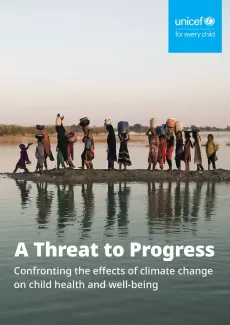
The current UNICEF report „A threat to progress: Confronting the effects of climate change on child health and wellbeing“ shows comprehensively which health risks for children are caused or exacerbated by climate change.