


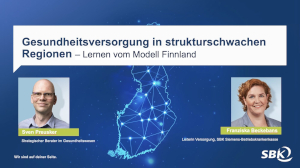
Rural healthcare – what we can learn from Finland
10.07.2024 17:24
Whether chronically ill, multimorbid, or acute cases, people in structurally weak regions must continue to receive optimal medical care. This is one of the key challenges facing the German healthcare system.
In some regions of Germany, the healthcare infrastructure is already threatening to become a patchwork quilt. Rural doctor's practices are closing due to a lack of skilled staff or because there is no successor. In addition, the new generation of doctors has different requirements in terms of compatibility and work-life balance. Demographic change is simultaneously increasing the need for medical and nursing care. [1] In the search for solutions to ensure continued healthcare in rural areas despite these burdens, it is worth looking to Finland. Our neighbors in the far north have created regional units and given them considerable scope for action. Among other things, nurses here can make many decisions themselves – without a doctor. Finland is countering the tradition of family doctors with teamwork and digital networking. This would be a major, but urgently needed, step for Germany as well.
Rural healthcare is at risk of becoming unbalanced. Statistically, each doctor cares for an average of around 198 people. However, rural states such as Brandenburg, Lower Saxony, and Bavaria have significantly higher rates, with a ratio of 230 to 250. [2] According to the German Medical Association, 25 percent of working physicians are 60 years or older. Many will soon retire, often without succession planning. Another factor is quality: The younger generation today wants teamwork rather than being left to fend for themselves in a rural practice. [3]
Key role in the health center: nursing professionals
The large but sparsely populated Finland knows these challenges only too well and has courageously implemented reforms. These have brought significant changes for patients. People are now taking more responsibility for their own health. The healthcare system invests heavily in prevention and healthcare – by 2050, more than 30 percent of expenditures are to be earmarked for prevention. In the event of illness, 130 health centers with a total of 510 locations are the first point of contact. There, various medical specialists work under one roof. The exclusive focus on a single doctor is being replaced by collaboration between interdisciplinary teams. Nurses play a key role in Finland. They are the ones who decide in the centers whether, for example, a medical examination is necessary. In addition to further training at universities of applied sciences, nurses receive special training. This enables them to care for sick patients independently and even prescribe certain medications.
Relief through new job profiles and telemedicine
With the growing shortage of medical professionals rampant in many regions, the question is also being asked in Germany: Which tasks, for example, will nurses be able to take on independently in the future? Finland has also introduced job profiles such as community nurses and physician assistants, to which the medical profession in this country has so far reacted cautiously. However, they could provide significant support for physicians if they are cleverly integrated into care. The same applies to telemedicine services. "Telemedicine must not be an addition, but must replace home visits or doctor's office visits. Only then will it have the potential to relieve the burden on doctors. There are still too many bureaucratic hurdles in day-to-day life here," says Franziska Beckebans, Head of Customer Management and Care at the SBK Siemens Company Health Insurance Fund.
Technology connects all facilities
The electronic patient record (ePA), which will be introduced for all insured persons in Finland in January 2025, has been in existence in Finland for more than 20 years. It is the heart of Finnish healthcare. All medical facilities are interconnected via it and are required to store their data there. Patients themselves also have access to their data at any time. While we in Germany are only looking back on six months of experience with electronic prescriptions, the Finnish people have been using this solution for years. "The traditional family doctor model will increasingly reach its limits in rural areas in the future. Instead, we will see more regional initiatives that network existing care options and providers," explains Franziska Beckebans. "Here, the ePA will ensure continuity in the future. In the medium term, it will connect the participants and ensure transparency – including for the insured persons themselves. In the long term, it has the potential to combine individual care components into a functioning whole. This makes it a game changer."
For the detailed article “Finland: Healthcare across the country”
Sources
1 https://de.statista.com/statistik/daten/studie/1460676/umfrage/ medianalter-der-bevoelkerung-nach-bundeslaendern/
2 https://de.statista.com/statistik/daten/studie/158847/ umfrage/arztdichte-in-deutschland-seit-2009/
3 https://www.bkk-dachverband.de/politikpapiere/positionspapier/primary-care-centers-pvz-integrative-medical-care