


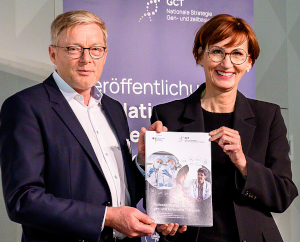
National strategy for gene- and cell-based therapies handed over to the BMBF
13.06.2024 13:26
On June 12, the Berlin Institute of Health (BIH) at Charité presented the National Strategy for Gene and Cell-Based Therapies to Federal Research Minister Bettina Stark-Watzinger (FDP). Around 150 experts from various stakeholder groups developed the document, outlining a roadmap for improving healthcare and strengthening Germany's position in the field of gene and cell-based therapies.
Gene and cell-based therapies (GCTs) are key technologies for innovation in biomedical research and healthcare. They not only modulate disease or alleviate symptoms, but also directly address the genetic cause of the disease process. In this way, they open up promising perspectives for patients with severe and very rare diseases for which there is currently no therapy.
To improve patient access to gene- and cell-based therapies and to strengthen Germany's position as a research and innovation hub in international competition, the Federal Ministry of Education and Research (BMBF) commissioned the Berlin Institute of Health at Charité (BIH) in autumn 2022 to coordinate and moderate the development of a National Strategy for gene- and cell-based therapies. This strategy was presented today at the Futurium in Berlin to the Federal Minister of Education and Research, Bettina Stark-Watzinger (FDP).
Federal Research Minister Bettina Stark-Watzinger: „The National Strategy for Gene- and Cell-Based Therapies is a significant step towards securing and expanding Germany’s position as a leading location for biomedical innovations. Our stated goal is to create new treatment options for patients in the long term. I am delighted that we have succeeded in bringing together so many stakeholders from different sectors to jointly develop the National Strategy. This collaboration between science, industry, the public sector, and society is a key to success. I thank all the stakeholders involved for their tremendous commitment. With this spirit of optimism, we should now move forward together in a national network.”
Interdisciplinary measures in eight fields of action
The National Strategy is distinguished above all by its development using a multi-stakeholder approach, which incorporated perspectives from science, business, politics, society, and patients. In total, over 150 experts contributed to the development of concrete goals and measures to be implemented in eight areas of action. These areas of action were initially developed jointly with stakeholders from various relevant sectors through discussions at public events and the opportunity to submit written feedback, and were subsequently finalized at a roundtable. They encompass the following topics:
I. Networking and supporting stakeholders
II. Training and skills development
III. Technology Transfer
IV. Standards, norms and regulatory frameworks
V. Expansion of quality and capacity in the area of Good Manufacturing Practice (GMP) production
VI. Research and Development
VII. Market approval and transition to supply
VIII. Interaction with society
The strategy emphasizes the enormous potential of the future field of gene and cell therapies (GCT) for patient care, the healthcare industry, and Germany's position as a pharmaceutical and innovation hub. However, this requires measures that can accelerate the translation of results from Germany's strong basic research into clinical practice, while simultaneously making gene and cell-based therapies safe, efficient, affordable, and widely accessible.
„Gene and cell-based therapies are the medicine of the future. They will make it possible to treat serious illnesses with therapies precisely tailored to the individual patient. At the same time, there is a great need for concerted research and development regarding issues of efficiency, safety, and health economics. This strategy paper primarily serves future patients in Germany. The past few months have shown what is possible when all stakeholders are willing to share responsibility: a strategy with concrete measures that now need to be supported and implemented by policymakers. In my view, this can only succeed if we think in a federated rather than a federalist way,” says Prof. Dr. Christopher Baum, Chairman of the Board of Directors of the Berlin Institute of Health at Charité (BIH) and spokesperson for the National Strategy for Gene and Cell-Based Therapies.
What are the next steps for the National Strategy for gene- and cell-based therapies?
The proposed measures will now be implemented step by step in cooperation with all stakeholders. Parallel to the development of the strategy, various activities have already been launched, such as the establishment of a National Network Office for Gene and Cell Therapies, the launch of the nationwide entrepreneurship program GeneNovate, the provision of low-threshold regulatory advice, and preparations for funding for individuals and projects in the field of gene and cell therapies. The network office is tasked with building a national gene and cell therapies community through independent, cross-site information and networking, ensuring that all stakeholder groups are represented.
„Gene and cell-based therapies represent a previously unattainable quality of life for many people. Today marks the starting point for the development of a strong GCT network in Germany and beyond. We are delighted by the very strong interest shown by the various stakeholders so far and look forward to further advancing networking in line with our mission and supporting the joint implementation of measures,“ says Dr. Elke Luger, Head of the National Network Office for Gene and Cell Therapies.
A total of €48 million is available for the development and implementation of the strategy's measures between 2023 and 2026, with 90 percent coming from the federal government and 10 percent from the state of Berlin. Dr. Ina Czyborra, Senator for Science, Health and Care of the State of Berlin, says: „The National Strategy for Gene and Cell-Based Therapies is a comprehensive set of relevant perspectives and demonstrates the enormous potential for promoting research in the long term and significantly improving healthcare. The Berlin Senate has supported this joint approach from the outset. We are pleased to contribute to developing Germany into a leading location for biotechnology.”