


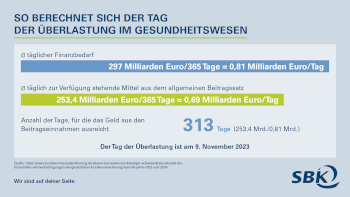
November 9th, 2023: Day of overload in the healthcare system
09.11.2023 12:28
On the day of health care overload, the SBK Siemens company health insurance company draws attention to the need to carefully use resources in the health care system.
This year, November 9th marks the day on which the money collected through the general contribution rate is no longer sufficient to maintain health care. Additional contributions, tax money, the reserves of the health insurance companies that they have saved through efficient management, and reserves of the health fund secure further financing.
The financing of the healthcare system is essentially based on the general contribution rate, which is based on income subject to social insurance contributions and the associated employer contributions, as well as the additional contribution. Although on paper this is individual to the health insurance fund, in reality it is largely determined by politics. Another pillar is the subsidy from federal funds.
Wage-based financing of statutory health insurance alone is not sustainable
Demographic change and new forms of work mean that fewer employees are paying contributions into the system. At the same time, they form the group that makes the highest contributions to the financing of statutory health insurance. This situation will become even worse as the so-called baby boomers retire in the next few years.
This challenging income situation is offset by increasing expenses. Demographic change also plays a role here. An aging society requires more medical and nursing services. Medical innovation, necessary investments in digitalization, for example, and, last but not least, climate change, which is leading to a higher burden of disease, are further drivers of increasing spending. Dr. Gertrud Demmler, board member of the SBK: “With today's overload day, we are drawing attention to the fact that the healthcare system needs comprehensive reforms. And we want to initiate a debate about solutions. People are already feeling the effects of the tense financial situation. You sit in overcrowded emergency rooms or wait months for a doctor's appointment - at the same time, health insurance contributions rise due to regular adjustments to the additional contribution. Less performance for more money – that’s the impression many people have. In order to ensure good care for all people today and in the future, we need a fundamental change that makes the healthcare system more sustainable overall. We have to make his income reliable and adequate and at the same time slow down the ever-increasing cost.”
Pushing back the overload day: Our suggestions for a sustainable use of healthcare resources
1. Reliable income for a secure supply
A reliable tax subsidy, dynamically based on clear rules, as well as creative health-related financing ideas for additional sources of income (keyword “sugar tax”) can stabilize the GKV's income. By only having one health insurance contribution instead of the “general contribution rate” in combination with the additional contribution, the bureaucratic effort can be significantly reduced. The financing of statutory health insurance is becoming more transparent.
2. Curb spending
Reducing expenditure and thus overall resource consumption in the healthcare system will become an even more important task. It's not just the system's financial resources that are scarce. A lack of skilled workers makes care even more difficult. In addition, the system is increasingly obliged to reduce its considerable ecological footprint. We see three important starting points for a more sustainable use of resources in the healthcare system:
-
- Reduce waste through quality transparency
It is important to break the prevailing mechanism of “a lot of money for a lot of resources”. Funds should primarily go to where measurable, long-term positive results can be achieved from the patient's perspective. This requires transparency about the quality of care. - Strengthen prevention
Promoting health is the greatest lever for relieving the burden on the healthcare system. Preventing diseases is a task for society as a whole that must be addressed by all actors in politics and society in the spirit of a “health-in-all-policies approach”. - Promote networking and digitalization
Digitalization is a prerequisite for a sustainable healthcare system. Avoiding duplicate examinations, making informed therapy decisions, saving paper, transparency about quality, and simplifying processes – for this and much more, we need digital exchange and networking.
- Reduce waste through quality transparency
This is how the day of overload is calculated
The day of overload in the healthcare system marks the date on which the statutory health insurance funds' income from the general contribution rate is exhausted. In order to calculate this date, the estimated income for 2023 (as of October 12, 2023) from the general contribution rate (253.4 billion) is compared with the expected expenditure from the statutory health insurance for 2023 (297 billion).