


7 out of 10 Germans would like AI support in clinics and practices
27.09.2023 13:13
According to a survey by the industry association Bitkom, the vast majority of people in Germany have high hopes for the use of artificial intelligence in healthcare. 81 percent of German citizens see AI as a huge opportunity for medicine. 70 percent believe that doctors should receive support from artificial intelligence whenever possible.
It's not just about evaluating CT or X-ray images, for example to identify tumors in the early stages. In the future, generative AI and language models could also answer medical questions and thus support doctors in their everyday lives. More than half of Germans (57 percent) demand that the use of artificial intelligence in medicine should be particularly promoted in Germany. These are the results of a current representative survey of 1,138 people in Germany, which was carried out on behalf of the digital association Bitkom. Can the AI-supported Robo-Doc possibly replace his human colleagues? A third (35 percent) of people are of the opinion: Yes, artificial intelligence will make better diagnoses than a human in certain cases. “Evaluating X-rays and CT images, identifying tumors or changes in the cardiovascular system in the early stages, individually adapting cancer therapies: artificial intelligence has enormous potential for medicine and is already helping to prolong and save lives,” says Bitkom President Dr. Ralf Wintergerst. “But much more is possible. In order to fully exploit the potential of AI in medicine, we need a regulatory framework that better enables research and practical use of the systems.” In this context, 87 percent of Germans are in favor of the use of AI in medicine being strictly regulated . And despite the opportunities perceived by many people, there is also uncertainty among some: 23 percent are afraid of the use of artificial intelligence in medicine.
Most people are familiar with e-prescriptions and electronic patient files
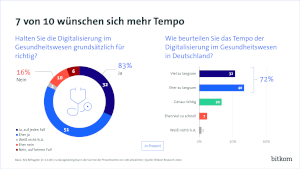
Overall, the digitalization of the German healthcare system is viewed as positive by a large majority of people. 83 percent of Germans believe that the digitalization of the healthcare system is fundamentally correct. 74 percent believe that more digitalization would strengthen Germany's ailing health system. However, 72 percent rate the pace of digitalization of the healthcare system in Germany as too slow, 20 percent rate the pace as just right and 7 percent rate it as going too fast.
People are already familiar with the majority of the digital innovations introduced in recent years: 97 percent have already heard of the e-prescription, which has been rolled out across the board since this summer. 95 percent can do something with the electronic patient file, which, according to the federal government's plans, all insured people will automatically receive from the beginning of 2025 unless they actively object. 93 percent are also familiar with the eAU, i.e. the electronic certificate of incapacity for work. 85 percent have heard of video consultations and 61 percent of prescription health apps. Almost half (49 percent) know that there is an electronic medication plan.
Great need for information at the ePA
The electronic patient record (ePA) plays a central role on the path to a digitalized healthcare system. Among other things, medical data, findings and examinations are stored in it so that they can be viewed by all patients at any time. Although the ePA has existed since January 2021, only a fraction of Germans (approx. 1 percent) have set up an ePA - mainly because of high bureaucratic hurdles. The so-called opt-out regulation will therefore apply from 2025. This means: All insured persons automatically receive an electronic patient file - unless they actively object. “The electronic patient file is the core of the digitalization of the healthcare system. With it, people become more informed, more confident and can take better care of their own health,” emphasizes Bitkom President Dr. Ralf Wintergerst. “The hurdles for application and use are currently still too high. The proposed opt-out is the right way. The announced schedule must now be adhered to at all costs.” In the current Bitkom survey, a further 59 percent stated that they wanted to use the ePA – 33 percent answered “yes, definitely” and 26 percent “probably yes”. Another 31 percent tend to say “probably no,” whereas only 6 percent categorically rule out its use. Overall, the need for information is still great: 73 percent want to be better informed about the electronic patient file. Two thirds (65 percent) believe the introduction in Germany is overdue. But there are also reservations: 59 percent are concerned about the security of their data with the ePA.
72 percent want to redeem e-prescriptions digitally
The e-prescription, which is also an important component of the digital health system, has been introduced in pharmacies and practices since this summer after some delays. Only 24 percent of German citizens want to continue using the paper version. A total of 72 percent prefer digitally redeeming the e-prescription - either via the app in the pharmacy or online (22 percent) or by inserting the health card on site at the pharmacy (50 percent). Similar to the electronic patient file, there is also a broad need for more information with the e-prescription: 47 percent would like to know better about it. Overall, 81 percent rate the introduction of e-prescriptions in Germany as too slow.
A fifth have already used the video consultation
Video consultations are now an integral part of everyday care in Germany. 22 percent of people in Germany have already communicated with a doctor or therapist via video consultation. In 2022 it was 15 percent and in the pre-Corona year 2019 it was only 5 percent. The costs for this have only been covered by health insurance since 2017. Especially during the Corona pandemic, bureaucratic hurdles were reduced for doctors who wanted to offer video consultations. The current digital law of the Federal Ministry of Health also promises the abolition of the cap that still applies to remuneration for video consultation hours. “In times of social distancing, video consultations have received a big boost. Many who tried it out during Corona have now stuck with it,” says Wintergerst. “In times of decreasing practice density and an aging population, video consultations are becoming indispensable in order to continue to provide optimal care to immobile people or those in rural regions.”
So far, however, a lack of mobility has only been the reason for video consultations for a very small proportion of 3 percent of users. The vast majority (51 percent) primarily want to save time, 38 percent simply find it more convenient and 31 percent were unable to get a timely appointment on site and therefore resorted to video consultations. 21 percent needed advice outside of regular practice opening hours. “Doctors sometimes offer video consultations well into the late evening and also on weekends. In certain and non-life-threatening cases, not only the patients but also the emergency rooms can be relieved,” emphasizes Wintergerst.
The advantages of a digitalized healthcare system outweigh the disadvantages
Overall, people in Germany primarily see advantages rather than disadvantages in the digitalization of the healthcare system. 80 percent believe that digitalization enables gentler and more precise operations through robotics. Only 17 percent see an increased risk due to technical errors. Two thirds (69 percent) are convinced that digitalization in the healthcare system relieves the burden on medical staff - 27 percent, however, assume that it will be excessive. Just over half (53 percent) believe that digitalization will lead to less bureaucracy in the healthcare system - 39 percent fear the opposite. 41 percent also believe that digitalization will lead to high costs in the healthcare system - and 50 percent assume that digitalization can offset the rising costs in the healthcare system. Wintergerst: “Digitalization can relieve doctors and nursing staff of many routine bureaucratic tasks so that they have more time for their patients. Only with digitalization will it be possible to maintain and improve the quality of medical care in Germany - despite a shortage of doctors, a shortage of nursing care and chronic underfunding.
Nevertheless, there are also concerns within the population. 70 percent agree with the statement that a digitalized health system turns people into “transparent patients” - and 62 percent are afraid of hacker attacks on clinics and practices. “Even in a digitalized healthcare system, people retain control over their data. Everyone can decide for themselves who can view which data in the electronic patient file - and everyone can see who has accessed their own electronic patient file. The insured are the masters of their data,” says Wintergerst. “One thing is clear: patient data is highly sensitive and must be protected in the best possible way. The hospitals in Germany also have to upgrade so that they do not provide any entry points for hackers and cybercriminals.”
Balancing data protection with health protection
Despite the worries: 74 percent of Germans currently see the digitalization of the healthcare system as an opportunity - a year ago it was 60 percent. A quarter (25 percent) see this as a risk (2022: 35 percent). “After many years of stagnation, the digitalization of the healthcare system is now making great progress. The corona pandemic has clearly shown that paperwork and analogue procedures are not fit for the future. It is now important that the announced laws and digital projects are brought to fruition quickly,” emphasizes Bitkom President Dr. Ralf Wintergerst. From Bitkom's point of view, the prerequisite for this is more balanced regulation in the use of data - the data from the electronic patient file should be anonymized and pseudonymized and can be used for private health research, for example to combat rare diseases. Wintergerst: “Data is the basis of highly efficient medical care tailored to each individual’s individual situation. In order to utilize this potential, we must also balance data protection with health protection in Germany. If this does not succeed, German patients will receive many medical services in digital form from other countries in the future.” The German healthcare system is now well on the way to catching up with the international gap and getting up to speed digitally.