


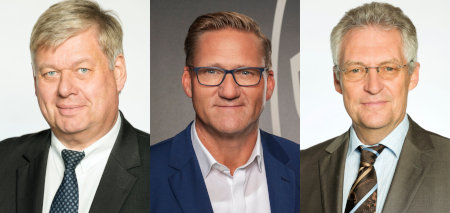
After the social election: Board of Directors of AOK Rheinland/Hamburg begins its work
26.09.2023 17:49
After the social elections in May 2023, the new administrative board of AOK Rheinland/Hamburg was formed. Günter Roggenkamp was newly elected as the alternating chairwoman of the board of directors for the insured side, and Wolfgang Ropertz was confirmed as the representative for the employer side. Both emphasize the importance of sustainable financing and a sustainable design of health care and nursing care.
Günter Roggenkamp, new chairman of the board of directors for the insured side, says: “Our healthcare is based on the principle of solidarity. That's why it's important to distribute the financial burden fairly on everyone's shoulders. In addition to stable contributions, insured people need the promise that benefits will not be reduced and that they will continue to receive the best possible care.” Roggenkamp also calls for sustainable financing of care that relieves the burden on those paying contributions instead of encouraging them to take out additional private insurance. “We must achieve a fair distribution of the inevitably rising costs of care that includes society as a whole.”
Social challenges should not be placed one-sidedly on those paying contributions
Wolfgang Ropertz, who was confirmed by the election as Chairman of the Board of Directors for the employer side, reiterates the call for a sustainable consolidation of the financial situation. It is essential to finance non-insurance benefits such as pension contributions for caring relatives and contributions for those receiving citizens' benefit from tax revenues: "Societal challenges must not be placed unilaterally on those paying contributions to statutory health insurance companies." Many employees, but also employers, cannot bear additional burdens Shoulder taxes more. “We need a strong economy to secure our strong health and social system in the long term. The state must therefore take responsibility for public services so that all people have equal access to appropriate, quality-assured care,” says Ropertz.
Demand for greater leeway in self-administration
Günter Wältermann, CEO of AOK Rheinland/Hamburg, calls for greater leeway from politicians in self-administration: “If politics expands the scope for action, self-administration is able to act flexibly, pragmatically and dynamically and can solve problems together.” This requires trust in the proven systems and the courage to give the actors involved responsibility for the sensible use of financial resources. “This applies not only to the future of care, but also to our healthcare system in general,” says Wältermann.
The Board of Directors
The most important body of social self-administration in statutory health insurance (GKV) is the administrative board. It arises from social elections every six years and is filled equally - i.e. half each - by the insured and the employer. The voluntary representatives of employers and insured persons on the administrative board each provide a chairperson. Both take turns as chairperson every year.
The board of directors of AOK Rheinland/Hamburg comprises 30 members. His responsibilities include, among other things, the election of the full-time board of directors. In addition, it decides on the health insurance fund's budget and discharges the board of directors with regard to the annual financial statements. With the budget, the administrative board also determines the amount of the additional contribution rate for AOK Rheinland/Hamburg and decides on changes to the statutes. Business and health policy issues as well as strategic decisions are also key topics for the Board of Directors. The administrative board of the health insurance company also takes on the tasks of the administrative board of the nursing care insurance fund.