


Life expectancy in 2022 in all federal states below pre-pandemic levels
07.09.2023 15:57
Life expectancy in Germany fell for the third year in a row in 2022 and has fallen by more than half a year since the outbreak of the corona pandemic in 2019.
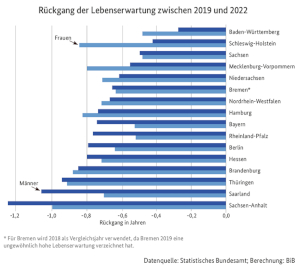
For men it fell from 78.7 to 78.1 years and for women from 83.5 to 82.8. However, according to current calculations by the Federal Institute for Population Research (BiB), there are significant regional differences in Germany in how life expectancy at birth has changed since the start of the pandemic. Some federal states that recorded very heavy losses in the first two years of the pandemic were able to make up some ground again in 2022. For men, life expectancy in Saarland and Saxony-Anhalt in 2022 was more than a year below the 2019 value. Among women, Saxony-Anhalt also stood out - life expectancy there is now significantly or almost a year below the 2019 values The situation for men in Baden-Württemberg, Schleswig-Holstein and Saxony has developed relatively favorably, where life expectancy is only a maximum of six months below the pre-pandemic value. This was the case for women in Baden-Württemberg and Saxony.
“While some federal states, such as Schleswig-Holstein or Lower Saxony, were spared major declines in life expectancy in the pandemic years of 2020 and 2021, the situation looks different for 2022,” says Markus Sauerberg, mortality researcher at BiB.
In 2022, East-West differences have narrowed
The differences between western and eastern German federal states that grew during the pandemic have now narrowed somewhat. In 2021, life expectancy fell significantly below pre-pandemic levels, especially in Thuringia, Saxony, Saxony-Anhalt and Brandenburg.
“These federal states were affected by a particularly drastic increase in mortality due to Corona,” explains Pavel Grigoriev, head of the mortality research group at BiB.
In 2022, however, these four federal states were able to record significant increases in life expectancy again, especially among men. This particularly applies to Saxony, which was affected by significant declines in the first two years of the pandemic. The situation is different in many western German federal states: life expectancy here fell the most between 2021 and 2022, mainly due to the massive spread of the pandemic.
All regions were also affected by the flu wave at the end of 2022: “This strong flu wave contributed significantly to the decline in life expectancy in 2022,” said Grigoriev.
Spatial trends in Germany partly coincide with trends in Europe
The spatial trend in Germany is similarly reflected at the European level. In 2021, Europe was also characterized by strong east-west differences in the development of life expectancy, as many Eastern European countries experienced sharp declines in life expectancy due to Corona. Similar to the eastern German federal states, countries such as Poland, the Czech Republic and Slovakia were able to record significant increases in life expectancy again in 2022. However, the values there also remained below the level of 2019. The development in West Germany again shows parallels to the Nordic countries such as Norway and Finland. These also recorded a sharper decline in life expectancy for the first time since the beginning of the pandemic in 2022. In other Western European countries such as Belgium, France and Italy, some of which recorded sharp declines in the first two years, life expectancy stagnated. Among the 13 European countries for which figures for 2022 have already been determined, only Sweden achieved a life expectancy at or even above pre-pandemic levels for men and women and Denmark and Belgium for men.