


Artificial intelligence will soon help with the creation of doctor's letters
17.08.2023 16:10
Around 150 million doctor's letters are written in Germany every year. This takes up time that is missing elsewhere. The “doctor’s letter generator” could help. Because: A large part of the medical data is in text form, the evaluation and further processing of which is often laborious and time-consuming. The solution: a combination of algorithms and artificial intelligence, which is used in so-called Natural Language Processing (NLP).
Information from texts is extracted and made available in a structured form, making processes such as quality assurance, the creation of statistics, clinical decision support and billing possible quickly and easily. New texts such as doctor's letters can also be generated from the data - in a fraction of the time it previously took. A prototype of the doctor's note generator is to be tested next year at the University Medical Center Essen as part of the KI.NRW flagship project SmartHospital.NRW. Scientists at the Fraunhofer Institute for Intelligent Analysis and Information Systems IAIS have summarized the other possibilities that NLP offers for the medical sector in the new white paper “Natural Language Processing in Medicine”.
Health data is currently one of the fastest growing amounts of data. “How we further process this data and what opportunities this opens up for patients, carers and doctors is an exciting question, the answer to which we have some control over ourselves,” explains Dario Antweiler, team leader in Healthcare Analytics Fraunhofer IAIS. Together with his team, he has written a white paper that shows current developments and possibilities for document-based processes in the medical field. Some of these are still a thing of the future, while other applications already developed by Fraunhofer IAIS are already being used successfully in hospitals.
In the near future, these models will be able to work multimodally
In the paper, the experts also focus on Large Language Models (LLM), which have undergone rapid development in recent months and have therefore increasingly come into the public eye. Probably the best-known example of an LLM at the moment is ChatGPT, a chatbot with which you can have a conversation, so to speak, and which creates natural-sounding texts. “In the near future, these models will be able to work multimodally, including images or tabular data, and not just process texts and spoken language as before,” explains Antweiler. This would also result in new possibilities in the medical field with which staff can be relieved and treatment processes can be further improved - always taking data protection into account - in the interests of the patients.
This is important because the healthcare system faces numerous challenges such as a shortage of staff, cost pressure and an “information overload” caused by the constantly growing amount of data. »Evaluating and analyzing this data and drawing conclusions from it costs valuable time in many different areas, which is simply missing in stressful everyday hospital life. In the worst case, important information is lost, which can make treatment more difficult, lead to expensive duplicate examinations or incomplete billing," explains Antweiler.
Prototype of the doctor's letter generator is to be tested at the Essen University Hospital
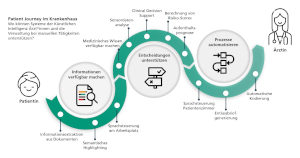
In order to bring solutions to these problems to hospitals, the healthcare analytics team is already working closely with medical staff: together with several university hospitals, including Essen University Medicine, they are currently developing various options for extracting information from documents. The next goal: By the end of 2024, a prototype of the doctor's letter generator is to be tested at the University Hospital in Essen, which simplifies the creation of discharge letters. To do this, the AI evaluates all existing documents and structured data and creates a natural-sounding text that also contains easy-to-understand explanations for the patient. After a check and possible additions or changes by the medical professionals, the discharge letter is created at the push of a button, so to speak, and in a fraction of the time that purely manual creation would have taken. An additional benefit: Patients who often have to wait longer for this document on the day of their discharge can leave the hospital earlier.
With AI, processes could be automated across the board, implemented quickly, precisely and safely
Further advantages of Clinical NLP: The workload of medical staff is reduced because AI can automatically summarize important information from a patient's medical data and make it available to all practitioners in a clearly structured manner. NLP in hospitals simplifies processes because information can be accessed in a very short time, processed immediately and made fully available to medical staff. Dario Antweiler: »In most hospitals, huge amounts of texts are evaluated manually every day, which is repeated - in different departments or after discharge by the family doctor or specialist. With our applications, these processes could be implemented comprehensively, quickly, precisely and – with regard to data protection – securely. The healthcare system, and especially the staff and patients, would benefit from this.”
The applications of the healthcare analytics team are implemented within the SmartHospital.NRW project. In particular, technologies in the areas of text, speech and signal processing are being researched. In addition, a process model is being developed that will enable hospitals to further develop into smart hospitals. Essen University Medicine acts as consortium leader and clinical partner in collaboration with the Fraunhofer Institutes IAIS and MEVIS, RWTH Aachen, TU Dortmund, Dedalus Healthcare Group AG and m.Doc GmbH. The project is funded by the Ministry of Economic Affairs, Industry, Climate Protection and Energy of the State of North Rhine-Westphalia. SmartHospital.NRW is a flagship project of the competence platform KI.NRW.