If you want health regions, you have to rethink
Since the GKV Care Strengthening Act (GKV-VSG) in 2015, Section 140a SGB V on “integrated care” was completely deleted, Section 140a on “Special Care” and Section 140b, which existed at the time, were completely deleted, everyone has been supported regional, population-related care concepts to the selective contract option of the new § 140 a. However, a useful legal basis is missing, as comprehensive regional supply goes far beyond a selective contract; There should actually be something like regional collective agreements - but they don't exist yet. With the present draft bill from the Federal Ministry of Health (BMG) for a draft of a law to strengthen health care in the municipality (Health Care Strengthening Act - GVSG), politicians are essentially making a move backwards and forwards at the same time by creating the new paragraph in question - according to the foreword – “Regionally networked, cooperative health care will be strengthened” and “new opportunities will be opened up for municipalities and health insurance companies to form health regions”, which should also “overcome interfaces”. At least if what is written in the draft bill is both visionary and correct and survives the upcoming hearings and the law-making process.
>> Anyone who browses through Book V of the Social Security Code will not come across the term “health region” once, but will come across the term “regional care” 151 times. However, this only has the connotation “regional supply conditions”, “regional supply obligation” and “regional area of responsibility” or “planning areas”.
regional peculiarities” as in Section 132 d SGB V. This would mean that the new Section 140b “Health Regions” would be a novelty according to the wording of the draft bill; one that has it all. Provided that the statements made in the draft bill in the new § 140 b survive the long process up to legislation - starting with further fine-tuning by the BMG employees and ending with association and specialist hearings, probably during the summer break - and not even in the Health Committee If the common denominator is slimmed down, this paragraph could well be able to ensure a real boom and create flourishing landscapes of regional healthcare. The only question is: who has the least and who has the most interest in it?
This question concerns
• first and foremost the statutory health insurance companies,
• secondarily the hospital landscape and
• in third eligible municipalities.
Finally, it is necessary to define, firstly, what exactly is meant by the care approach of a health region and, secondly, what the minimum requirements look like.
The perspective of the health insurance companies
The GKVs are financed via the morbidity-oriented risk structure compensation (M-RSA), which was redesigned with the GKV Competition Strengthening Act (GKV-WSG) of 2009, which readjusted the RSA, which had been introduced since 1999, by including the morbidity factor. Since then, almost all allocations from the health fund to the GKVs have been paid out based on the M-RSA system. The following applies: the more patients a health insurance company cares for in individual morbidity groups within the so-called full model - which, since the reform in the law for fair health insurance competition in the GKV (GKV-FKG), includes all diseases in the Morbi-RSA - in individual morbidity groups, the more money she gets. The question therefore arises as to what interest large health insurance companies in particular might have in a regional care model: It probably won't be financial, but perhaps there will be the momentum that they should and want to promote health, if only for that reason to underline their respective market position and dominance
The situation is different for smaller, mostly regionally active funds and especially BKKs, which are often linked to larger companies. Here, the motivation for getting involved in regional care can be to present yourself as the best employer or supporter of a region with special care offers or simply to ensure that the employed employees enjoy a better care model so that their health status and satisfaction improve At the same time, absenteeism can be minimized.
Whether large or small funds: they all have the same problem. “The current system of how health insurance companies receive their allocations has a dangerous weak point: it neglects the crucial future task of today, which is that those insured need to be supported and encouraged to stay healthy for longer, only get sick later and then also in the progression their illnesses progress more slowly. We urgently need to massively reduce the number of years spent sick,” explains OptiMedis founder Dr. H. c. Helmut Hildebrandt in conversation with “Monitor Health Services Research”. This false incentive, which extends from the health insurance system to the service providers on the inpatient and outpatient side, who are paid almost exclusively based on performance (exception: HZV models, see MVF 03/23), not based on outcome, must be addressed in the discussion that is sure to arise be addressed in the new § 140 b. Hildebrandt: “However, I am still unsure whether politicians have understood how closely the M-RSA and the upcoming hospital reform are intertwined in this future task.”
The hospitals' perspective
Although Federal Health Minister Karl Lauterbach was able to announce a fundamental agreement with the states after the last federal-state round regarding the federal hospital reform, many questions remain unanswered. On the one hand, Lauterbach wants to introduce retention allowances as a kind of “guarantee of existence for small clinics in the countryside”, largely independent of the number of patients treated, which should cover 60% of the necessary financing, and on the other hand, initiate a “transparency law” so that the quality of treatment can finally be improved of all houses becomes transparent. Since patients are increasingly “voting with their feet” by often seeking treatment at the better quality but slightly further away clinic instead of the nearest clinic, it remains to be seen how hospital owners and management will act.
Lauterbach recently had the significance of this step worked out in a study he commissioned (1), which impressively demonstrated what really makes the difference between good and bad clinics. According to the results of the study carried out by the government commission for modern and needs-based hospital care, if complicated medical treatments are carried out exclusively in specialized clinics, the quality of care and often also the probability of saving more lives, for example in the case of strokes and cancer, improve.
The current hospital rating report 2023 shows how drastic the situation is (2). This makes it clear how much the economic situation of German hospitals has deteriorated in 2021 due to persistently low utilization. The report, which is prepared jointly by the RWI-Leibniz Institute for Economic Research and the Institute for Healthcare Business GmbH (hcb) in cooperation with the Bank in the Diocese of Essen (BIB), explains that the hospital reform planned by Lauterbach “implicitly represents a target image of the future hospital structure”. In 2021, the approximately 437,000 beds in general hospitals were only 66% full. In addition, with a target utilization of 85% and increasing outpatientization in the target picture, there is only a need for around 316,000 beds or around 1,200 locations, although comprehensive care is still easily possible. The core data of the hospital rating:
• 11% of hospitals were in the “red zone” with an increased risk of insolvency,
• 16% percent in the “yellow” and 73% in the “green area”. The year before, 7% were in the “red”, 25% in the “yellow” and 68% in the “green”.
• The earnings situation also deteriorated in 2021: 32% of hospitals posted an annual loss at group level, in 2020 it was 22%.
• In 2021, the average annual result was only 0.8% of revenue, in the previous year it was 1.8%.
• The main reason for the worsening economic situation of the clinics was the decline in compensation payments in the context of the Covid-19 pandemic, while the performance level of the hospitals remained low.
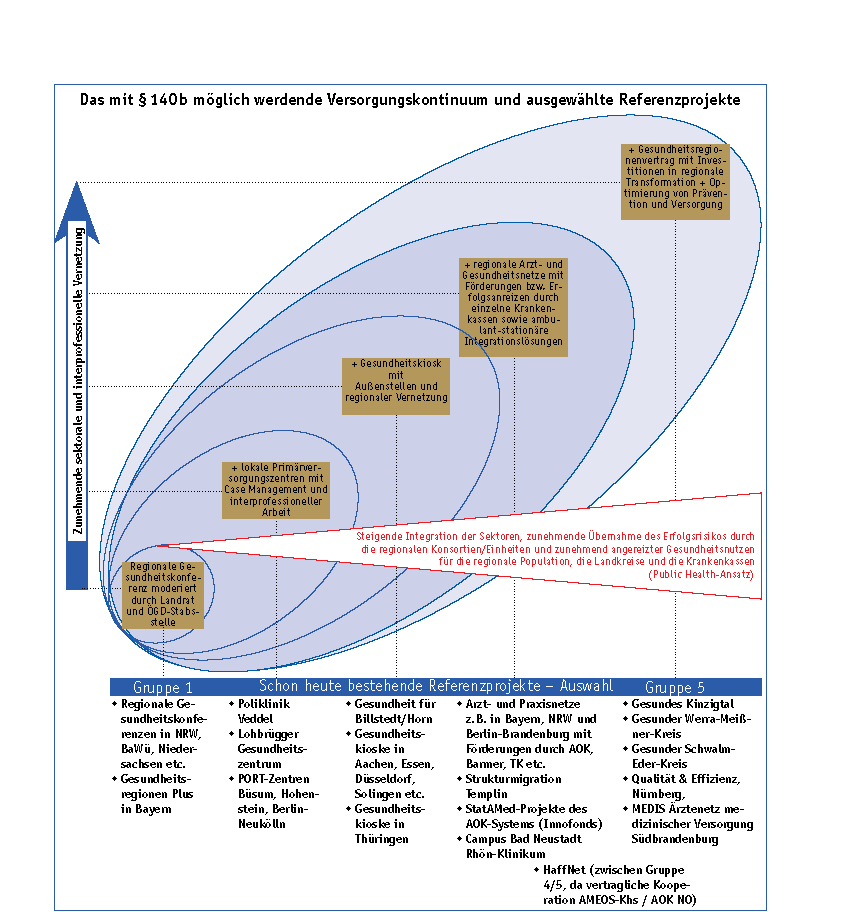
In principle, all hospitals – regardless of size and specialization – have a great opportunity with the new paragraph 140 b: “The draft law opens up an entire care continuum from primary care centers, as we know them from the Templin structural migration project, to the position as a partner and driver entire health regions, as is the case, for example, in the 'Healthy Kinzigtal' or the 'Healthy Werra-Meißner District',” explains Hildebrandt. The establishment of community medical care centers (MVZ), which are also addressed in the new § 140 b, and the creation of health kiosks are - relatively speaking - the simpler models, while the formation of health regions that have an impact on the population level is by far the most demanding project. The reason for this: In addition to the difficult contractual design work, which amounts to a kind of regional collective agreement, which the social code does not even recognize in this form, the public health model of a health region needs “a certain change in thinking” - away from the actor-driven one towards the population-driven formulation of a regional healthcare system. Hildebrandt: “Suddenly the aspects of remuneration and individual services no longer count, but only what the local patient group really needs in order to stay healthy as best as possible for as long as possible with a high quality of life. That’s the big difference between a care mindset and a public health mindset.”
This is exactly where the possible interests of certain health insurance companies and hospitals meet those of smaller and larger municipalities or even entire districts.
The municipalities’ perspective
“There may be deficits and special needs for support, particularly in socially or structurally disadvantaged regions,” says the draft bill for the GVSG. Therefore – according to the introductory text under the passage “Problem and Goal” – the draft law aims to “strengthen local health care in the municipalities” and to obtain more opportunities “to respond to the local needs with regard to the health care response”. Furthermore, according to the draft text, new opportunities should be opened up for municipalities and health insurance companies to form health regions “to strengthen regionally networked, cooperative health care.” This should make it possible to “eliminate regional deficits in health promotion and prevention as well as care, overcome interfaces or improve access to regional care”. Hildebrandt thinks that she can read from the lines in the draft bill that has been presented so far that the policy here is “somewhat geared towards the structurally weaker regions”.
Whether this is really the case will be seen in further details of the GVSG or in the work of further legislatures. “Basically, every region, whether it is rural or urban, needs a regional infrastructure that is fit enough to actually develop the management and organizational structure of regional health,” says Hildebrandt. However, since there are currently no such regional organizational structures in this country - apart from model projects - Hildebrandt believes that newly emerging health regions will have to develop over different stages and iterations. And in doing so, they usually – or almost always – clash with the cemented sectoral organizational structures.
Depending on regional requirements, disease burdens, morbidities and needs, but also depending on the existing service provider structure, there will also have to be an adapted modular solution between the large scale of a health region and smaller ones such as health kiosks (based on the experiences of the first in the urban Billstedt/Horn or the first rural one in Thuringia in the Unstrut-Hainich district) or regional MVZ right up to what was exemplified in the Templin model region in the form of structural migration - also as an intellectual background for the new 140.
In Templin - according to a current ARD PlusMinus article (3) - it was tried out how it could be possible to interlink outpatient and inpatient care. What outpatient care takes place is carried out in the ASZ outpatient-inpatient center at the Sana Hospital Templin. The aim is to use existing synergies and offer comprehensive support and advice under one roof: for the benefit of around 30,000 citizens in the greater area of the Brandenburg city in the Uckermark district. The touch that was conveyed quite well in the TV report was that although there are major challenges in the necessary restructuring of regional health care, there are, despite all the pitfalls and problems, positive design approaches that take advantage of opportunities: the “Templin Project” as “ DoWhat” option.
Templin's long-time mayor Detlef Tabbert from the party “Die Linke” (who has been active since 2010) also had his say in this TV report. According to a player in front of the PlusMinus camera, he rates the Templin project as a “successful example of good cooperation between the two sectors”. He knows, the soundtrack continues, “that several doctors will be retiring in the next few years.” For this reason, too, it is important to him to maintain medical care in his city, “even using unconventional means.” And with a now quite long history: It emerged from the forerunner of a KV RegioMed program and an innovation fund project* based on it, now transferred to the New Templin Consortium for the Promotion of the Templin Health Region (NKT), supported by the doctor network “Gesund in Templin” , the Sana Hospital Templin, the city of Templin and the KV Brandenburg - all already partners in the original Innofonds project consortium. The NKT can certainly be seen as an existing example that anticipates a new reality of care that the draft law on health regions could form. It also shows that it is not necessary to set up huge apparatuses to start health regions, but rather that comparatively simple and available organizational structures can be used so that resources do not disappear in organizational self-management, but are available for change. <<
by: MVF editor-in-chief Peter Stegmaier
“§ 140 b health regions”
from: Draft bill of the Federal Ministry of Health: Draft of a law to strengthen health care in the community
(Health Care Strengthening Act – GVSG)
(1) The regional associations of health insurance companies and the replacement insurance funds can jointly and uniformly conclude a contract with one or more districts or one or more independent cities upon their request with the aim of eliminating regional deficits in health promotion and prevention as well as care, overcoming interfaces or improving access to regional care (health region). If the districts or independent cities meet the further requirements according to paragraph 4 and are prepared to cover half of the costs according to paragraph 3 sentence 3, the regional associations of health insurance companies and the substitute insurance funds are obliged to start contract negotiations on the formation of a health region.
(2) The tasks of a health region can in particular be:
1. Formation of networks and cooperation between regional providers and the public health service,
2. Ensuring networked and coordinated health promotion and care across sector boundaries in accordance with regional needs, taking into account the evolved structures,
3. Expansion of services to increase mobility offerings in order to facilitate access to curative and preventive care,
4. Further development of the stated goals and measures.
The details must be regulated in the contracts according to paragraph 1.
(3) The organization of a health region can be carried out individually or jointly by the contractual partners named in paragraph 1 sentence 1. The contractual partners can also transfer the task according to sentence 1 to participating service providers in the health region or their communities or associations or agree that this task will be carried out by third parties. The investment and operating costs of organizing the health region are borne equally by the regional associations of health insurance companies and the substitute funds on the one hand and by the districts and independent cities involved on the other hand.
(4) The prerequisite for starting contract negotiations in accordance with paragraph 1 sentence 2 is that the districts or independent cities provide the regional associations of health insurance companies and substitute funds with qualified information about the goals and tasks of the health region, naming the participating service providers, and are prepared to do so to contribute to the costs in accordance with paragraph 3 sentence 3. Close cooperation with the public health service must be ensured. If negotiations do not take place, the country's highest administrative authority responsible for social insurance will decide whether the application meets the requirements of sentence 1 and whether negotiations should begin."