


Medical emergency or not? – G-BA defines requirements for initial assessment in emergency rooms
10.07.2023 15:16
In accordance with its legal mandate, the Federal Joint Committee (G-BA) has defined requirements for a qualified and standardized initial assessment procedure in hospital emergency rooms. Among other things, it decided on minimum requirements for the procedure, the digital assistance system and the qualifications of the medical staff involved. The initial assessment procedure is intended to quickly and reliably assess how urgent the need for treatment is for those seeking help.
Only if an immediate need for treatment is identified should the patient be treated as an outpatient in hospital or, if necessary, admitted as an inpatient. In all other cases, treatment should generally take place in statutory health care. The G-BA resolution provides for various transition periods for hospitals, for example in order to further train the required staff and implement a digital assistance system.
Prof. Josef Hecken, impartial chairman of the G-BA, said: “With the nationwide requirements for an initial assessment procedure in emergency rooms, we as the Federal Joint Committee have today decided on another important building block for a comprehensive reform of emergency care. The new procedure in the hospital is intended to ensure that those seeking help receive good care - if they have an urgent medical need, directly in the clinic, otherwise by practicing doctors. Our general requirements for emergency structures in hospitals, which include a central emergency room, have been in effect since 2018.
The consultation process for the new directive was not easy, because of course every detail is highly relevant for a process as sensitive as the classification of medical treatment needs. In my opinion, we have ultimately found a good solution that also takes into account the concerns of the hospitals, which have to meet the requirements, with transitional regulations. It was a challenge to implement the legislative mandate that was changed at short notice - especially since the interpretations of what this meant in concrete terms were very different. But that also succeeded.
In the run-up to today's decision, voices were heard as to whether G-BA regulations could be dispensed with in view of the upcoming hospital reform - this is not the case. Firstly, it is currently unclear when the reform will actually take place. And secondly, it will take a few years until the structural changes envisaged for the hospital reform become reality in practice. In view of overcrowded emergency rooms, practical and appropriate solutions are also needed for this transitional period.”
Referral to statutory medical care
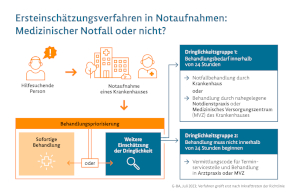
The urgency of immediate medical treatment is already being determined in emergency rooms with the help of so-called triage systems: In this way, those seeking help with a life-threatening illness or injury are identified and treated as quickly as possible.
For those seeking help who do not need immediate treatment, an expanded initial assessment procedure will follow in the future, which will determine the time window until treatment and the level of care based on the results of the triage. Depending on whether medical treatment should begin within 24 hours or not, two so-called urgency groups are distinguished:
- For urgency group 1, treatment should begin within 24 hours: either as an outpatient in the hospital or in an emergency service practice of the Association of Statutory Health Insurance Physicians (KV) located in or near the hospital or a corresponding medical care center in the hospital.
- For urgency group 2, no treatment is required within 24 hours. The insured receive a referral code with which they can book an appointment via the KV appointment service point.
Come into effect
The G-BA directive comes into force after no objection from the Federal Ministry of Health and subsequent publication in the Federal Gazette.
Background: Order from the G-BA for the initial assessment procedure
The legal basis for the decision on the initial assessment procedure is Section 120 Paragraph 3b SGB V, last amended by the Care Support and Relief Act. According to this, the G-BA must decide on specifications for carrying out a qualified and standardized initial assessment of the medical care needs of those seeking help who turn to a hospital to treat an emergency.