


AIQNET: An ecosystem for the digitalization of medicine
24.05.2023 17:05
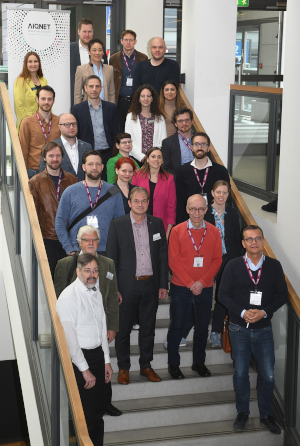
After a project duration of three and a half years, the consortium partners of the AIQNET project funded by the Federal Ministry of Economics met in Berlin to present groundbreaking project results and successes at the final press conference. They emphasized the high relevance of digital technologies for modern healthcare.
The European Union's Medical Device Regulation (MDR), which has to be implemented since May 2021, has caused great uncertainty among medtech manufacturers. Among other things, it requires regular testing of the medical devices on the market with regard to performance and safety. This requires real data at the level of clinical studies. “When we launched the project, there was no solution that, on the one hand, would enable medical device manufacturers to collect such data on their products cost-effectively and that would also not result in any additional work for the clinics. We wanted to solve this challenge with AIQNET and succeeded in many respects,” explains Frank Trautwein, consortium leader in the AIQNET project and managing director of RAYLYTIC GmbH. “AIQNET creates the basis for obtaining a comprehensive understanding of a wide range of clinical factors in therapy using state-of-the-art algorithms. The infrastructure developed as part of the project allows us to collect data more efficiently and quickly, which continuously improves our medical products,” adds Dr. Ina Wüstefeld, Vice President Regulatory & Medical Scientific Affairs at Aesculap AG – part of the B. Braun Group, explains the added value of AIQNET for medtech manufacturers.
The AIQNET project was made possible by the AI innovation competition of the Federal Ministry of Economics and Climate Protection, which has been promoting outstanding approaches for new forms of AI-based platform economy in important sectors of the German economy since 2020. The aim is to integrate companies active in the healthcare sector into a digital ecosystem along the entire value chain. This strengthens the medical technology companies that gain access to important clinical data through AIQNET, and patients benefit from better products and more safety. As the consortium partners emphasized, the successful AIQNET project was able to achieve important goals within the three and a half year funding phase: Together they developed concrete products that are already being used or will be used in the very near future. For example, an AI-based solution was created to analyze x-rays and is one of the most powerful on the market. In addition, contracts were concluded with several clinics; They expect to not only save costs in the six-figure range with AIQNET, but also to find solutions to the staff shortage and to improve the quality of indications.
AIQNET ecosystem as a catalyst for interoperability and AI in the field of health
It became clear that not only medtech manufacturers, but also hospitals benefit from AIQNET: Every hospital has a lot of unstructured patient data that is collected for medical reasons and is usually stored in various archive systems. AIQNET makes it possible to collect this treasure trove of data and take an important step towards digitalization in the healthcare system. “AIQNET offers the opportunity for AI to enable progress in the interests of the patient. This positive development in technology deserves to be supported. AIQNET is therefore a key project in our clinic, although we also had to learn that the existing data protection guidelines are currently slowing down many developments,” says Prof. Dr. Andreas Nüssler, head of the Siegfried Weller Institute for Accident Medicine Research (SWI) at the BG Klinik Tübingen.
When asked about the future of AIQNET, Frank Trautwein concluded: “In five years we will still be the fire accelerator we started out as. I fully expect that the applications for interoperability and AI-supported use of data that we have developed together here will be used in thousands of clinics and used by several hundred medtech and pharmaceutical manufacturers.”