


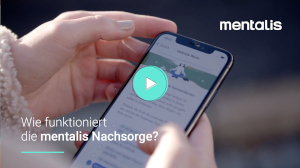
mentalis for those affected: take psychotherapeutic aftercare into your own hands
24.04.2023 17:45
It is not uncommon for patients to have to endure long waiting times after inpatient psychotherapy before they receive an outpatient therapy place for further care. The hybrid aftercare from mentalis can help close this gap in care and can now be used by those affected without registering at a clinic.
The strict separation between inpatient and outpatient treatment continues to create a gaping gap in psychotherapeutic care. For many patients, taking advantage of follow-up outpatient services after inpatient psychotherapy is associated with major hurdles and is often not seamless. Appropriate aftercare is crucial for long-term and sustainable treatment success. So it's not surprising that a fifth of patients in Germany return to the clinic within twelve weeks and this number even increases to a third within a year. In order to close the gap in care, mentalis has developed a hybrid aftercare offer that seamlessly follows the inpatient hospital stay.
Self-organized aftercare without waiting time
Numerous clinics are already working with mentalis, so that patients are enrolled in follow-up care while still on the ward. Until now, follow-up care in this way was not available to patients whose clinics did not offer such an option. In order to enable them to continue their treatment seamlessly, patients can now report to mentalis independently after being discharged from the hospital and, after careful examination, will be included in the aftercare program. This means that follow-up care can begin regardless of the clinic that previously treated you.
To ensure that patients are suitable for mentalis follow-up care, they need proof of their diagnosis and hospital stay before admission. In order to participate, this must not be more than twelve weeks ago. After reviewing the data, the psychologists from mentalis check your personal suitability for follow-up care in a free telephone call and, together with the patient, select the initial appointment for the psychological interview. Once all data has been released, follow-up care can begin.
Digital and innovative: hybrid supply concept
Patients can register conveniently via the website from mentalis. Many health insurance companies already cover the costs of the offer and thus support their members in successfully mastering the return from the clinic to everyday life. Mentalis' aftercare relies on psychological tele-conversations that are immediately available and algorithm-based therapy apps that are tailored to individual mental illnesses.
Using the apps, patients can easily and intuitively access their personal therapy plan with interactive exercises. These teach techniques and strategies that can be helpful in dealing with mental illnesses and contribute to stabilizing treatment successes that have already been achieved. There are also weekly teleconversations with certified psychologists in which patients are supported as they return to everyday life. They not only offer treatment continuity, but also provide content feedback and motivation for the sustainable use of the aftercare programs.
Aftercare after aftercare: Prepared for further treatment
The mentalis offering also supports the selection of long-term further treatment options. The connection navigator helps patients to identify suitable measures for the time after care from mentalis and shows options for contacting them. In times of a lack of psychotherapy places and waiting times of months, hybrid aftercare offers like this provide an important bridge between hospital stay and outpatient therapy. In doing so, they make a significant contribution to closing the psychotherapeutic care gap and reducing the rehospitalization rate.
About Mentalis
mentalis was founded in 2018 by psychologist Dr. Christian A. Lukas, the computer scientist Alexander Ploner and the designer Leonhard Glomann. The e-health company offers therapy apps for people who have been (partially) hospitalized due to a mental illness. They are intended for follow-up care after a hospital stay and are limited in their duration of use. mentalis aftercare programs combine therapy apps and psychological tele-coaching. Because the aftercare apps have a strong tele-coaching component, they are not digital health applications (DiGAs). Mentalis' e-health offering is currently available for the following indications: depression, alcohol addiction, eating disorders (anorexia, bulimia), borderline personality disorder. A transdiagnostic therapy app for emotion regulation complements the offering. mentalis is a spin-off from the Chair of Clinical Psychology and Psychotherapy at the Friedrich-Alexander University Erlangen-Nuremberg. mentalis products are based on scientific research and evidence-based methods. In 2021, mentalis was awarded the Novartis Digital Health Prize, among other awards. The company currently employs 23 people.