


Forsa survey: Major loss of trust in health policy
29.03.2023 14:06
A representative Forsa survey commissioned by the Bosch Health Campus of the Robert Bosch Foundation shows that citizens' trust in German health policy has fallen.
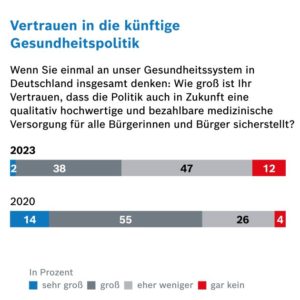
Almost 60 percent of those surveyed say they no longer have little or even no confidence in the ability of politicians to provide high-quality and affordable health care. That is more than twice as many as in 2020 (30 percent). Around 40 percent of those surveyed are also of the opinion that health and medical care in their area has deteriorated overall over the past year. This feeling is even more common among participants with chronic illnesses (46 percent).
Prof. Dr. Mark Dominik Alscher, Managing Director of the Bosch Health Campus: “The survey results clearly show that we must act urgently and consistently align our healthcare system with patient well-being so that it remains sustainable. Access for everyone to affordable and high-quality health care must be guaranteed in the long term - for this it is important that politicians actively involve citizens in decisions."
The central content of the Forsa study includes, among other things, the population's trust in health policy, citizens' priorities with regard to the health system of the future and the assessment of the traffic light coalition's previous health policy.
Redesign primary health care
Many people want better health care in their own environment. For those surveyed, medical contact points close to home (84 percent) and quick appointments (98 percent) are important or very important. In addition, most of them would like to spend more time with doctors and health professionals (98 percent), for example to make joint decisions about therapies or medication (91 percent). In particular, chronically ill patients, people in small and medium-sized cities (up to 100,000 inhabitants) and people over 60 attach great importance to these aspects.
Invest in nursing staff and strengthen health literacy
When asked which aspects make the German healthcare system sustainable, many citizens agree that working conditions for nursing staff need to be improved, for example through better pay or working hours (97 percent). The fact that nurses are allowed to take on more responsibility was important or very important to 76 percent of those surveyed. Many see the need to invest in the training of medical and nursing staff (63 percent) and to gradually strengthen the nursing profession through academization (57 percent).
At this point, Alscher brings up the concept of community health nursing, the introduction of which has already been announced in the current traffic light coalition agreement: “Following the example of other countries such as Canada or Scandinavia, nursing contact persons are trained who are academically qualified and suitable for use in the primary health care in urban and rural areas. There, the so-called Community Health Nurses are available to answer all kinds of health questions and support people of all ages in coping with everyday illnesses and help to make up for the increasing gaps in care, including in the medical field.”
Dr. Wünning Tschol, head of the Robert Bosch Center for Innovative Health, says: “As many people as possible should be given the chance to take responsibility for maintaining their own health. Easy access to evidence-based health information is an important prerequisite for this. There are great opportunities for this in digitalization and artificial intelligence.”
Background to the survey
For the representative survey, the opinion research institute Forsa surveyed a total of 1,850 people aged 18 and over nationwide from January 25th to February 10th, 2023. The survey commissioned by the Bosch Health Campus of the Robert Bosch Foundation marks the conclusion of the “Neustart! Reform workshop for our healthcare system”. Forsa conducted an initial survey for the initiative in May 2020. As part of Restart! The Robert Bosch Foundation has worked with citizens and experts for three years to develop proposals for a fundamental reform of the healthcare system. The Robert Bosch Center for Innovative Health at the Bosch Health Campus continues this work today. The focus is on two innovation focuses: Patient Journey in a Digital World and Health Literacy for People and Organizations.