


Significant increase in mental illnesses in the third year of Corona
27.02.2023 14:37
Exhausted and depressed: The severe impact of the coronavirus crisis on the mental health of working people is now evident in the statistics. While there were almost no changes in the first and second years of the coronavirus pandemic, these changes are becoming even more apparent in the third year of the crisis.
Last year, the KKH Commercial Health Insurance Fund registered around 57,500 sick notes nationwide, resulting in 2.3 million days of absence due to mental illness. This represents an increase of around 16 percent compared to 2021. Employees in nursing, education, and social work were most affected.
In 2022, employees were most frequently absent from work due to depressive episodes. At 30 percent, this diagnosis accounts for the majority of days lost due to mental illness. Close behind, at 28 percent, were depressive reactions to severe stress and adjustment disorders as the reason for absence from work. In 2022, the KKH recorded almost 15 percent of sick days due to recurring depression, a good twelve percent due to chronic exhaustion, and around eight percent due to anxiety disorders. Almost seven percent of days lost were due to so-called somatoform disorders, i.e., psychosomatic complaints such as abdominal pain or headaches without an organic cause.
Worrying increase in men
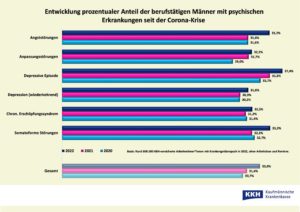
What's striking is that the crisis appears to be taking a greater toll on men than on women. While significantly more female employees are still affected by mental illnesses, men are catching up: KKH recorded a significantly greater increase in all diagnoses among them than among women, especially with regard to anxiety disorders and somatoform disorders. In 2022, KKH received around 40 percent more medical certificates from employees due to anxiety disorders than in the previous year. While this increase was also significant among female employees, it was comparatively much smaller (19 percent). The gap is even wider for somatoform disorders. An increase of around six percent among women compares with an increase of almost 22 percent among men.
The proportion of men with mental illnesses is now almost 34 percent overall. The proportion of women has fallen accordingly to around 66 percent in 2022. In the first year of the coronavirus pandemic, 2020, the ratio was 31 to 69 percent.
Men suffer differently than women
"It is primarily the consequences of the restrictions during the coronavirus crisis that are now clearly having a psychological impact on men," explains KKH occupational psychologist Antje Judick. During the pandemic, it was primarily those men who were previously involved in club or team sports, such as soccer or handball, who reduced their physical activity to a minimum. "The resulting lack of exercise and social interaction appear to have had a lasting negative impact on their psyche, i.e., on their drive and motivation, and their general mood," says Judick.
The coronavirus crisis has also had a negative impact on the labor market, especially the private sector, where more men than women are employed. For many, the economic situation has yet to recover. War and rising prices have added even more uncertainty. "Because men are often more concerned about their job prospects and the financial situation of their families than women, they may be suffering particularly severely from existential fears and the feeling of powerlessness that they will no longer be able to fulfill their responsibilities due to the consequences of the crisis," explains the KKH expert.
For female employees, it is more likely the balancing act between job, caring for children, and relatives in need of care that places a significant psychological strain on them. This problem existed even before the coronavirus pandemic, but has become even more acute during the pandemic: young children had to be supervised in the home office alongside working, and older children had to be looked after during homeschooling, while top performance was still required at work. Last but not least, this situation is now also reflected in the statistics. However, since women have been diagnosed with mental illnesses significantly more frequently for years, the renewed increase does not seem as dramatic as it does for men. "The fact that men are now catching up so quickly shows that they are suffering a very high level of suffering," explains Antje Judick. In general, men are no less ill than women. However, they are more likely to suppress health issues and often see a visit to the doctor as a last resort. Women, on the other hand, are more likely to seek medical help and therefore receive more diagnoses.
About the study
The number of calendar days with a medical certificate from compulsorily and voluntarily insured members of the KKH Commercial Health Insurance Fund with entitlement to sickness benefit was evaluated, new for 2022 – excluding unemployed persons and pensioners.