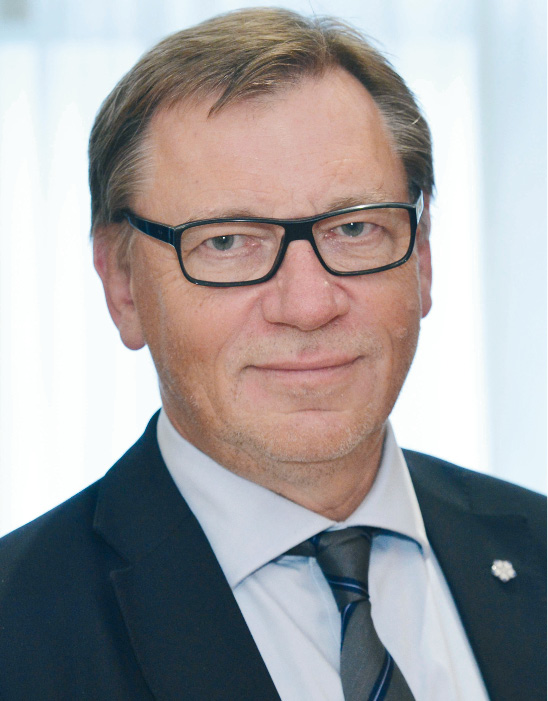
He has been a specialist in general medicine since 1983 and knows the concerns and challenges of his profession inside and out. To make a difference, Ulrich Weigeldt became a medical association official: first in the Bremen Medical Association, then in the Bremen Association of Statutory Health Insurance Physicians and the German Medical Association, and finally even as a board member for primary care in the National Association of Statutory Health Insurance Physicians. In this capacity, he introduced the fundamental principles of his now-implemented remuneration model in the primary care contract in a 1997 motion for a vote, for which he lost the confidence of the association. He resigned and was elected Federal Chairman of the German Association of General Practitioners in the same year. In his secondary role as First Deputy Chairman of the Supervisory Board of the Association's affiliated General Practitioners' Contractual Cooperative (HÄVG), he became the most prominent negotiator for selective primary care contracts.
Mr. Weigeldt, the general practitioner contract between Signal Iduna IKK and the German Association of General Practitioners, which you represent as Federal Chairman, is a selective contract covering almost the entire country. Do you and your association see this as a sign of a breakthrough for selective direct contracts, since such contracts can also establish a kind of standard or model?
Absolutely. We used the AOK contract in Baden-Württemberg as a model – that was our blueprint. We had concluded the first contract for primary care physician-centered services there – even before Section 73b was newly written into the Social Code. AOK Bavaria followed with a slightly different fee structure. But in their basic structures and especially in their processes, these contracts are uniform. We didn't want to establish overly different processes; that would have been difficult for both the doctors and the health insurance funds in terms of administration. The nationwide contract is of particular importance – as the starting point for standardized structures across Germany. The other potential partners at the federal level have been somewhat hesitant so far – to put it mildly. I'm not sure if it was a very good strategy for the substitute health insurance funds to entrench themselves behind the VdeK (Association of Substitute Health Insurance Funds), not conclude a contract, and wait for the federal elections in the hope that Section 73b would be repealed. Especially because the partners have completely different interests: DAK, Barmer after the inclusion of GEK, DAK or TK have different structural, financial or strategic orientations.
Birgit Fischer, the CEO of Barmer, sometimes explains that she cannot understand the purpose of these general practitioner contracts; the doctors are getting more money for nothing.
It's a misconception that doctors get paid for doing nothing. The focus on primary care and the fixed fee, regardless of patient contact, have their advantages – this is internationally recognized and undisputed in the scientific community. The existing system of the last 10 to 20 years has created an incredibly high number of doctor-patient contacts in Germany, unparalleled worldwide. This has also led, as demonstrated by the Barmer GEK physician report, to the shortest doctor-patient contact times in Europe. Yet, doctors need a lot of time, especially for patients with chronic conditions. We need to get general practitioners out of this rat race, and fixed fees are extremely useful for this.
It therefore makes sense to create a structured system of outpatient care. This, incidentally, does not restrict patients' freedom to choose their doctor. I don't feel restricted in my freedom when I sign a phone contract and commit to a year. What's often forgotten about obligations is that they are always twofold: when someone registers at my practice, I also feel responsible for that patient – that's just how it is.
According to initial survey results, the doctors are apparently satisfied. What about the patients?
General practitioners are extremely satisfied, and patients seem to be satisfied as well. Since the introduction of the AOK (General Local Health Insurance Fund) contracts in Baden-Württemberg and Bavaria, the number of patients voluntarily enrolling has increased by six figures. The first patient surveys are already underway and will be completed soon. We expect to have initial results in the first quarter of this year. However, we have already observed that patients who have enrolled in a general practitioner contract very rarely withdraw. It's important not to underestimate the very close relationship patients have with their general practitioners.
Moreover, a massive transformation is currently underway within the system, and this needs time. General practitioners are, on average, 55 years old. They will adapt, but they can't change everything overnight. The problem is that doctors have learned to write down a code for every single service. If they can no longer write codes, they become confused. We need to be patient. AOK Baden-Württemberg has that patience, and so do we. Strategic planning must extend over a five-year period, as is standard practice in other companies. Only such long-term perspectives are truly meaningful because we are dealing with people on both sides whose behavior needs to change.
Do these contracts therefore lead to a completely new or a very traditional doctor-patient relationship?
It's more of a traditional model, which isn't necessarily a bad thing. It's just that the 6-7 minute consultations are frustrating for both sides. Added to that is the requirement that patients shouldn't wait longer than 30 minutes at their GP's office. But if, under the old reimbursement system, doctors have to schedule every patient per quarter, then short consultation times are inevitable. We also shouldn't underestimate the fact that older people, in particular, fear that their GP might no longer be available. What will seniors in rural areas do without a GP? It's precisely in these areas that our new care structures are being particularly well received. On the physician side, we've established specific quality criteria that limit the number of participating doctors. This includes structured, GP-specific continuing education. We want to include in the contracts the doctor who truly provides comprehensive GP care, who also makes house calls, and who isn't just specialized in acupuncture, homeopathy, oncology, or diabetes.
What do you think about add-on contracts?
We believe that add-on contracts are counterproductive. The logic of add-on contracts must be abandoned because they perpetuate the old fee system under Section 80 % and merely offer an additional bonus for changing behavior. This doesn't work, however, if behavior is determined by Section 80 % in the old system. The new contracts therefore stipulate that the new system will be implemented alongside the collective system to determine which is truly superior. For this reason, we are pleased that policymakers resisted the short-term temptation to remove Section 73b from the German Social Code, Book V (SGB V). While the new Federal Minister of Health is known to be no fan of this section, he has agreed to give us three years. This is a timeframe we can work with, and within which we must clearly demonstrate that we have achieved more than under the previous system. This means: a smoother transition to specialist care, despite all the challenges that also exist there. The quality of the discussions and the atmosphere here are exceptionally positive, unlike anything I've experienced before at the corporate level. We need to define the points of transition between primary and specialist care, in both directions. If we can then also manage to get both based on a similar contractual structure, we'll have achieved a great deal.
You've probably been asked by the ministry where you want to be in three years?
We want to have contracts for primary care in 80 of the republic, one-third of which will already have interfaces to the specialist level according to § 73c, and also one or two further contracts according to § 140 towards hospitals.
So, a truly cross-sectoral contract architecture?
Based on my long personal experience, I am convinced that we will repeatedly encounter sectoral boundaries. But we can only overcome these through contractual arrangements; otherwise, we will only entrench structures that do not communicate with each other.
Health services research in Germany is currently hampered by sectoral boundaries. What needs to be done?
Health services research in Germany is a disaster precisely because we can't establish proper, cross-sectoral quality assurance. This is neither factually nor medically justifiable. It's embarrassing to report abroad that we have to obtain our epidemiological data from England because we can't generate it ourselves. Health services research needs longitudinal data, not snapshots. But currently, I can't even track pseudonymized patient cases to determine which interventions are medically sound and economically viable, and which aren't.
How can healthcare research be implemented in the general practitioner contract system?
Regardless of the political climate, a sound primary care system is also the foundation for health services research. There needs to be a central point where the data converges; this cannot be a central server at some medical association. The disciplined data management practices of general practitioners can be utilized much more effectively than before. We are required to retain all findings for ten years anyway, and the enrollment model provides us with precisely the findings that can serve as a starting point for health services research. In Heidelberg, for example, all data from various sectors, such as inpatient and outpatient care as well as rehabilitation, are already being compiled. We are very interested in improving the connection to long-term care. This isn't entirely straightforward, because the provider landscape isn't necessarily homogeneous.
They certainly also need the results from healthcare research as a form of legitimation.
We need results that show our system works. If the results show it's all nonsense, the family doctor model will be abolished – that's the risk. But based on previous international experience, that won't happen. However, it's quite likely that the results will have a significant impact, especially on primary care itself and certainly on the development of clinical practice guidelines.
Who would be a potential partner for healthcare research in your case?
I see a promising approach in Barmer-GEK, AOK Baden-Württemberg, AOK Bavaria, and Signal Iduna IKK – health insurance funds that have carefully considered how to move forward. However, it's also clear that these funds are structured very differently. When I look at the opening of the system recently implemented by the legislature, it seems to me as if everyone is being released from prison, but then they see the bright sunlight in the courtyard and cling fearfully to the bars. These funds are sometimes very cumbersome, large bureaucratic machines. Their behavior doesn't always give the impression that they are all players who are using their billions in policyholders' money wisely.
There are at least 1,600 arbitration proceedings underway because most health insurance funds did not conclude contracts by mid-2009, as required by federal law. What is your opinion on this?
That's a very high number, but we have to assume that many will be processed en bloc. The 1,600 figures only come about because, nominally, settlements must be reached in every collective bargaining district. The supervisory authority, the BVA, has appointed one arbitrator for each of the four districts. I think that things will start moving after the first arbitration proceedings.
Presumably in which timeline.
My optimistic estimate is July 1st, 2010. This also depends on the arbitrators, who communicate with each other. It makes sense for the system that not every region has a different contractual structure.
Aren't 80 % general practitioner contracts in Germany a little too optimistic?
We want to establish primary care contracts in 80 regions. We won't be able to secure 80% of the primary care physician fees within the next three years. This naturally depends on the satisfaction levels of doctors and patients: the more positive the contracts are among patients, the faster a domino effect will be triggered.
What happens to the KVen then?
I can't say. I'm not fighting the statutory health insurance system either. But why don't we support each other if we both represent the interests of physicians? If we arrive at reasonable fee structures, the statutory health insurance associations could say, "Great, we'll join in." Instead, they say it's all worthless, the contracts are bad, and general practitioners are ruining the world. Even though there are certainly more tasks to be done now than just distributing fees. Entirely new service opportunities are opening up, along with potential avenues for cooperation.
It's disappointing that a system with 10,000 employees and 39 board members has nothing on its mind but backward-looking discussions. Take the yellow budgets, for example. When Seehofer introduced budgeting in 1992, the question arose of how to regulate fee distribution. Back then, there was a basic budget for standard medical services, the green budget. Then a red budget for individual services such as psychotherapy requiring approval. In addition, there were those yellow budgets: 15 points for ultrasound, 15 for psychosomatic intervention, and 10 for minor surgery, which were then paid more or less poorly, as is typical for such a budget system. Now all the budgets have been abolished and a euro-based fee schedule introduced. And what's the latest proposal? Fees for individual services using yellow budgets! Perhaps it's sometimes historically necessary to make a clean break when a system becomes increasingly complicated instead of simpler.
In the last two cover interviews of "Monitor Versorgungsforschung", Professors Sawicki and Glaeske called for a decommercialization of the medical profession, because in their view, doctors should not constantly be thinking about their points when they have a patient in front of them.
Our system includes a fixed, contact-independent flat fee as a basic payment, which covers the general practitioner's standby functions. This means the doctor doesn't have to constantly schedule appointments with patients to earn an income. These standby functions encompass space, equipment, staff, and maintaining quality. These are all values not reflected in the individual reimbursement system, but are covered in our P1 payment. This provides a regulatory mechanism, as even healthy patients register, generating a certain level of background activity in the practice. In addition, there's the P2 payment, which is only paid out from the second quarter onwards, if an illness lasts longer than a quarter or requires more intensive consultation, as this necessitates more time and effort. Patients with chronic conditions trigger a further payment – number 3 – although this group is defined differently in the various contracts. And targeted referrals to specialists will also increase efficiency in this area. What good does it do if a patient with back pain goes to a cardiologist because the pain radiates into their chest? That clogs up the system. It also clogs up the specific capacity of specialist practices themselves, which is also the reason for the long waiting times there.
Isn't the basic flat rate therefore a – albeit initial – part of decommercialization?
The basic fee reflects reality. Look at the results from the Bertelsmann Foundation: 80% of people say they have a family doctor, even if they last saw one four years ago. Incidentally, the fixed fee, regardless of the number of visits, is the main source of income for Dutch family doctors. This is, of course, a form of decommercialization, because it's almost a component of their salary. Some doctors would even go along with paying them a salary, but I'm not sure that alone would get the morbidity burden in Germany under control. The term decommercialization is flexible. What is true, however, is that medical care should no longer be driven by commercial interests.
The interview was conducted by MVF publisher Prof. Dr. Reinhold Roski and MVF editor-in-chief Peter Stegmaier.