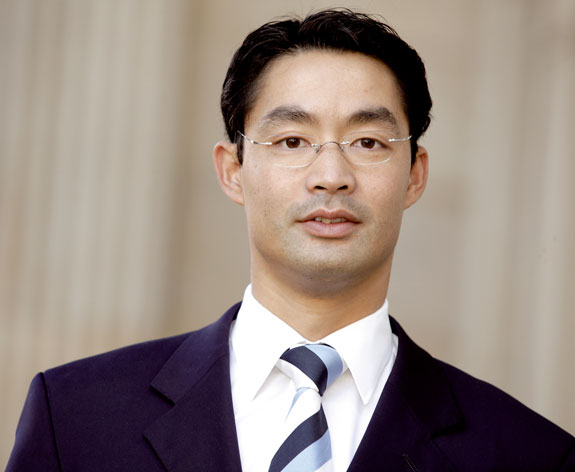
12 health insurance funds have to demand additional contributions of between 8 and 37.50 euros from their members - mainly due to the effects of Morbi-RSA - and this is what Federal Health Minister Dr. Philipp Rösler is under media pressure: Instead of calmly supporting the requirements of the coalition agreement with details and designing a structured health care reform, we have to patch things up again. “Monitor Health Care Research” spoke to the Federal Minister of Health about his concept for a real health care reform that would also be worthy of its name. It is already clear: health services research has a central role to play!
>> Minister Rösler, the pressure of expectations from everyone involved in the healthcare system and especially from the media is high. Some complain that too little happened in the first days of their term in office, others praise some personnel decisions, which we will certainly come to later. And the third parties complain that nothing major has happened so far apart from a moratorium in the area of eHealth. But now you seem to be under pressure after the current additional contributions from health insurance companies are being attributed in the media - and also in the eyes of the public - primarily to rising drug prices, which is not entirely true.
For me, it is crucial that the insured's contributions are used efficiently. This means that possible – and certainly existing – savings potential in the pharmaceutical sector, but also in other areas, is increased. We can all be proud that Germany has one of the best health systems in the world, in which access to new, innovative medicines is guaranteed for those insured by statutory health insurance. But the same applies: In Germany, the prices of innovative medicines in particular are too high. This is not just something we want to do, this is where we have to work if innovative medicines are to continue to be available to patients in Germany in the future.
While drug prices are too high, doctors openly discuss rationing and prioritization. Isn't it a bit unethical when at the same time there is no talk about ending or at least attempting to eliminate inefficiencies in the system?
Nobody has carte blanche when it comes to statutory health insurance expenses. I have presented a concept with measures for drug pricing. This is one of several building blocks. My goal is an efficient system in which the insured people's money is used optimally. Because if it is publicly argued that there is too little money in the system despite 174 billion euros or that there is creeping rationing, then there are two options: either a set of rationing rules or a really efficient system. I want the efficient system.
And what if the efficiently used budget still isn't enough?
If, despite optimal use of funds, there is actually too little money in the system, I will be the first to say that more money needs to be used. But as long as we don't have an optimal system, no one can seriously ask for more money, nor can they claim that there isn't enough.
It is certainly clear to everyone involved in the system that, even in 2010, we are still in a system of over-, under- and incorrect care.
It is precisely this mismanagement of resources that triggers the kind of discussions we are currently witnessing. That's why I see it as my job to create a better, i.e. higher quality, system.
Politics has certainly not covered itself with glory in recent years and decades: a veritable patchwork of legislation, mutually contradicting or even overriding instruments are all too often criticized.
That's only partially true. But the criticism has a kernel of truth: most previous health care reforms - regardless of party leaning - were always limited to cost containment, which was perhaps the right thing to do at the time because it was something that could be implemented in the short term. But all of these reforms and laws have failed to improve the system as such because they have not contributed to creating a more efficient and, at the same time, better quality system. That is exactly my stated goal.
A truly noble goal.
I really believe that with a total volume of 174 billion euros spent year after year just in the statutory health insurance sector, there is enough scope to optimize the system.
Perhaps they are also verbal smoke grenades that are being thrown because all service providers have adapted quite well to the existing system.
This cannot be generalized. In my opinion, there is a big difference between unfair competition on the one hand and fair competition on the other.
Because people are trying to survive in a system of tightly budgeted pots - whether these are standard service volumes, capped or even partially capped budgets for doctors, or maximum prices or selective contract models for the pharmaceutical industry?
You can't do anything against that in a free market economy. But my point is how someone tries to run their business. In unfair competition, those who are particularly skilled at exploiting the individual rules and the system as such are successful. This behavior has absolutely nothing to do with freedom of treatment or performance for the patient. This is the outgrowth of a competitive situation in which there is a tough fight for market share - whether between general practitioners and specialists, outpatient versus inpatient or one medication against the other. I think this approach is wrong. In a fair competition, on the other hand, those who deliver a good but understandable performance will be successful. And I primarily call good what benefits the patient.
They argue for a moral dimension to the market economy.
I don't want to hang it that high. First of all, I'm talking about fair treatment - not only with the resources available, but above all with the greatest asset that we all have: that is our health. But I also strongly advocate for a new coexistence that can replace the current antagonism.
If you consider the public discussions of the last few years...
...then the sound makes the music. This dissonance is certainly one of the basic problems of the German healthcare system, another is the deep-seated mistrust. I want to make it clear to everyone involved in the healthcare system that I cannot promise them more money - that is my clear message, whether I am speaking to doctors, pharmacists or the pharmaceutical industry. But I can promise entry into a fair system with reliable framework conditions. That's why I don't believe in playing the individual actors off against each other. On the contrary, I follow a comparable strategy for every topic that comes to my table: I invite the individual actors, usually the service providers first, then the payers. In my opinion, this is the only way to take a common path into the future.
This is what happened with the example of the eCard moratorium or drug prices.
Exactly. The discussion about the eCard has been going on for many years without any concrete results. The same applies to future drug pricing. Here I first had the National Association of Statutory Health Insurance Funds with me, then the progenerika industry association, followed by the BAH, BPI and the VFA. I consciously always listen to all sides that can openly articulate what their respective ideas are. But what I explain to everyone I speak to in advance is just as clear: the BMG and the legislature make the decisions - based on what is good for the insured and patients.
A new tone seems to be entering the Federal Ministry of Health.
Absolutely. Also because I don't summon those involved but rather invite them. I am pleased that the representatives of the health insurance companies and the pharmaceutical industry have recognized this small sign, but perhaps also the larger signs of the times. Everyone – including the pharmaceutical industry – must make their own contribution.
Isn't the drug given a little too much leverage here? The pharmaceutical sector identified by the health insurance companies as a cost driver is only a cost driver in the area of patent-protected original preparations, but here again it is only one of many.
Product innovations have always been and are the be-all and end-all of medicine. So it is no wonder that large financial resources have always flowed into this area. It was certainly a mistake on the part of politicians not to recognize that perhaps process innovations are at least as important for the efficiency of a system as innovations in the product sector.
What then also has to mean moving away from individual considerations and towards a look at the big picture.
We are currently discussing the question of how to redesign the income side. The question of how processes in the entire system can be improved would also be interesting. Because process innovations could help to save costs and work more efficiently. It is therefore my job - in addition to the income side, which primarily concerns the public - to transform the expenditure side into a more efficient system. Such a systemic approach involves looking at the entire treatment chain in everyday life, because there is certainly still a lot of potential here.
If only we knew more about what we have arrived at in health services research.
This is a very important topic for me. This is precisely why the term “health care research” appears as one of very few other terms twice in the coalition agreement - once in the BMBF and once in the BMG part.
The formal responsibility lies with Ms. Schavan.
But we have agreed to tackle the topic together with workshops that have already started. My main aim is to work through the problems of illness in everyday life. We are excellently positioned in high-end and high-tech medicine, but there is often considerable need for improvement in the supply chain - from a qualitative but also from an economic point of view.
Do you see a rethink that could free healthcare research from its shadowy existence?
For sure. When even the health insurance companies are now prepared to rethink their approach in order to get out of the eternal debate about too much or too little money. But here the health insurance companies are just at the beginning, as is admittedly the case with politics. Because in the last coalition agreement there was nothing at all about health care research.
How do other actors react to this?
I think I can see a certain movement among all the actors involved. You can even see this in the cumbersome topic of requirements planning, which we at the BMG have taken on. In the 1990s, demand planning aimed to prevent doctors from setting up shop in view of the glut of doctors that existed at the time. Today, however, the requirements are completely different - almost the opposite is the case. Even the KBV has already considered joint requirements planning with the inpatient area. What ultimately comes out of it is another matter. But the signal alone is remarkable.
The challenges will be enormous here too, because in the end the citizens will not measure the success of a health minister by how well he has initiated a reform.
Correct. But above all, how access to doctors is guaranteed per se, i.e. little to no waiting times.
Will that even be possible?
Even the perceived reality looks different. According to statistics, there are no poorly served areas. The question is what incentives we need to provide so that doctors move from metropolitan areas to rural areas. We know that it will hardly be possible to get a well-established specialist from Berlin to Havelland. But in the phase of becoming self-employed you can motivate a doctor. This is where you have to start.
There has been the possibility of surcharges since January 1st of this year. This is already a form of incentive model.
There are completely different, very different and much more advanced models that we are currently looking at: Saxony, for example, offers scholarships for medical students. And medical care centers would be another option.
Do you favor MVZ?
As a model, yes. But we want to prevent large investors from getting involved and ending up with MVZs no longer being operated from a medical point of view in the sense of freelance work, but from a capital market point of view. That's why the rule already applies that an MVZ must be managed by a doctor. We also agreed in the coalition that the majority of the shares and voting rights should belong to the doctors. However, implementing this is not that easy.
Is the MVZ – similar to the flat rate 1 of general practitioner contracts – a step towards decommercializing the medical profession?
That would be a matter for self-government, which has the opportunity to use such instruments within family doctor contracts. There simply has to be a performance and quality competition that goes far beyond the current volume incentives, but must also not degenerate into piecework, which would not do justice to the medical profession as such, but above all to the patient.
This is where the keyword “pay for performance” comes in handy.
That also sounds good at first. As part of the EbM model, there is already the possibility of rewarding employees according to certain quality criteria. But how should performance be evaluated? And: What does performance mean in the health sector? If you want to pay for quality, you also have to be able to assess quality and also be able to establish a connection between payment and the quality of the results. But: How do I define and control this quality relationship? This is not an easy question, even if the aim is certainly correct from a regulatory perspective.
How can health services research counteract inefficiencies in the system, which, if not solved, can also be described as unethical in the context of the prioritization debate?
For example, we can treat heart attacks very well, that is undisputed. But how do you get a patient to a specialist quickly in rural areas? Or how do we deal with dementia? With care? The workshop between the BMBF and BMG is intended to develop exactly that and much more.
However, perhaps the more pressing question is how to implement health services research as a concerted approach.
It will be impossible to try to explore the entire system in one go. That's why you have to look at one area at a time. All topics relating to common diseases are certainly very important.
And a truly cross-sector approach!
Secure. I also view the healthcare system as a chain from prevention to aftercare.
And even care, which is unfortunately a different type of insurance.
If you look at the issue of health holistically, then the individual is not interested in which type of insurance is ultimately responsible for what. That is why politicians must redefine the interfaces between the individual security systems - whether GKV, nursing care or social assistance. The task of health services research is then to locate the relevant interfaces and solve any problems.
This more global approach quickly leads beyond the statutory health insurance system.
True. For example, we are currently having this discussion regarding the new definition of care terms. At some point, when talking to those involved, you come to the point of, for example, what exactly integration assistance looks like. When it comes to this question, the countries have a say at the table. I'll say it casually: I believe in healthcare reform, but for good reason I don't believe in federalism reform. But the goal actually has to be to overcome boundaries, including those in social security systems. At least you can identify the interfaces and define what difficulties there are. How long these can be solved is another question. But you shouldn't have a taboo in your head right from the start.
Also not a taboo about throwing unsuccessful instruments overboard? For example: discount contracts?
One thing is certain: we have the discount agreements and they have worked. At least they mainly reduced the prices of generic drugs or kept them stable and for that reason alone they must have led to savings for the health insurance companies. But since I am a declared supporter of fair competition, it is always important to check whether fair competition exists within this discount contract system. Because on the one hand there are large funds, some of which represent a monopoly - at least a regional one. And on the other hand, smaller, mostly medium-sized companies that have no chance in a bidding concert with large, often multinational providers.
So you're ready to think a little further.
You have to think further! So that this does not ultimately lead to a decline in diversity. If at some point the cash register no longer has the opportunity to switch to other providers because they have been ruined by the discount agreements of the last few years, then nothing has been gained.
There are several models for this that have been discussed for years.
This requires audits of procurement law and greater use of competition and antitrust law. And more freedom of choice for patients as part of additional cost regulation is also conceivable.
If only one knew what savings were actually achieved. Can't politicians prescribe a little more transparency to the health insurance funds?
The health insurance companies must show the savings from the discount agreements in a designated account framework. However, this is currently happening with a considerable delay.
Despite all the confidentiality of trade secrets, the healthcare system needs a certain level of transparency in order to be able to make assessments. If you have data, you have to be able to handle it. Not only researchers need data and information, but also patients. What about them?
One goal of the new healthcare reform is to ensure more transparency, especially for insured persons and patients. An insured person who acts confidently and responsibly needs knowledge about illness and illness processes as well as information about his or her rights as a patient.
But so far, for example, only a tiny fraction of those insured by statutory health insurance know how much their treatment costs. So much for transparency.
True. No patient can make a serious price-performance assessment because they do not know the price. You hand in your health insurance card and receive treatment. It's no wonder that those insured often have completely wrong ideas about how much their treatment really costs.
On the other hand, every person with health insurance has the feeling that they constantly have to pay more into their health insurance.
The term “pay in” is the wrong word because the GKV is not a savings association. What is true, however, is that you pay and want the funds to be used sensibly.
And on the other hand, the desire to get as much as possible. This discrepancy hinders one's own self-control function, which in itself would be the only sensible thing to do. But how do you get the patient to have more self-control?
That is the most important question of all. If you want a health insurance system to be based equally on personal responsibility and solidarity, then the trick is to know where the line lies between the two. That means: What are the limits of personal responsibility for more efficiency that I can and must demand? And where is the natural limit of solidarity? We all know that at some point everyone can find themselves in a situation in which they are dependent on the help of others - i.e. on the solidarity of society.
But this primarily requires a patient who is both enlightened and self-confident.
The patient can exercise a certain market power with his knowledge, although there will always be information asymmetry. But that's exactly why you need a good doctor-patient relationship. But the patient could be expected to have more self-confidence than before.
So would a new version of the HWG also be necessary?
I wouldn't go that far at the moment. First of all, the patient needs the best and neutral information possible. Patient information and education as well as prevention is much more than just back training: a change in mentality must be brought about.
Is there a current plan you have in mind for this?
If you look at the system as a whole, you come to the following solution: You need a competitive system and a mature and informed insured person and patient. This is precisely why patient information and education as well as prevention are so important to me.
But there is still little sign of this at the moment.
Sometimes you get the impression that today's health insurance offers are more marketing than real prevention measures. Our studies show that currently only two million insured people are being reached through preventive measures.
Which isn't exactly a lot compared to 70 million insured people and 50 million contributors.
In addition, these are usually those who are already health-conscious and consciously choose such courses. The crucial question is therefore how to reach those who are more lacking in information and sometimes perhaps also in education for prevention offers. One approach, for example, would be to act through family doctors. A second approach would be to place greater emphasis on the entire area of occupational health promotion - also because there is a close connection between occupational stress and burnout syndromes and even depression.
These are certainly just two small building blocks – but you definitely have to start somewhere. If you say yes to more prevention, won't you automatically get a bonus?
Secure. You have to create incentives! My job is not only to ensure that health care is always well secured, but also that people stay healthy for as long as possible. Through your own knowledge, through your own information and above all through your own behavior.
Which in the end is just the management of illness or health.
That's exactly why you have to create the right incentives - whether for service providers or for the patient. This is the best way to avoid unnecessary economic costs in the area of health insurance. This is actually a truly banal insight, but at the same time incredibly difficult to implement - also because it has not been learned in the history of health policy.
Do you have the feeling that service providers actually want transparency?
Definitely that. If you can assume a fair system, then everyone knows that good performance is rewarded and bad performance is not. Anyone who accepts this basic principle will, for example, happily exchange an anonymous competitive situation for a transparent and fair cost-benefit assessment. And anyone who offers a real process or product innovation does not need to be afraid of a cost-benefit assessment.
The problem is the step innovations. Unfortunately, the big world of medicine does not live from the big things, but mostly from many small advances.
That's exactly why there have always been rules that led to evasive mechanisms, which in turn led to new rules. Which, by the way, explains the excessive bureaucracy in the health system quite well. This would be over if we agreed on internationally recognized rules, although I know how difficult that is.
The direction of the cost-benefit assessment that Prof. Sawicki, who answered our questions in the cover interview two issues ago and whose contract expires on August 31st of this year, should be the benchmark?
You have to separate between the person Sawicki and the IQWiG institute. In order to succeed in the role of head of the IQWiG institute, you have to be a certain type of person - namely almost insensitive to criticism. It's almost like being a health minister: you are criticized from all sides and everyone is dissatisfied, no matter what they do. Believe me, after just under 100 days I'm pretty familiar with it. However, when you become insensitive to criticism, you can sometimes also become insensitive to self-criticism.
And that’s why Professor Sawicki failed?
I want to distinguish between errors in the administrative procedure and the structure of IQWiG itself, because the latter was an enormous achievement for which I personally give him great credit. Building such an institute from nothing and introducing cost-benefit assessment in certain parts requires a great deal of assertiveness.
Should the German special path remain as it is in the cost-benefit assessment or should it not be better reconsidered?
The ultimate goal must be international comparability. The pharmaceutical sector cannot only be viewed nationally, which requires a minimum level of comparability. The more accepted the procedures used are, the easier the cost-benefit assessment will be in the end. And if performance in fair competition is worthwhile, this process will ultimately become established more quickly. Then we would have achieved a lot from the patient's perspective. Because then only those medications that actually have a reasonable cost-benefit ratio will be reimbursed.
And the appropriate price.
Naturally. The fact that every company can come up with a price after market approval is a situation that can only be found in Germany. That will have to change.
The professional associations are already making initial approaches to this.
The associations have recognized that this lucrative business model cannot continue in the long term. From a political perspective, a fair system needs to be developed. The new pricing system will certainly not have an immediate financial impact - but it will in one or two years. It is important that savings are realized for the statutory health insurance without preventing innovations. The balance is important.
This could be the opportunity for new competition.
The opportunity is there. In the end, I want to stand for a fair system that promises success for all sides in the long term.
Long-term reliability will be important, as that has been lacking so far.
You actually just have to apply the normal principles of the social market economy: fair competition and a clear regulatory system. Politicians should not presume to always want to regulate everything. What is important is the broad cornerstones of a system and the necessary market transparency, in line with the right incentives to reward real performance rather than skill in exploiting the system.
The journey will be the destination.
Confucius said this very wisely and it is true.
Do you already have a name for the next law?
Not yet. The name comes at the end. The most important question is how do I convey to people that we want to create a system in which all insured people and patients can ultimately be sure that the money is available for prevention and care instead of evaporating in inefficiencies. If we succeed, we would have achieved more than all previous reforms.
In your recently presented key issues paper, the entire pharmaceutical market is to be reregulated. What are the goals?
We want to ensure that all new and innovative medicines are immediately available to patients. But also that these medicines remain affordable in the future. We finally need a necessary balance between innovation and affordability.
How should this balance be achieved?
It is important that pharmaceutical companies will no longer be able to unilaterally determine the prices for new drugs in the future, but will instead be able to demonstrate the benefits of all new innovative drugs through studies. These are then checked by the GBA so that the health insurance companies have a solid basis for price negotiations.
So in the form of selective contracts?
In the future, the health insurance companies should negotiate the prices of medicines with the companies. This is another important step towards patient-oriented health management by health insurance companies for their insured persons.
What exactly should the procedure look like?
Pharmaceutical companies will be required to submit a dossier on benefits and costs before they are brought onto the market.
In principle, this would be a similar model to that already practiced in Scotland.
You don't have to reinvent everything. Such a dossier is intended to provide the most important evidence, such as approved areas of application, medical benefits, additional medical benefits compared to the standard therapy or therapy alternatives, therapy costs, quantification of the number of patients or delimitation of patient groups eligible for treatment, description of the requirement to a quality-assured application.
So a lot of health services research content.
It is planned that the G-BA will quickly initiate a benefit assessment based on the facts submitted with the dossiers, which should generally be available no later than three months after approval. The assessment should, for example, examine which patients and diseases have an additional benefit.
What happens then?
As agreed in the common key points, the pharmaceutical company must agree on a discount on the selling price of medicines with recognizable additional benefits with the umbrella association of health insurance companies in direct negotiations within one year of approval - with effect for all health insurance companies.
What happens if there is no agreement?
A central arbitration board will then decide within three months. The arbitration board sets the discount, for example, based on international comparative prices.
What happens to medicines without any apparent additional benefit?
Medicines for which no additional benefit is identified in this benefit assessment should in future be transferred directly to the fixed fee system. In principle, there should also be a reversal of the burden of proof for analogue medicinal products, meaning: a therapeutic improvement will only be recognized at the company's request. They are obliged to provide the necessary evidence themselves.
Overall, a demanding time window when you consider how long benefit assessments have taken so far.
That is why IQWiG is being strengthened in its scientific work and its procedures are being streamlined.
The entire package is not due to come into force until January 1, 2011. What short-term actions are you planning?
The coalition factions have followed my line: We prefer the price moratorium and the increase in manufacturer discounts. The discount for medicines without a fixed amount will be increased from the current 6 to 16 percent. That brings us 120 million euros every month this year alone. The earlier we can start, the better for statutory health insurance and therefore also for those insured. <<
The conversation was conducted by MVF publisher Prof. Dr Reinhold Roski and MVF editor-in-chief Peter Stegmaier.