


Using big data to combat mental illnesses
30.01.2023 17:16
The interdisciplinary team of the TUM Innovation Network “Neurotech” is developing new methods to research the neural patterns that underlie depression, cognitive disorders or chronic pain.
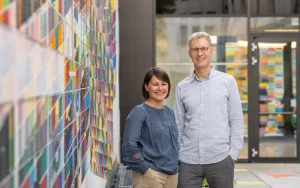
The doctors and scientists of the TUM Innovation Network “Neurotech – Neurotechnology in Mental Health” are breaking new ground with their research approach. “In numerous areas of medicine, technological progress has been of great benefit to patients in many ways - but in neuroscience the situation is somewhat different. That is exactly the challenge we face,” says Simon Jacob, Professor of Translational Neurotechnology and coordinator of the research network.
Its goal is to use new technologies and state-of-the-art computer-aided analyzes as well as models and artificial intelligence (AI) to discover activity patterns in the brain that are related, among other things, to cognitive symptoms of mental illnesses. These findings could improve treatment options for stroke patients with cognitive deficits or people suffering from depression or chronic pain.
One problem connects many disciplines
Neurotech is an interdisciplinary team of researchers from a wide range of disciplines and nationalities who deal with numerous different aspects of this problem. It was particularly important to the Neurotech network to bring together clinical doctors with expertise in psychiatry and neurology with data scientists, specialists in the development of computer models and engineers. “Because we know which clinical issues arise when treating patients and where there is a need for improvement, we can develop procedures that fit into the daily clinical routine,” says Jacob. The active members of the innovation network also include neuroscientists working on cognitive diseases as well as experts in ethics and research policy.
Research into cognitive mechanisms using brain implants
Jacob and his team use brain implants to delve deep into the neural networks responsible for cognitive functions and understand their development and disorders. Language is a central cognitive function for humans that is often severely impaired in the event of a stroke. The team therefore decided to start their research here. The implants consist of small sensors that are inserted into specific brain regions of stroke patients with problems producing and understanding language. These implants can precisely measure the activity of groups of individual neurons while the patient has to solve specific linguistic tasks. The international team of young doctors and scientists from Germany, Italy, France, Turkey, India and China has already reached an important clinical milestone: the first sensor has been successfully implanted and is providing high-quality data.
Big Data and AI
But what kind of information is hidden behind these enormous amounts of data? Macedonian scientist Julijana Gjorgijeva, Professor of Computational Neurosciences, is the team's expert when it comes to developing computer models. She came to TUM in 2016 as part of the MaxPlanck@TUM career program and is now an associate professor there. Their task is, among other things, to identify patterns in the recordings of neuronal activity that are correlated with language ability or its disorders. On this basis, models with greater depth of detail as well as models for other cognitive functions can be developed.
Gjorgjieva and her group use so-called “recurrent neural networks”. These computational models can mimic the behavior of real neurons, for example how they connect to form networks. “With their help, we can change connections in the network models by turning them on and off. “This is comparable to brain injuries in stroke patients,” explains Gjorgjieva. The research team can then train these new models using the recorded neural data from the study participants. This allows them to develop a detailed understanding of what is going on in the healthy or damaged brain.
Looking for biomarkers for chronic pain and depression
In another Neurotech Network project, scientists collect brain data using electroencephalography (EEG). The participants in the study wear a hood on which electrodes are attached that measure neuronal activity on the surface of the skin. Although this method does not enable resolution at the level of individual neurons, it does have the advantage of covering the brain spatially very well.
The researchers have already collected EEG data from hundreds of people suffering from chronic pain. Using machine learning methods and other AI methods, they are now trying to find patterns in the brain that are characteristic of pain. In the future, these could serve as biomarkers for improved diagnosis and a more precise prediction of therapeutic response. The next step is to transfer the knowledge gained and the procedures used to patients with depression.
The global increase in mental illnesses is putting a strain on people and health systems. The TUM Innovation Network “Neurotech” has taken on the challenge of developing state-of-the-art neurotechnological tools to help mentally ill people.