


Make better use of advances in the treatment of multiple sclerosis
06.04.2016 15:20
Thanks to advances in the treatment of multiple sclerosis (MS), more and more people affected are able to lead largely normal lives. However, the disease cannot be stopped in the long term. In addition, there is a lack of therapies to treat the stressful symptoms of MS. More structured care concepts are also needed. This is one conclusion of the White Paper Multiple Sclerosis, which IGES scientists published together with medical experts.
“The understanding of the clinical picture and the therapeutic options for multiple sclerosis have changed significantly. Scientific advances have made MS a manageable disease, even if it remains incurable. Structural deficits in care must not slow down these successes,” says Prof. Judith Haas, medical director of the Center for Multiple Sclerosis at the Jewish Hospital in Berlin and chairwoman of the German Multiple Sclerosis Society (DMSG) Bundesverband eV
Early start of therapy and treatment according to disease activity are important
In the case of MS, early therapy can be crucial for the further course of the disease. After an initial attack, patients should be treated promptly with so-called course-modifying medications. The goal is to prevent disease activity (1). Experts speak of “no evidence of disease activity”, or NEDA for short. Signs include the frequency of relapses, progressive disability, neuropsychological symptoms such as fatigue and other nerve damage (2).
Place of residence determines care
But only about every second patient with an initial diagnosis also receives course-modifying therapy in the same year, as studies with data from 2009 show (3). The care varies regionally: in Brandenburg, where there are 4.4 specialists per 100,000 inhabitants, only 37 percent of those affected visited a specialist for further treatment within six weeks of the initial diagnosis. In Hamburg, however, this was 64 percent with 11 specialists per 100,000 inhabitants. In addition, in regions with many outpatient specialists, fewer patients with MS need to be treated as inpatients compared to regions with a low outpatient specialist density, as studies using health insurance data show (4).
Since 2011, the therapeutic spectrum has expanded to include five new preparations. “The consumption of new MS medications has increased continuously in recent years, which indicates good availability of therapeutic options,” says Hans-Holger Bleß, head of the health services research department at the IGES Institute. “However, studies indicate that even more patients can benefit from therapy adapted to the disease activity in accordance with the current guidelines,” says Bleß.
Terminations of therapy jeopardize treatment success
Barriers are discontinuation of therapy. MS medications interfere with the immune system and often have to be taken for life. According to studies, only about one in three people with MS take course-modifying medications continuously over a period of two years (5). Patients cite side effects and suspected or actual ineffectiveness of the therapy as reasons for discontinuation. They also list the neuropsychological symptoms typical of MS, such as depression or fatigue (6). Fatigue is a feeling of severe mental and physical exhaustion that puts a lot of strain on those affected. It is one of the most common MS symptoms.
“Neuropsychological symptoms and fatigue are increasingly seen as key in dealing with multiple sclerosis, for which we urgently need standards in diagnostics and therapy in everyday care and more treatment options,” says the chairman of the Professional Association of German Neurologists (BDN), Dr. Uwe Meier.
Deficits in the treatment of symptoms
But it is precisely in this area that the White Paper identifies deficits. It shows evaluations by the German Multiple Sclerosis Society (DMSG), according to which around 80 percent of MS patients with cognitive disorders such as memory or concentration disorders or fatigue received no treatment between 2005 and 2006 (7). According to current statistics, there are almost 300 neuropsychologists working on an outpatient basis nationwide (8). In purely mathematical terms, there would be around 650 MS patients for every outpatient neuropsychologist.
Deficits in spasticity treatment and information about changing sexuality
From the patient's point of view, there is also a need for improvement in the treatment of the muscle stiffness, or medically spasticity, typical of MS. The treatment of choice is physiotherapy, if necessary additional medication. However, there is currently a lack of effective medicines that can be taken long-term. According to DMSG data, one in three MS patients does not receive any treatment for spasticity. Doctors are therefore calling for more physiotherapeutic offerings, as the white paper explains.
According to surveys, 86 percent of MS patients also feel inadequately informed about the restrictions on sexuality that also occur with MS. Every second woman affected would also like to have couples discussions with her doctor (9).
MS is associated with high medical costs
MS primarily affects women at a young age, when personal issues such as family planning or career dominate. In addition, MS is associated with high medical costs. Overall, the direct treatment costs for MS amount to an average of around 22,000 euros per patient per year. The direct and indirect costs of the attacks associated with MS are around 3,000 euros per attack. As the disease progresses and disability increases, follow-up costs such as inability to work become increasingly important (10, 11). One in two people affected by MS received a disability pension in 2010 (10, 4). In comparison: in the total population it is an average of only three percent.
“Due to its many faces, the treatment of MS requires doctors and health professionals from a wide range of disciplines. Here we urgently need better networked and more patient and participation-oriented care offerings,” says Meier.
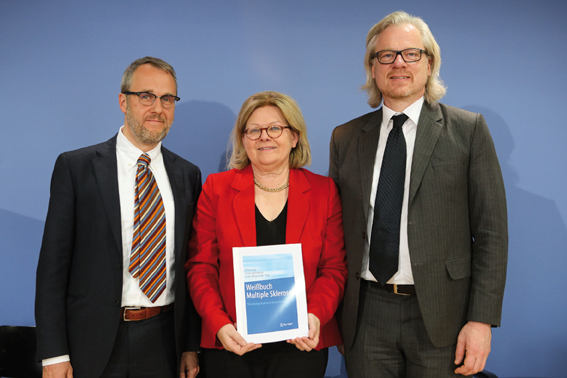
The white paper “Multiple Sclerosis – Care Situation in Germany” is published by IGES experts and contains contributions from renowned MS experts. It was published by Springer-Verlag Berlin Heidelberg and will be available from the beginning of May 2016. The book was created with financial support from Novartis Pharma GmbH.
literature
(1) DGN (Ed.) (2014): Guidelines for diagnostics and therapy in neurology. Diagnosis and treatment of multiple sclerosis. Development level: S2e. Status: January 2012, supplement August 2014.
(2) Stangel M, Penner IK, Kallmann BA, Lukas C & Kieseier BC (2015): Towards the implementation of 'no evidence of disease activity' in multiple sclerosis treatment: the multiple sclerosis decision model. Ther Adv Neurol Disord 8(1), 3-13.
(3) Höer A, Schiffhorst G, Zimmermann A, Fischaleck J, Gehrmann L, Ahrens H, Carl G, Sigel KO, Osowski U, Klein M & Bless HH (2014): Multiple sclerosis in Germany: data analysis of administrative prevalence and healthcare delivery in the statutory health system. BMC health services research 14, 381.
(4) IGES Institute (2014): Neurological and psychiatric care from a cross-sector perspective. Study commissioned by the Professional Association of German Neurologists eV (BVDN), Professional Association of German Neurologists eV (BDN), Professional Association of German Psychiatrists eV (BVDP), National Association of Statutory Health Insurance Physicians (KBV) / Central Institute for Statutory Health Care in Germany (ZI), German Society for Neurology eV (DGN). Results report.
(5) Hansen K, Schussel K, Kieble M, Werning J, Schulz M, Friis R, Pohlau D, Schmitz N & Kugler J (2015): Adherence to Disease Modifying Drugs among Patients with Multiple Sclerosis in Germany: A Retrospective Cohort Study. PLoS One 10(7).
(6) Bischoff C, Schreiber H & Bergmann A (2012): Background information on multiple sclerosis patients stopping ongoing immunomodulatory therapy: a multicenter study in a community-based environment. Journal of Neurology & Neurophysiology 259(11).
(7) Flachenecker P, Stuke K, Elias W, Freidel M, Haas J, Pitschnau-Michel D, Schimrigk S, Zettl UK & Rieckmann P (2008): Multiple sclerosis registry in Germany: results of the extension phase 2005/2006. Deutsches Ärzteblatt 105(7), 113-119.
(8) Society for Neuropsychology (GNP) eV (2015): Certified neuropsychologists of the GNP - list of practitioners. September 22, 2015: 287 entries. 36001 Fulda: Society for Neuropsychology (GNP) eV http://www.gnp.de/_de/fs-Behandlerliste.php [accessed on: September 22, 2015].
(9) Goecker D, Rösing D & Beier KM (2006): The influence of neurological diseases on relationships and sexuality: With special consideration of multiple sclerosis and Parkinson's disease. The Urologist 45(8), 992-998.
(10) Kobelt G, Berg J, Lindgren P, Elias WG, Flachenecker P, Freidel M, Konig N, Limmroth V & Straube E (2006): Costs and quality of life of multiple sclerosis in Germany. The European journal of health economics 7 Suppl 2, S34-44.
(11) Karampampa K, Gustavsson A, Miltenburger C & Eckert B (2012): Treatment experience, burden and unmet needs (TRIBUNE) in MS study: results from five European countries. Multiple sclerosis 18(2 Suppl), 7-15.