


Heart disease: Survival is a question of gender and where you live
02.02.2016 10:45
The German Heart Report 2015, presented on November 27th in Berlin, reveals that men are far more likely to suffer from the most common heart diseases than women, although overall mortality in this regard is significantly higher. In addition, the risk of dying from heart disease is geographically very unevenly distributed in Germany.
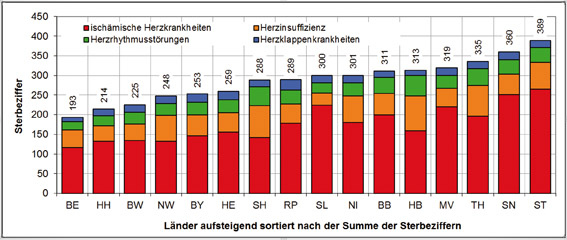
This shows that the eastern federal states recorded the highest death rates in 2013. Led by Saxony-Anhalt, where 389 out of 100,000 residents died in the year mentioned from one of the most common heart diseases (ischemic heart disease, i.e. heart disease caused by reduced blood flow, heart valve disease, cardiac arrhythmias and heart failure), to Baden-Würrtemberg with 225, to Berlin, which died on lower end of the scale has a death rate of 193.
The regional distribution of heart attack mortality (acute myocardial infarction) is similarly heterogeneous. In Saxony-Anhalt the death rate was 99, in Brandenburg 98, in Bremen 94 and in Saxony 93. The lowest death rates were recorded here in Schleswig-Holstein with 43, Berlin and Hamburg with 48.
“The differences in death rates between the federal states are due to various factors, for example the age structure, the socio-economic status of the population, the respective health awareness, the density of doctors or the regional diagnostic and therapeutic offering,” explains the President of the German Society for Cardiology – Heart and Circulation Research eV (DGK) Prof. Dr. Karl-Heinz Kuck. “From a health and health policy perspective, the aim must be to consistently bring the situation in countries with high death rates closer to that of the best-performing countries through appropriate measures.”
Men get sick more often and women die more often
But there are also major gender differences: of the cardiological diagnoses recorded in the current German Heart Report in 2013, 57.8 percent affected men and 42.2 percent women. Overall, the mortality rate for women is significantly higher than for men in the sum of all selected diagnoses. Of the patients who died from one of the most common heart diseases presented in the report, 45.9 percent are men and 54.1 percent are women. For example, the death rate for women from cardiac arrhythmias exceeds that of men by 47 percent. The difference in the death rate for heart failure is also “unexpectedly large and not easily explainable,” says Prof. Kuck, since the rate for women is 81.6 percent higher than that for men.
“The increase in mortality varies with age for different diagnoses,” says Prof. Kuck. In men, mortality from coronary heart disease increases from the age of 65 to 70, while mortality from other diagnoses only increases from the age of 75 to 80. What is striking in men is the significant increase in mortality from heart failure from the age of 80 to 85. “In women, mortality from coronary heart disease only increases exponentially from the age of 75 to 80; the same applies to mortality from heart failure from the age of 80 to 85,” said the DGK President. A key factor in the increase in mortality is the improved life expectancy of patients, which is not taken into account when calculating the morbidity and mortality data.