


Good, but needs improvement: Germans know this much about health
21.10.2015 12:32
Increased health knowledge has a positive effect on quality of life, according to a theory that emerges from the Pfizer Health Monitor – Chronic Illnesses. The representative study, which was carried out from November 2014 to September 2015 by Pfizer in cooperation with the Institute for Medical Sociology and Rehabilitation Science at the Charité - Universitätsmedizin Berlin, reveals: More than half of Germans have moderate health knowledge, but a quarter still have it clear gaps in knowledge. Further results were published on October 20th. presented in Berlin.
Knowledge, especially about chronic illnesses, is an important tool for sustainable health management. In order to find out how good Germans' health knowledge is, Pfizer and the Charité surveyed the German population: The aim of the study was to obtain representative data from both healthy and affected people across Germany, to uncover gaps in knowledge and to provide an information basis for experts , politics and the public.
“The results confirm our expectation that more needs to be done to educate the population about health,” said Prof. Dr. Adelheid Kuhlmey, Director of the Institute for Medical Sociology and Rehabilitation Science at the Charité – Universitätsmedizin Berlin. “Only if people are well informed can they speak clearly to their doctor about their complaints and needs when they become ill.” A statement that Pfizer also supports. “It is the job of everyone involved to impart relevant knowledge about diseases and risk factors,” says Dr. Andreas Ludäscher, Managing Director of Pfizer Pharma GmbH. “This is the only way to further improve the level of knowledge, health literacy and thus the self-responsible actions of the population, especially those with chronic illnesses.”
This is shown by the federal state comparison
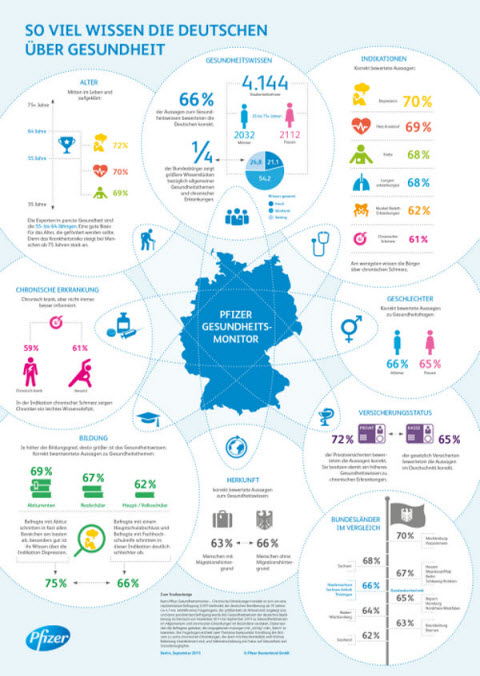
The Pfizer Health Monitor – Chronic Illnesses shows: The residents of the new federal states are knowledgeable about health issues. The people in Mecklenburg-Western Pomerania are Germany's health specialists. With 70 percent, they rank first in a federal state comparison and are therefore the best informed about health issues. The Saxons (68 percent kb A. = correctly answered statements), Thuringians (66 percent kb A.) and Saxony-Anhaltians (66 percent kb A.) also have a good one
Health knowledge. They are in the middle range with West German states such as Hesse, Rhineland-Palatinate and Berlin (67 percent kb A. each). The people of Brandenburg and Bremen (63 percent kb A. each) as well as the Saarlanders (62 percent kb A.) have rather low health knowledge.
Old versus young
A comparison of age groups shows that younger people tend to know better about health issues. The 55 to 64 year olds performed better in the survey on general health topics and chronic illnesses. With 66 percent kb A., they are the most knowledgeable about health topics, especially in the area of depression. The 35 to 44 year old age group shows the highest level of knowledge about cardiovascular diseases (71 percent kb A.). “The results of the younger ones
We find age groups pleasing,” says Prof. Dr. Adelheid Kuhlmey. “Now it is important to consolidate and further promote the knowledge of the age groups so that in the future older generations will have a higher level of knowledge in the health sector.”
More results in detail
If you look at the survey results for the genders, there are hardly any differences: men are slightly more knowledgeable about cancer (68 percent not specified) and lung diseases (69 percent not specified). Women, on the other hand, are slightly more knowledgeable about cardiovascular diseases and musculoskeletal diseases. There is a level of knowledge in the indications of depression and chronic pain.
A comparison of chronically ill and healthy people shows that both groups have the same level of knowledge when it comes to health (66 percent kb A. each). The situation is different for people with or without a migrant background: people without a migrant background show a higher level of knowledge in all of the therapeutic areas surveyed - the biggest difference occurs in the indication depression (71 vs. 67 percent kb A.). There were also results for those with private and statutory insurance
Differences: Privately insured people answered more questions correctly across all therapeutic areas.