


Migraine medications: New antibodies are being prescribed more and more frequently - but not always in a targeted manner
19.08.2020 12:59
More and more migraine patients are being prescribed new drugs to prevent migraines, so-called CGRP antibodies. This is a result of the headache report from the Techniker Krankenkasse (TK). The evaluations also make it clear: the medications are not only used on the patients for whom they are intended.
The prescriptions have continued to rise sharply after the first CGRP antibodies were approved on the market at the end of 2018. In January 2019, people with statutory health insurance were prescribed around 200,000 daily doses; in October there were more than twice as many, just over 500,000 daily doses. The numbers roughly correspond to a prescription of 7,500 syringes at the beginning of 2019 and almost 13,000 in October 2019. The CGRP antibodies are used significantly more often in women than in men: 90 percent of the insured people with a prescription were female. The monthly costs have risen steadily and in October 2019, extrapolated to the entire statutory health insurance, were around 9.4 million euros.
Use CGRP antibodies more specifically
In the early benefit assessment of the drugs, the Federal Joint Committee only saw an additional benefit of CGRP antibodies if none of the six available previous therapies were effective. “However, we see in our data that these new drugs are not always used in a targeted manner and that patients have received significantly less prior therapy. We see a need for action and education here,” says Dr. Jens Baas, Chairman of the Board of TK. According to the evaluation, almost 52 percent of the insured people who were prescribed CGRP antibodies had received no prior therapy at all, and a further 25 percent had only received one.*
Prof. Dr. Hartmut Göbel, specialist in neurology and special pain therapy, treats migraine patients every day: “The CGRP antibodies are intended for patients with at least four migraine days per month who do not respond to previously approved medications for prophylaxis, cannot tolerate them or cannot take them due to other illnesses. These requirements must be clarified before the prescription is issued, since on average immunotherapy is no more effective than previous therapeutic methods. According to my clinical experience and scientific studies, under these conditions they work in about a third of this patient group." The expert also makes it clear that using the new preparations does not completely eliminate migraines: "The treatments help to reduce some of the attacks . It is also essential for those affected to adapt their behavior and lifestyle to the genetically anchored basis of migraine.”
Women are three times more likely to suffer from migraines
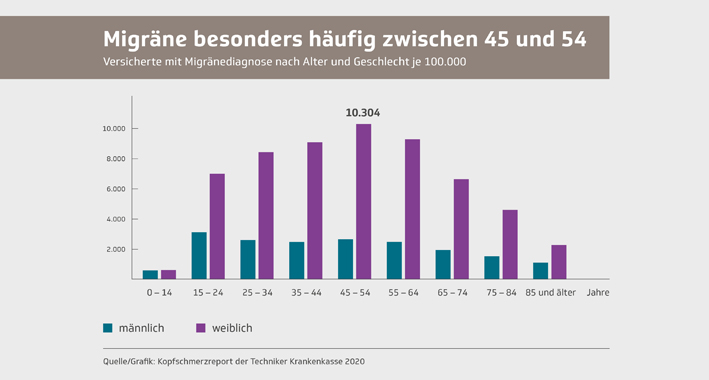
According to the TK evaluation, a total of seven percent of women and 2.2 percent of men suffer from migraines. The frequency is below the numbers found in population-representative surveys, for example, because the insured data only shows medically documented diagnoses and therefore usually particularly serious cases. In terms of age, most migraine diagnoses occur in the 45 to 54 year old group. A total of 6.6 percent of insured people are affected here, around 10 percent of women and 2.7 percent of men.