


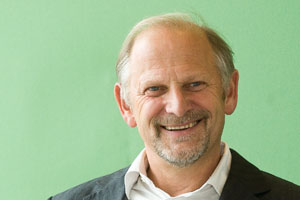
High award for Freiburg immunobiologist
16.11.2012 18:01
Michael Reth receives an Advanced Grant worth 2.24 million euros from the European Research Council.
Professor Dr. Michael Reth, Chair of Molecular Immunology at the Institute of Biology III, spokesperson for the BIOSS Centre for Biological Signalling Studies Cluster of Excellence, and group leader at the Max Planck Institute of Immunobiology and Epigenetics in Freiburg, has been awarded an Advanced Grant from the European Research Council (ERC) for his research. The grant provides €2.24 million in funding for the next five years. The researcher from the University of Freiburg intends to use this time to embark on what he calls a "journey of discovery into the nanoscale of biological membranes." The results are expected to yield new insights for basic research and enrich medical diagnostics and practice.
The funded project „Nanoscale analysis of protein islands on lymphocytes” builds on Reth’s previous research findings: He investigates the structures and functions of receptors on immune cells. Receptors are proteins or protein complexes that can bind signaling molecules and thereby trigger signaling processes in cells. With his research group, Reth has already succeeded in developing a new model for the activation of the B-cell antigen receptor and confirming it using novel methods. His investigations have also shown that receptors in the nanoscale range of membranes are more complexly organized than previously assumed.
Due to the physical resolution limit of visible light, which is 250 nanometers (nm), the structures of receptors on living cells cannot be directly observed. However, most signaling processes in cells based on receptor rearrangements occur in regions below 150 nm. Reth's research group developed methods that, for the first time, allow the investigation of receptor organization on membranes in the range between 10 and 100 nm. "In our investigations of the nanoscale of biological membranes, we feel like marine researchers who are, for the first time, able to penetrate the deepest regions of the ocean and discover new worlds there," explains the immunobiologist. The project could provide significant new insights into the organization of biological membranes in the coming years. True to the BIOSS motto of "understanding and controlling signals," this could lead to new therapeutic options for misguided signaling processes.
Reth was brought to Freiburg in 1989 by Nobel laureate Prof. Dr. Georges Köhler. He received the Leibniz Prize in 1995 and the Schering-Plough Prize for Immunology in 2009.