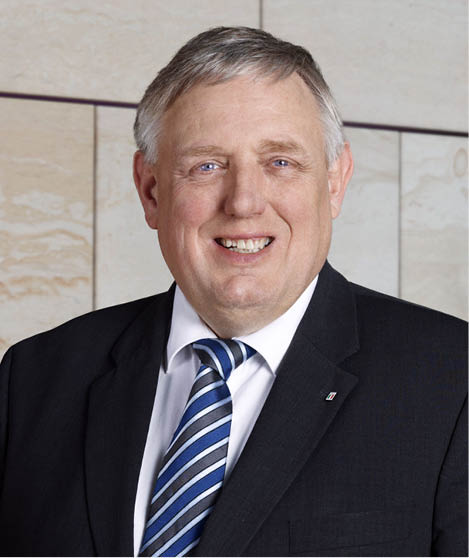
Since 2014, Karl-Josef Laumann has served as the Federal Government's Commissioner for Patient Affairs and Commissioner for Nursing Care. In this role, he speaks his mind forcefully and emphatically, denouncing the shortcomings in the system and fighting for solutions. He did this, of course, as Minister for Labor, Social Affairs, and Health of the state of North Rhine-Westphalia, but now even more so as Commissioner for Patient Affairs. His focus is primarily on the design and implementation of the Patient Rights Act and, above all, the new, multi-tiered Nursing Care Act. The issue of quality in healthcare and nursing care is particularly close to his heart.
Mr. Laumann, the office of the Patients' Representative has existed since January 2004, and the office of the Nursing Care Commissioner since January 2014. Here, in the patient's best interest, what belongs together is brought together: healthcare under Book V of the German Social Code (SGB V) and nursing care under Book XI of the German Social Code (SGB XI). However, reality is still far from this cross-sectoral approach. Do you see the political will and the means to implement it to integrate patient care and nursing – ideally from cradle to grave, through prevention?
Strengthening patients in our healthcare system and strengthening nursing care: these are two sides of the same coin. Good medical care is inconceivable without good nursing care. For example, without comprehensive primary care coverage, we could not organize dignified nursing care. That's another reason why we finally need to take action against the looming shortage of general practitioners. Or imagine yourself in the situation of a person with dementia who is just waking up after surgery under general anesthesia. In addition to medical care, we naturally need a completely different kind of nursing care here than for people who don't have any form of dementia. And that's why we also want to strengthen nursing care in hospitals. Yes, we are pursuing a holistic healthcare policy where everything works together seamlessly.“
You yourself have been in office for a year. What are your personal experiences? What have you been able to achieve so far? Where have you already experienced disappointments?
Caregiving must finally receive the recognition it deserves in both politics and society. We must create the right structures for people over 80, just as we have done for childcare for children under three. Imagine, for example, that you are receiving outpatient care at home: a care service comes to help you at 8 a.m. and 6 p.m. But what do you do in between? Everyone can imagine how long a day without proper activities can be. Against this backdrop, I am very pleased that with the First Care Strengthening Act, we have effectively doubled the funding for day care.
I am also very committed to making the nursing profession significantly more attractive. We are currently taking an important step in this direction by reducing the bureaucracy involved in nursing documentation. Furthermore, I am pleased that the legislature has once again clarified that paying according to collective bargaining agreements is not uneconomical in the nursing sector. This prevents payers from shirking their responsibility and insisting on low wages. Our nursing staff must finally be paid fairly across the board. And for me, fair pay means paying according to collective bargaining agreements. So, some progress has already been made, although this is certainly no reason for me to rest on my laurels. Fortunately, I have not yet experienced any disappointments.
How has patient participation been strengthened through the office of the Patients' Ombudsman over the past ten years? At what points has the Patients' Ombudsman been able to intervene in the healthcare system and improve it?
Patients' rights and position have improved significantly in recent years. The Patient Rights Act, which came into force in 2013, represents a particularly important step forward. Since then, it has been clearly stipulated by law that, as part of the treatment contract, doctors are obligated to provide patients with clear and comprehensive information about the benefits and risks of a treatment. Furthermore, as a patient, you now have the right, in principle, to access your complete medical records at any time. Health insurance companies, in turn, must adhere to clear deadlines when deciding on the approval of a service.
What is your current focus?
I am currently working, for example, to put a stop to unacceptable excesses in sickness benefit case management. It cannot be that health insurance companies pressure policyholders to declare themselves fit for work as quickly as possible through regular phone calls or highly personal questions. The planned Healthcare Strengthening Act aims to clarify that counseling is voluntary for policyholders. This means that sickness benefit payments cannot simply be stopped if counseling is refused. Furthermore, policyholders must be fully informed beforehand and must, in principle, give their written consent to the collection, storage, and use of their data.
Patient participation often ends at the level of self-governance. While patients are now heard, they have no say in the final decisions. Even in the new quality institute, patient representatives have no independent voice. Why, unlike in some other countries, does patient representation in Germany not have more weight within self-governance?
Our healthcare system has absolutely nothing to fear from empowered patients. Quite the contrary: the voices of patients and their representatives must be taken seriously. And they will only be taken seriously if discussions take place on equal footing, not just as an afterthought. Unfortunately, our self-governing bodies are sometimes rather cumbersome. This needs to change, especially regarding patient participation. We have had very positive experiences with this in the Federal Joint Committee. That's why I believe that granting patients the right to participate in procedural matters is the next logical and sensible step we should take.
Where can we begin to strengthen and make patient participation more effective across the entire system? Firstly, on an individual level, by involving the patient in their care (strengthening compliance and adherence), and secondly, by involving the patient in the healthcare system as a whole. Is there a significant gap between intention and reality?
No. A great deal has already happened here, if you look at the developments. Patients have a completely different position in our healthcare system these days. They've also become much more assertive. You can see that just by looking at the fact that the Medical Service of the Statutory Health Insurance Funds (MDK) investigated around 14,600 suspected cases of medical malpractice in 2013. A year earlier, the number was around 12,500. This isn't because we've suddenly seen a large increase in medical malpractice. In fact, the number of medical malpractice cases confirmed by the MDK has actually decreased. No, in my opinion, the increasing number of MDK assessments also shows that citizens are exercising their rights more frequently today than before. That's a good thing. And we should continue to strengthen the position of patients. I've already mentioned sickness benefit case management and the right to co-determination in procedural matters within the Federal Joint Committee (G-BA).
Federal Health Minister Gröhe is focusing on quality assurance and quality-oriented management of the healthcare system. He wants to move away from retrospective quality measurement towards quality-oriented needs planning and quality-based remuneration. How do you think this will work?
Naturally, high-quality medical care must be at the heart of health policy. We will create the right structures and incentives to achieve this. In the Hospital Financing Act, we intend to enshrine quality as a binding additional criterion for hospital planning decisions. The Quality Institute, as an independent body, will ensure greater transparency by publishing the collected and analyzed data in an easily understandable format. And hospitals must also be financially rewarded for providing high-quality care. There will be bonuses for good performance and deductions for poor performance.
And what about nursing care? The current nursing care indicators, where every "nursing home" receives an average score of 1.2, don't make much sense. You see a need for reform, especially regarding quality assurance in nursing care, as you've mentioned. You're calling for an independent panel of experts for a "nursing care inspection." What is the Medical Service of the Statutory Health Insurance Funds (MDK)/Medical Service of the Statutory Health Insurance Funds (MDS) doing wrong? Do the current quality assessments not differentiate enough between nursing facilities? Are they not transparent enough for those receiving care and their families?
The problem here isn't the Medical Service of the Health Insurance Funds (MDK). The quality inspections in nursing homes are correct and absolutely necessary. And in my experience, the MDK inspections themselves are also good. The problem lies rather in the translation of the inspection reports into the care grades. This has failed. The average grade for all approximately 12,500 inpatient care facilities is currently 1.3. This is meaningless to the public. On the contrary, it misleads them. Therefore, I demand a suspension of the care grades. Instead, we finally need measurable and scientifically sound criteria by which the quality of care can be determined and compared. The Second Nursing Care Strengthening Act must establish an independent panel of experts comprised of scientists who will define binding rules for how the results of the MDK inspections can be published in the future in an accurate and easily understandable manner.
This is a fundamental question for the healthcare system as a whole: Various guidelines list nearly 2,000 different quality indicators, but very few of them are evidence-based. The set of quality indicators developed for inpatient care in recent years is also poorly suited for quality-oriented management. What data do we need instead? What data is missing? Are we perhaps expending considerable effort to collect the wrong quality data? Shouldn't a professional consensus be reached on this?
The German healthcare system, and nursing care in particular, struggles with transparency and quality indicators. Sometimes I get the impression that nobody really wants it. We evaluate and document a great deal, but this rarely creates comparability and transparency. The nursing care grades are a prime example. That's why I, along with a number of experts, want to put forward a new proposal.
The major challenge of cross-sectoral and perhaps even cross-Social Code (SGB) quality assurance remains largely untouched. This is a huge undertaking for the G-BA (Federal Joint Committee). From your perspective: How can the G-BA make progress on this?
With the Innovation Fund. This fund explicitly aims to promote cross-sectoral collaboration in the healthcare system. To this end, a dedicated Innovation Committee will be established within the Federal Joint Committee (G-BA). I strongly support the use of this fund to better integrate hospitals and outpatient care on the one hand, and nursing care on the other. This will, of course, also serve quality assurance. That's why we now want to finally take the right path in geriatric and general nursing with the introduction of generalist training.
Do you see great opportunities in Big Data? Will the many health apps and the data collection that many citizens and patients are conducting themselves gradually increase the empowerment of the insured and patients? Or do you see more risks here?
If modern digital technologies help people lead a healthy lifestyle and ensure they receive the right medical care, that's a good thing. In this context, I consider it a disaster that after so many years, the electronic health card still only contains a photograph. We clearly need a faster pace, clear implementation deadlines, and binding financing agreements.
But data collection also needs clear limits: If, for example, a health insurance app regularly and almost automatically transmits lifestyle data, the question of personal rights and privacy arises for me. I don't want people to be marginalized and discredited because of their lifestyle. Constant surveillance of citizens, possibly even combined with a system of rewards and punishments, is something I simply cannot imagine as humane.“
The concept of pay for performance (P4P), which originated in the USA, has been thoroughly examined for the German healthcare system. The conclusion was essentially that while the idea is good, it doesn't fit into the German system. What makes quality-based remuneration different?
At first glance, P4P sounds like a good-sounding buzzword. If implemented correctly, it will certainly lead to a number of positive effects. But as a patient advocate, I also have to pay attention to the side effects: Will it lead to misallocations of resources due to misguided incentives? Will it negatively impact the motivation and patient-centeredness of physicians? Will we potentially face further bureaucratic burdens? Will patients be treated unequally, and will so-called vulnerable groups be disadvantaged because treating these groups can inherently pose higher risks for me as a physician? So far, there are no entirely convincing answers to these questions.
As the Commissioner for Long-Term Care, you are advancing the 5th Amendment to Book XI of the German Social Code (Long-Term Care Strengthening Act I). What are the key points? What progress is the Long-Term Care Strengthening Act intended to bring?
The law will initially bring more money into the system. Almost all long-term care insurance benefits will be increased by four percent. But we all know, of course, that money alone doesn't provide care. That's why it's particularly important to me that we've created clear simplifications and greater flexibility in accessing benefits. This takes into account people's individual circumstances. For example, starting January 1st, short-term and respite care can be accessed much more flexibly. In addition, benefits for day care will effectively double. And additional care staff will be provided for residential care facilities.“
The new care levels and the new definition of care have been discussed at length, and are now to be introduced gradually by 2017. What caused the delay? What improvements will this bring?
We mustn't forget that the introduction of the new definition of care dependency is arguably the most significant reform of long-term care insurance since its introduction 20 years ago. I understand that some people are eager for it to happen quickly. But such a fundamental reform can't be rushed through overnight. However, I can assure you: we will implement it during this legislative period. With the new definition, we will create a completely new and fairer system in which the level of care dependency is no longer determined solely based on physical factors. In the future, mental and communicative criteria will also play a crucial role. This will particularly benefit people with dementia, who were previously inadequately assessed under the old definition.
More money in the care system and new care levels will be useless if the aging of German society is not countered by skilled immigration. But this raises ethical questions: What happens in the countries of origin, which often struggle with similar problems to Germany?
That's an important point. For example, anyone who wants to work as a caregiver here with us is very welcome, provided they are paid fairly, have social, health, accident, and liability insurance, and, of course, are well accommodated. This is not only an asset to our care sector.
But the problem of the skilled worker shortage cannot simply be solved through immigration. We have to do our own homework. We need to make the nursing profession so attractive that as many people as possible want to learn and practice it here in Germany. And indeed, we should always bear in mind that the people who come to us may also be needed in their home countries.
Mr. Laumann, thank you very much for the interview.
The interview was conducted by MVF publisher Prof. Dr. Reinhold Roski and MVF editor-in-chief Peter Stegmaier.