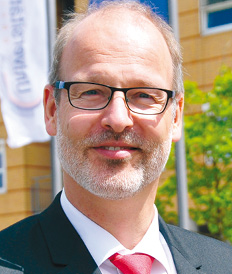
>> Prof. Hoffmann, what can you imagine an abstracts congress to be?
This format has proven successful at other scientific congresses because it motivates the participating scientists to specifically formulate their own contribution and make it available for review. But that's not the only change impacting Congress overall. For the first time, we have also changed the submission system. In all previous health services research conferences, entire sessions had to be submitted; this year, individual presentations could also be submitted. This has the positive effect that you no longer have to fill a session with four or five presentations, which were sometimes only included because the entire session could only be accepted or rejected. Everything didn't always fit together so well thematically. As before, the program committee paid close attention to the fact that, in addition to the criterion of scientific quality, the relevance to care was also a decisive factor in the acceptance of lectures. At this point we remain entirely in the tradition of health services research congresses.
Critics will no doubt say that this approach dilutes pure research.
But we reply to them that we don't want to do "pure" science - if possible still in an ivory tower - because supply
Research must be one thing above all: relevant to practice! We have a very strong consensus for this priority in the German Health Services Research Network; a consensus that corresponds to reality: Health care research always requires a very close connection to the actors in care, many of whom are not scientists - but who nevertheless work intensively with us, the science community. Because together we want to increase the quality of care.
After many years of methodological work that is certainly necessary, is this also a bit of a real orientation?
Naturally. The goal of health services research is not to serve academic circles, but ultimately to improve care for our patients. We are all committed to this science in order to further develop the healthcare system into a learning system. But that is exactly what requires close contact with practitioners, whether in politics, the health insurance companies, the self-government bodies, the associations and of course also in the pharmaceutical industry and medical technology.
Can one say that health services research has arrived in translation?
We've always been translation enthusiasts. But one thing is true: the number of positive examples is increasing!
Nevertheless: So far, it has come across a bit too little.
We are of course happy to accept critical comments - especially from people who know the scene well. But in general, the health system itself – let's put it cautiously – wasn't exactly waiting to be changed. This is because it is fundamentally an inherently conservative system that is skeptical of change. But that changes over time if you manage to identify the things that need to be changed more precisely and justify alternatives well. As a supply researcher, you have to have patience. Much patience.
20 years or so...
The German health system, with its self-administration, has certainly never been quick. Which not only has disadvantages, but also some advantages. Because science as such is of course always impatient. This is also important because this is the only way things can change. On the other hand, the system must not follow every trend and implement it - even nationwide - before there is reliable evidence.
This brings up an important point: nationwide implementation equals nationwide pilot tests instead of sensibly conducting policy impact research first.
Of course, health care researchers would always like to do the latter, but this often reaches the limits of what is politically feasible and feasible. It is therefore advisable to show, if possible, in the reality of care or at least realistically, which success and failure factors exist and which steps are necessary for sustainable success. Only when you have analyzed all of this in sufficient detail can you assess whether it even makes sense to scale up a smaller project. This can also be done in several detailed steps - for example from a city to a larger area, from a selective to a larger IV contract or to a regional model project - before you ultimately have to go to standard care. Translation is the declared goal of the Innovation Fund, which stipulates that well-evaluated projects should be included in standard care.
The big question is how.
What this process should look like is not yet entirely clear. By the way, it is also not clear what exactly is meant by standard care and who decides what is already “standard” and what is not – does standard care mean that all patients are entitled to it? This is not the case with selective contracts, for example.
Is the German Network for Health Services Research involved in this?
We do that very intensively. We are working on defining the criteria for a “positive evaluation”. But also how the transition from positively evaluated projects envisaged by the Innovation Fund should be operationalized. I am optimistic that we can do this together with politicians and self-administration - because there is a great willingness there at the moment - and also that the speed of development in the German supply system will continue to increase. By the way, you can also see this a little at the German Doctors' Day in Freiburg, which this year, for the first time in its history, a large majority spoke out in favor of digitalization in the healthcare system.
KBV boss Gassen! You think you're dreaming!
These are very positive developments in self-administration, which is no longer just politically obstinate. If one of the benches in the Federal Joint Committee notices that the tide has changed, it can suddenly become very flexible. This was seen in the delegation of medical activities to other health professions, but also in many structural laws in recent years, where the usual resistance from self-government was really only restrained - sometimes there was even a very broad consensus early on. Which may also be due to the good sense and dynamism of our current health minister - but also to the self-government bodies' increasingly sensitive perception of the spirit of the times - there are certainly many thoughtful colleagues there. The system is conservative at its core, but many today no longer want to be the “forever”, which is particularly evident in the greater openness towards digitalization. Or as blogger Sascha Lobo, who was invited to the German Medical Day 2017, put it: “Digitalization cannot be hoped for.” In other words, it is coming anyway, whether you take part or not. This is exactly what the medical profession has now finally understood: if they continue to refuse, digitalization will take place without them.
Now we still need the pharmacists.
We'll get them on board too. The pharmacist profession as such has traditionally not necessarily been distinguished by revolutionary ideas or even attempts to overthrow the health system. To be fair, however, it must also be said that pharmacists have been hard hit in recent years - privileges have been lost and the health structure laws of the past have meant that pharmacists have lost a lot of earning potential. This is one reason why they are currently so vehemently opposed to mail-order pharmacies - but there are also good arguments for the off-office pharmacy from a supply perspective.
Instead of the pharmacists clearly justifying their place in the supply system.
But this is not only due to the pharmacists, but also to the system and often also to doctors, who still have a certain skepticism and reluctance towards pharmacists as partners in the healthcare system. Pharmacists are very important players in supply, because if you look at where the big problems are in the healthcare system - under-supply, over-supply and incorrect supply - you quickly get to the medication. And the pharmacists understand the most about them.
If you take multimedication alone, who else wants to be able to assess the consequences?
Science assumes that preventable hospital admissions due to drug-related problems alone are in the seven-figure range. That's why a natural cooperation between doctors and pharmacists would make perfect sense, which, by the way, often takes place locally: most family doctors talk to “their” pharmacist at least once a day on the phone about very specific problems.
Apparently, this hasn't really caught on with the established pharmacists and doctors.
This is also a problem for self-administration - cooperation works in many places at the prescribing and care level, that's what matters and what counts for the individual patient. Which brings us back to the reality of healthcare – this is exactly where the domain of healthcare research lies, and where it is indispensable.
Is this reflected in the Health Services Research Congress 2017?
It does and it has to, absolutely. This is exactly why we actively involve all system partners in the congress. Even if you have to run after some people to motivate them. But we're happy to do that because we believe that the German Congress for Health Services Research is a forum where all relevant actors can exchange ideas - and this must be expanded further every year. Of course, this has always included doctors, psychotherapists and pharmacists, but also nursing, physiotherapy, occupational and logotherapy, midwives and many other professional groups. All of these professional groups are represented in the German Health Services Research Network.
A truly multi-professional approach that will be reflected in the congress.
This is the only way care works, as Health Minister Gröhe recently said: “a team game”. Of course, you shouldn't forget the patients, which is why patient representatives will also speak in some sessions.
Is there some grounding there?
As researchers, we must not distance ourselves from those involved in care, and certainly not distance ourselves from the patients for whose good care the health system is responsible. The megatrend in care – patient-centeredness – also means that the effectiveness of therapeutic measures in the future will be measured using criteria that are much closer to the patient than most of the previously existing success parameters. Although this fundamental insight is now mainstream, it has not yet been actually implemented anywhere. As healthcare researchers, we are of course in demand here, because who else is supposed to explain how to measure success and quality?
Especially when quality becomes increasingly important for allocation decisions...
... then you first have to define what exactly is meant by quality. Achieving what the patient and the doctor have mutually agreed upon as the therapy goal - for me, that is the quality that is important. Unfortunately, the whole thing is very complex, but it is an achievable goal today with the new possibilities that we have at our disposal, particularly through digitalization, but also through better networking between the medical professional groups.
If you look at the well-known throughput model, isn't the patient value missing at the back?
The model is a diagram that illustrates the sequence of care processes. But of course we have to work on all of these points, although today's throughput is no longer the throughput it was when the scheme was first invented. There are now all sorts of interaction loops between patients and their practitioners, and between the different practitioners in a region, because everyone is involved in the care. In the current new edition of the textbook on health services research, the traditional input-throughput-output scheme is expanded and discussed in great detail in its double complexity - worth reading!
And the doctors have now learned that they have to allow something like delegation.
The doctors in the regions love the delegation. There are now many evaluations from various federal states that show enthusiastic approval rates. If you remember what it was like eight or nine years ago... back then we had developed the first of these models, AGnES, the community-based systemic intervention that relieves the burden on doctors, and tested it in large implementation studies in several federal states. We were criticized heavily, and not always objectively, sometimes downright insulted and outright suspected of wanting to abolish the medical profession. Which is of course completely crazy, because it's exactly the opposite: the doctor's role is strengthened through delegation because he can make optimal use of his team and gain more time for his actual tasks.
So he can focus on the essentials of his diagnostic and therapeutic work.
Wait and see, that's exactly why, in addition to delegation, we're also getting substitution into the system, which is also a bad fighting word from the past. Substitution means nothing other than a new, rational and evidence-based division of labor in the health system. All those who are supposed to take on care tasks on their own responsibility must be appropriately and sufficiently qualified to do so. We are not yet doing this well enough, as can be seen from the reform of nursing training, which has made great progress but is unfortunately still not consistently standardized.
The problems of generalization and academization.
Both are important steps. Of course there are still unanswered questions. But some people have also exaggerated this hopelessly when, for example, there is talk of an impending total academicization of nursing - as if only nursing doctors and professors were standing at the sick or elderly bedside and changing the bedpans in a special academic way. This is utter nonsense. In fact, around 10 to 20 percent of nurses are supposed to receive academic training. This proportion is urgently needed because many of the highly complex management tasks that these people have to handle can no longer be mastered on the basis of training at a vocational school. These jobs require a high level of problem-solving skills: analysis, planning, strategy, management and interprofessional cooperation. This means professionalization, which you can only learn at a university and ideally at a medical faculty.
Will that also be addressed in Congress?
We will see a large number of very different projects that develop and promote a division of labor between doctors and nursing, and in some cases also other health professions. Many show that a more flexible division of labor is absolutely sensible in the interests of the patient.
So you can say that the Health Services Research Congress 2017 reflects the reality of health care by increasingly bringing science and practice together.
That is the goal! And also by thinking a little outside the box, both internationally and temporally. The DKVF 2017 has definitely decided to take up the tendencies and trends of the time and to influence them a little. He also wants to highlight modules and solutions that will be needed in the next few years. The German Health Services Research Network has been able to do this quite well for a long time, and it is now increasingly being integrated into processes that are important for the future - including through the BMG.
Is the DNVF ready for this?
But definitely! We are always happy to discuss, develop our own ideas, make suggestions, write down papers and also comment on templates. This work helps to avoid some of the backward loops that we have repeatedly gone through in the supply system over the past decades. However, in the sense of a truly long-term strategic plan, we need to know more precisely where we actually want to go.
Are there agreed supply targets?
Only in the beginning. That's why we finally have to convert the health goals that have been developed for a long time into care goals. But we are also actively involved as a network and are currently in very close coordination with the patients, with the other players and with the health insurance companies. Consensus care goals will play a major role because they are particularly crucial in regional care - which the upcoming DKVF will focus on. But this is also logical, because ultimately you can only organize meaningful collaboration in a way that is relevant to the contract and viable in terms of billing if the goals are clearly formulated and supported by everyone involved.
This is a bit like setting up an RCT without first knowing the primary endpoint.
True. However, health services research must also self-critically say that in the past the scientific questions were not always formulated with sufficient precision. This was partly due to the fact that mainly descriptive research was carried out. This is important in order to get closer to the reality of care, but does not automatically lead to new insights if it has not been clearly defined beforehand what exactly you actually wanted to know.
Because you didn't know or couldn't do it any better?
In our science we differentiate between descriptive and analytical research, and we simply haven't done enough analytical research. Instead of testing hypotheses, we mostly just conducted hypothesis-generating research. That's why the DFG rightly asked us years ago to work more theory-based and to conduct more controlled intervention studies.
In other words, determine in advance what the specific research question is, because only this can be clearly answered afterwards.
Exactly. But then it continues: If I don't ask a clear question, I don't get a clear answer, and in many cases you don't really know what to do with a result. This cost money, caused frustration and did not make the best use of time and effort.
That is why the healthcare research scene must focus primarily on researching – and of course on the basis of appropriate questions, study designs, instruments and methods – what is best able to improve the system.
That would be the best. Research becomes more relevant the more you know what exactly you want to address. This was an important motive for switching the congress to abstracts, because this format always contains an answerable question in addition to the methodology to be presented.
But one could also fear that everything will be shortened even more.
No not at all. In an abstract conference, the researcher is asked to think through and structure their own project and to present the whole thing in a simple, concise and condensed form.
So it's a kind of "elevator challenge": A researcher is really good when he can explain what the question is and what the study finds in the duration of an elevator ride.
Agreed. But the skyscraper has to be tall enough for that. For me it's not so much about the time, but rather that it promotes highly structured thinking. Something we haven't had everywhere in health services research so far.
But that was also important.
German health services research has long since grown out of the purely descriptive stage. But this is also necessary, because things don't change with description alone, they only do so with and through analytical research.
Is German health services research that far?
This is shown by the number of abstracts submitted to the congress alone: 426 in total, which is much more than in previous years. You can see that you can certainly motivate our research community if you challenge them a little.
What about the quality of these 426 submissions?
Most are really good. Of course, we also had some that, from the experts' point of view, were - let's say - borderline. The justification of the research question, the choice of study design, methods and instruments used should be described in a comprehensible manner. On the other hand, there is a wide spectrum among healthcare researchers; not all of them come with a clear direction and a well-founded arsenal of methods. That too is reality.
For example?
We had some submissions that were very oriented towards clinical research. There were even animal experiments. Then you start to become a little skeptical as to whether this is really still health care research. Although we are of course pleased that clinical researchers are also turning to health services research, because it cannot be our goal to exclude other areas of research. On the contrary: we want to encourage everyone to discuss and work together with us healthcare researchers.
Wouldn't it make sense to include a quality sublevel?
This will certainly be done in the future. If someone doesn't describe what they did at all, then they got the abstract back earlier and can, if they want, submit it again in an improved form next year. But despite all our scientific demands, we have so far been a bit cautious about rejections.
Which new formats should appeal to younger healthcare researchers? Isn't German health services research actually quite young?
Luckily, it is. Thanks to the various courses on offer, we now have a really solid education for young talent.
Also a sufficient one?
Not yet. There has to be more of this because we are increasingly being given more tasks and funding is increasing. The quality is still far from being at a level where we can rest on our laurels. We have to work hard on this, starting with the theories, the methods, and also with the fieldwork skills and networking.
Doesn't it come on its own?
Certainly, because a generation of researchers is growing up who are already networked and can therefore hopefully carry out even better health services research together later on. It was completely different for us older people: most of us were career changers and therefore had our sometimes hindering background connections and also problems finding our way into the new subject.
What branch of science are you from?
In epidemiology, where I come from, the first attempts at health services research were viewed critically and sometimes even laughed at, especially because initially the quality of studies in health services research was still quite roomy compared to the standards of epidemiology. In the meantime, however, the close connection between epidemiology and health services research has developed in a very collegial manner and the two disciplines have stimulated each other.
Some of the epidemiology has drifted into areas that were super methodical but rather clear in terms of relevance.
There are indeed examples. Health services research never has this exact problem! Everything we examine is relevant and therefore important. Even if the quality of research still needs to improve in many areas.
Now one could say that the researcher-driven approach is important, but where is the conceptual approach?
Both are important, there is no either/or. Although you are right: health services research is still responsible for the conception and agenda setting. We have to do this, but we can do it even better than before. For example, by talking intensively with actors, players and payers as well as politicians at the DKVF. And also with the recipients, i.e. the committed patients. Our job is then always to transform what patients need and want into measurable instruments and equally measurable endpoints.
You shouldn't be content with using purely subjective satisfaction scales.
These are important, but should not be used alone and exclusively. We have to go beyond this status, which is understandable because politicians and health insurance companies rightly ask for objective standards. Here too, we as healthcare researchers have a duty. Our sporting challenger here is often IQWiG. Its head, Prof. Wascher, takes the position that health services research is not relevant for benefit assessment. We see it completely differently. But it is not easy to find convincing evidence here. That's exactly why we must never neglect methodological work - for example with the registers.
What good is that if IQWiG simply doesn't want to allow registers in the benefit assessment?
Professor Wascher won't be able to prevent that. On the other hand, he is of course right when he says that so far some registers do not yet have the necessary quality that is simply needed for a reliable benefit assessment. But above all, this is an incentive for us. We are happy to accept the challenge of creating the necessary quality. And as quality improves, registers will of course also become relevant for use.
Keyword: External relevance, for which registers stand, among other things.
From the perspective of health services research, external evidence is just as important as internal evidence; this has been the position of the network for many years. In order to strengthen this approach, more controlled intervention studies must be carried out in health services research than before, with - of course as far and as well as possible - randomized designs, because this improves the validity of the results. But in view of all the RCTs, one should not forget that there are many other designs, research formats and methods that can also provide relevant information for care. We need to describe this arc of tension in much more detail.
With the innovation fund, health services research can enter the era of intervention studies.
There had already been controlled intervention studies in health services research. Unfortunately, it has to be said that for structural reasons only a few institutes can currently carry out intervention studies. This requires a certain amount of equipment, personnel, resources and a fair amount of expertise, experience and field access. To date, only a few healthcare research institutes in Germany have been able to maintain the size required for this. Large BMBF programs and, since 2015, the Innovation Fund are now supporting their development.
At least with the smaller budget share of 75 million euros per year for health services research.
The part is completely underestimated by many! For me, this part is the crucial part of the innovation fund. In the other, larger and often more public part, there may be major breakthroughs, but also some projects that will fail because they simply do not achieve what they want to achieve. A lot of knowledge is generated with this, and that's why the money is well spent. But in the health care research part, pure knowledge is created!
Will that also be part of the upcoming congress?
Why, surely. We call this a data café, in which innovation fund projects from both funding channels are presented. After all, significantly more than half have agreed, which gives the congress participants a unique overview of the projects that have received positive approval so far. But the same applies here: There are consortia, particularly in the area of new forms of care, that are rather distant from research and that have often not formulated clear research questions and have not clearly defined how they really want to measure their success. But this is also a learning system - and we health care researchers in the German network are ready and happy to be available as dialogue partners.
It's actually surprising how the project was even awarded.
The Innovation Fund is not a classic scientific funding program that per se involves a strictly scientific evaluation, as is done by the German Research Foundation or the BMBF. It is an open secret that the Innovation Committee did not follow the advice of the expert advisory board in all cases, and some funding decisions were more the result of a mixture of political will and demands from the banks. But be that as it may, the goal of health services research must be to ensure that as many of the funded projects as possible are successful. The German Network for Health Care Research would like to actively contribute to realizing as many relevant health care research aspects as possible with the highest possible methodological quality because we believe that this is the only way to guarantee the sustainability of this funding.
Does the Innovation Fund have a future after 2019?
We are doing everything we can to ensure that the innovation fund continues. The German Network for Health Services Research has always said that one per mille of the statutory health insurance budget is
is enough to trigger a huge boost in health services research - and at the same time create planning security, which is crucial for our young scientists, for example. As a DNVF board member and also as Congress President, I say: We will save the amount made available through smarter care! The innovation fund is an investment that will also be really worthwhile from an economic perspective.
Would you want to place a bet on that?
I would do it if the pot were removed from the direct access of the cash registers and the G-BA. Although – to be fair, it has to be admitted – the innovation fund would certainly not have existed without G-BA boss Prof. Hecken! His great commitment was extremely courageous and he really deserves credit. Nevertheless, after waves 2 and 3, more science and more transparency must now be included in the fund.
So that this type of funding can come even closer to the high-quality funding from other areas.
Correct. However, the committees that have made decisions so far are simply not the ones that would allow a formal review process and thus more scientificity.
That brings us back to the topic: A project without a clear question will not succeed.
Due to their design, such projects are limited in their meaningfulness and thus also in their translational effectiveness. Independent experts should be more closely involved in funding decisions with this budget from the statutory health insurance and the resulting pressure to succeed. We must continue to work on this too - the German Network for Health Services Research sees itself as a partner here that offers its help and support at any time. This is also what a congress like the DKVF 2017 is for: to engage in communication and exchange, to strengthen trust and to deepen cooperative relationships.
Prof. Hoffmann, thank you for the interview. <<
The interview was conducted by MVF editor-in-chief Peter Stegmaier.