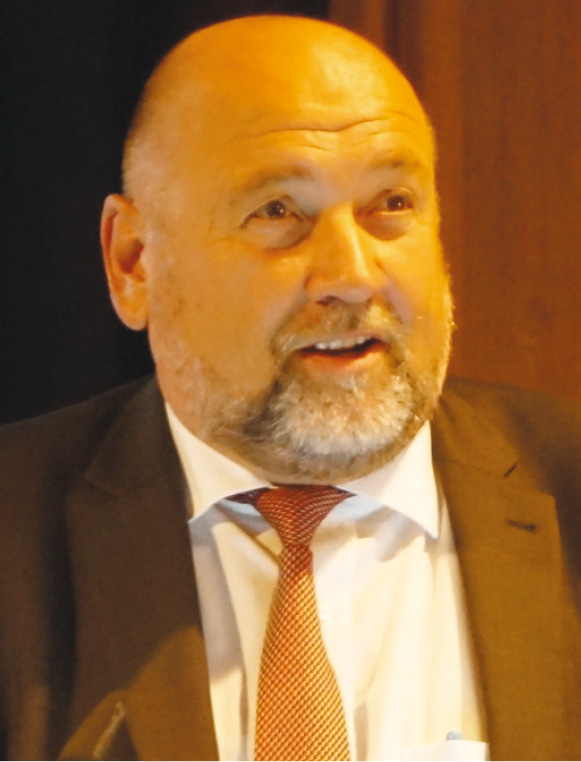
>> The federal state of Mecklenburg-Western Pomerania has assumed the first state partnership for the German Congress for Health Services Research this year…
…which reflects the importance we, as a nation, attach to healthcare research. The congress is an ideal platform for exchange with representatives from health policy, long-term care and health insurance funds, and of course, leading healthcare researchers and all the dedicated young professionals.
One could critically question why a federal state as small in terms of population as Mecklenburg-Vorpommern plays such a prominent role.
I can give three reasons for this. First, we want to raise awareness of our state as a hub for innovative solutions. Second, we hope that supporting the congress will provide concrete insights for improving healthcare in Mecklenburg-Western Pomerania. And third, we want to express our appreciation for healthcare research, which consistently delivers important contributions to practical solutions. This is particularly relevant given our collaboration with the Institute for Community Medicine in Greifswald, whose director – Professor Dr. Wolfgang Hoffmann – was president of this congress, which is why we were happy to assume the role of patron. May this serve as a model for other German states in the coming years.
Incidentally, Hamburg has already announced its intention to sponsor the next congress in 2018. But why does healthcare research play such a prominent role in your state?
Mecklenburg-Western Pomerania is perhaps somewhat more affected by demographic change than other German states. This presents us – and later, of course, all the other German states – with challenges that we don't need to predict, but which are already foreseeable in our healthcare system. The figures clearly demonstrate this: Currently – as of 2015 – the proportion of people over 65 in our total population is around 23 percent. According to forecasts, this will rise to around 32 percent by 2030, in just over a dozen years. In addition, about two-thirds of currently practicing physicians are 52 to 53 years old or older. By 2030, most of the doctors currently practicing in our state will therefore be retired. Since everyone knows how long the demanding training of a physician takes, we want to take countermeasures in good time.
What exactly do you do?
We need to be ready not tomorrow, but right now – today – to forge new paths to optimize medical care in a large, geographically diverse state like Mecklenburg-Western Pomerania. We have already implemented several innovative solutions, such as the AGnES concept – developed in Greifswald and now enshrined in the German Social Code as a fundamental approach, thus becoming standard practice throughout Germany. Other innovative solutions from our state, besides AGnES and the Dementia Care Manager, include telemedicine solutions. These include the "LandRettung" (Rural Rescue) project, funded by the Innovation Fund, which aims to ensure a future-proof emergency medical restructuring of a rural district, and the "HerzEffekt MV" (Heart Effect MV) project, also funded by the Innovation Fund, which aims to guarantee all chronically ill heart patients with mild to severe symptoms access to specialized medical care close to their homes in Mecklenburg-Western Pomerania in the medium term. Another new approach is the "Portal Practice Clinic in Wolgast." A concept has been developed in collaboration with stakeholders in the region that combines the advantages of outpatient emergency care with those of linking to inpatient care. This project aims to overcome the rigid boundaries between outpatient and inpatient care.
And what is the country itself doing?
In the field of telemedicine, we support a wide range of projects – from establishing a testing and advisory center for health apps to the cross-border German-Polish Pomerania network. As the presiding state of the Conference of Health Ministers, we already secured a corresponding resolution from the health ministers in 2016, which provides for strengthening and, in some cases, realigning the public health service – with the stated goal of ensuring sustainable improvements in regional healthcare. If we manage to make progress in most of the aforementioned areas, I am convinced that we will succeed not only in improving healthcare provision itself, but also in increasing the attractiveness of rural areas for both medical and non-medical healthcare professionals.
Which also includes your scholarship program.
Of course. Every federal state must take action to counteract the foreseeable shortage of doctors in rural areas. A scholarship program – initially planned for six years – totaling one million euros is to be launched this year. This program will provide stipends for medical students willing to work in rural areas or in the public health service. The stipend will amount to 300 euros per month and can be granted until the end of medical school, but for a maximum of four years and three months – only after passing the first state examination (Physikum), which is the difference compared to funding programs in other federal states. However, this is state funding that does not need to be repaid.
All of this is of little use if there is no future-proof, long-term concept for cross-sectoral healthcare planning.
Exactly. That's why such a concept is being developed in close collaboration with the Institute for Community Medicine at Greifswald University Hospital. Since this is no easy undertaking, the project is designed to run for five years, aiming to develop solutions for specific healthcare challenges in rural areas and then test them in pilot regions. In the first phase, models will be designed and implemented for specific focus regions. The final step will be to assess the extent to which the solutions can be transferred to other regions. The project also focuses primarily on pediatrics, geriatrics, and palliative care, including the implementation of innovative care concepts. However, overarching themes such as the integration of all sectors and professions, the need for skilled workers, securing skilled personnel, and telemedicine support are also being considered. This makes one thing clear: things are happening in Mecklenburg-Western Pomerania.
What role does healthcare research play in this?
An extremely important one! For us, healthcare research is a key partner in regional health policy.
Isn't this still relatively young life science somewhat overwhelmed by this?
Health services research can identify areas for improvement in healthcare very early on and develop innovative, regional, and patient-centered care models. However, this requires the will, particularly from health insurance companies, doctors, hospitals, and pharmacists – and of course, state policymakers – to test these care models in practice.
Nevertheless, all innovations face a wealth of resistance, primarily of a legal and accounting nature.
It is our task to provide moderating support in this process. This requires mutual understanding among all involved and a level playing field where not only fair cooperation but also objective communication is possible. This works very well in our state because we learned very early on to talk to each other and act together to improve healthcare provision. Therefore, for Mecklenburg-Western Pomerania – always, of course, only after positive evaluation – it is the stated goal to put healthcare models into practice.
A truly noble goal.
The broader the range of partners in the project, the greater the acceptance of the results and, if successful, the permanent transfer into practice – possibly also into standard care.
Does that always work?
This varies from case to case. This is due, in part, to the fact that regional healthcare challenges require proven solutions that, ideally, can also be applied in other regions and thus across regions. Often, however, there is a lack of awareness about which projects have been or are currently successful in different regions. Therefore, I hope that the innovative healthcare approaches presented at the German Congress for Healthcare Research will gain nationwide recognition through specialist media. In this way, the congress can provide important impetus for discussions on ensuring high-quality healthcare in our country over the long term.
Such care must be provided primarily through interprofessional and intrasectional measures.
This requires appropriate innovative models, for which I have one main demand: patient-centeredness! We have an increasing number of patients who suffer not just from one, but from multiple illnesses, and who can only be well cared for if they receive optimal medical care – and this must be done in the long term. This also means that we must not only consider new cross-sectoral care pathways, but also new competencies for healthcare professionals – keywords being substitution and delegation – as well as established and emerging professional groups and their academic training. We are also monitoring this very closely: Preparations are currently underway for the implementation of the Nursing Professions Reform Act. This includes, among other things, the development of a framework curriculum, training and examination regulations, and financial regulations. This will be a major undertaking for the entire Federal Republic.
Are you in favor of academic education?
I believe that the expansion of university-level nursing education, as described for the first time in the law, is the right approach. With the currently evolving range of tasks in nursing, nursing professionals will assume more complex and new care responsibilities in the future. These require university-level education. The goal must be to prepare graduates, in particular, for direct patient care and improved collaboration within a multidisciplinary team. Therefore, in my opinion, future degree program concepts should include a primary qualifying Bachelor's degree and consecutive Master's programs for specialization in a specific field of nursing, or in research, management, or education. Attention must be paid to vertical mobility and the development of recognition procedures for nursing professionals with three years of vocational training but without formal university entrance qualifications.
What is the situation in your state?
In Mecklenburg-Western Pomerania, we are already in the starting blocks: In May of this year, at the initiative of the Ministry of Education and with the participation of the Ministry of Economic Affairs and Social Affairs, a statewide working group was established for the "Further Development of University-Level Nursing Education in Mecklenburg-Western Pomerania." Currently, a joint university-level nursing education concept for our state is being developed with the participation of Greifswald University Medicine, Rostock University Medicine, and Neubrandenburg University of Applied Sciences. Each institution is contributing its scientific research and experience in nursing education. The success of this concept depends on two crucial aspects: Firstly, the fastest possible definition of the fields of work and activities for university-level nursing professionals, including the development of corresponding job descriptions. These are the most important prerequisites for defining and ultimately implementing appropriate remuneration in a second step.
That costs money...
...and for this reason, the state of Mecklenburg-Vorpommern will establish a university chair for nursing at the Greifswald location, affiliated with the medical faculty, which the state will fund with around one million euros.
Are you preaching to the choir?
It always depends on which door you want to go through. That's why I want to encourage all those involved in the discussion to talk to us and participate. This isn't about health policy, the medical profession, nursing care, or health insurance companies, but about providing care for the people for whom we all share responsibility.
Last but not least, the currently perhaps somewhat overused keyword telemedicine should of course not be omitted.
Especially in a large, geographically dispersed state like Mecklenburg-Western Pomerania, digitalization is the only way to ensure that healthcare professionals' services reach the places where they are needed. This requires not only robust IT infrastructure, but also a sound legal framework and, as the foundation, an electronic patient record. This record should enable collaboration within and across sectors, both with different stakeholders. Our "HaffNet" project is addressing this need by testing a new form of collaboration between hospitals and private practitioners based on an electronic patient record.
Must one's place of residence be a matter of fate? Are you either lucky enough to be well provided for, or poorly?
Medical care in Mecklenburg-Western Pomerania is ensured by a large number of facilities and dedicated professionals. To guarantee this care in all parts of the state in the long term, we need to explore ways to better utilize existing resources. We are working on this, because in the long run we need to better align healthcare provision with regional conditions.
A look into the future: What should happen next in Mecklenburg-Western Pomerania?
I would like to appeal to all stakeholders in the healthcare sector: Stay curious, move forward, launch exciting projects, and let's work together to develop a modern healthcare system in Mecklenburg-Western Pomerania for the coming years. Many existing projects – and not just those funded by the Innovation Fund – are worth pursuing. This also means that we all need to become more creative and open-minded and learn to cooperate much more effectively. Substantive discussions are, of course, part of this – no one knows that better than a politician. But we should stop immediately dismissing everything we don't understand or that doesn't seem expedient due to professional considerations.
Mr. Glawe, thank you for the conversation.
The interview was conducted by MVF editor-in-chief Peter Stegmaier.