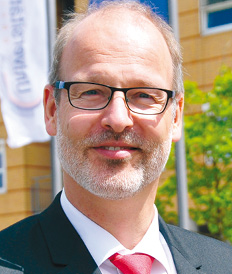
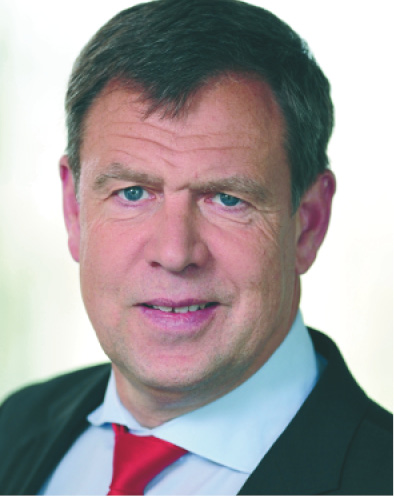
>> What do you have to say about this statement with your long-term health insurance socialization, Dr. Meusch?
Meusch: Part of my socialization is that I have a doctorate in political science and have experience in practical politics, in party politics as well as in my five years of work in two federal ministries. This is also why one thing is important to me: health insurance companies and G-BA are not the same thing.
Hoffmann: Of course, G-BA and health insurance companies are not the same thing. But if you look at the distribution of votes in the G-BA and in the Innovation Committee, you can definitely see a clear distribution of power.
Meusch: But it wasn't the health insurance system that wanted it, but rather politics, when it created the G-BA in 2003 as part of the GKV Modernization Act as a joint committee of the German Hospital Association, the National Association of Statutory Health Insurance Physicians, the Federal Association of Statutory Health Insurance Dentists and the then seven central associations of the Established statutory health insurance companies. Until then, there were four committees working in parallel, each made up of equal numbers of service providers and representatives of the statutory health insurance companies. So not much has changed with the founding of the G-BA in terms of distribution of power.
Hoffmann: Only that the former seven have now become one large umbrella association of health insurance companies...
Meusch: ... with powerful opponents like the KBV or the DKG. That's a good thing: it's part of our pluralistic society. If politicians - as we all hope - think about extending innovation funding from 2019, they can change that. However, I advise against it. What I am definitely against, however, is the statement that only the health insurance companies should be excluded from decisions about funding for innovations in statutory health insurance.
Prof. Hoffmann, what prompted you to make that statement?
Hoffmann: I advocate more scientificity and independence in the innovation fund's funding decisions. The Innovation Committee is currently not set up for this. Mr. Meusch is absolutely right - this not only affects the health insurance companies, but also the other representatives of self-government. Here, the actors of the present, often with influences from the past, decide on future innovations.
Meusch: In my view, for the translation into standard care, which is considered and explicitly wanted by politicians, it is important to maintain a critical discourse towards those who are primarily responsible for care. These are the usual suspects, namely the umbrella association of health insurance companies, but also the individual health insurance companies. But that is also the German Hospital Association, the KBV and the KZBV, which politicians correctly commissioned to form the G-BA. The Innovation Fund has given impetus to the approach of stimulating healthcare-related research, which would not work at all without funds.
Hoffmann: It's not about wanting to operate without the health insurance companies - rather, their experience and skills in the health system must definitely be included. In health services research, we consistently rely on dialogue with all players in the healthcare system. The aim, however, is to separate the resources of the innovation fund from the direct access of the cash registers and other representatives of self-government. This would help to avoid conflicts of interest and counteract both clientelism and proportional thinking in the distribution of funds.
However, the TK is only part of the G-BA through the central association.
Meusch: That's right. And it is true that associations per se are certainly not the most dynamic form when it comes to promoting innovation, but this applies equally to all cross-sectional organizations of this type. Initial experiences also show that this form of funding has difficulty breaking down the innovation backlog in the long term.
Let's try out a thought experiment together: What if the innovation fund were actually removed from the direct control of the banks that make up the G-BA?
Hoffmann: ...then there would be room for the applications to be assessed by the expert advisory board regardless of the person, supported by independent external experts. Funding decisions would give greater weight to the scientific quality, the priority and relevance of the topic and – very importantly – the actual feasibility of the proposed projects. And at most secondarily the interests of the actors involved. I can well imagine that this would also take a big burden off the shoulders of some members of the Innovation Committee.
Meusch: Then you immediately get a big problem, which is: How does research get into the reality of care and how
will it be implemented? What is crucial is that
the research findings reach patients in the form of better care, otherwise the most beautiful research results are of no use. If you stick to a fund, something like the innovation committee makes a lot of sense.
Why this?
Meusch: Because there are people in this committee who can say exactly which project has a chance of overcoming the hurdle of translation if the evaluation is positive,
which the legislature has stipulated - i.e. to be included in the standard care via G-BA. As long as these hurdles remain as they are - and I don't see anyone wanting to fundamentally abolish them - the link between those who decide on supply projects to be funded and those who are supposed to later implement them makes perfect sense.
If you look at the current composition of the G-BA and that of the Innovation Committee, the only difference is that the BMG and the BMBF have a vote on the committee. In this way, politicians have actively sat down at the table, which was also the wish of the impartial chairman, Professor Hecken. What would be opposed to the fact that, at the instigation of politicians, a completely new body is created that is explicitly intended to promote and research innovation and therefore has to move much further away from the designers in order to maintain the necessary freedom and independence. Of course, the implementation of the positively evaluated projects must always be wanted by the coffers at the state level and desired by politicians. Why does a leading federal association have to play a strong role in such a construct?
Hoffmann: I see it that way too. Instead of deciding on scientific and methodological questions, the innovation committee should concentrate on questions of practice transfer and, above all, the transfer of successful approaches to statutory health care. The G-BA and self-administration are in the driver's seat!
Meusch: That's a completely different logic than wanting to explicitly and only remove the cash registers from the innovation committee. If in this scenario, in principle, all top decision-makers in the given
common self-administration is kept outside, this is worth considering from the perspective of science. As a political scientist, however, I would like to point out that the complexity of the decisions increases with every new player. Because we jointly stated above that the committee structure is already having a hard time dealing with the innovation backlog, I would warn against further increasing the complexity and allowing additional players to have a say. To put it practically: let's protect the innovation fund from taking the fate of Gematik. Furthermore: Since Plato's failed attempt to translate his clever thoughts into real politics, we know that theory and practice follow different rationalities. I also salute Niklas Luhmann, whose very abstract systems theory, which assigns science and politics to different systems with different rationalities, has more practical relevance than dreams about scientists making better politics.
And what does this mean for the question of who should be in charge of deciding how innovations in the German healthcare system should be promoted?
Meusch: An answer in two parts: Firstly, I reject a state health system and therefore the focus on state decisions. The state should concentrate on providing a framework that does not specify everything, but is worthy and in need of completion. This also applies to health services research and the promotion of innovation. Secondly, we live in a plural society with a multitude of institutions and people who participate in decisions with different perspectives. I think it's good that there are not only G-BA institutes that conduct research, but that service provider institutes such as the ZI or the PKV or the GKV play their role in this. Heaven forbid that WINEG has the say over which innovations should be promoted. Like us, our colleagues from the WIdO, the INGEF or the PKV or other relevant players are the icing on the cake of a pluralistic research landscape. The Fraunhofer, Leibniz and Helmholtz societies are indispensable. Do you not want to grant IGES, AQUA or WIG2 a relevant role in articulating ideas for improving care because we rely on central research funding? We are all think tanks who want to enrich the discussion. I don't want a central institute for research funding, neither at the G-BA nor anywhere else. Central think tanks are parts of state health systems, which I reject in Germany.
Hoffmann: A centrally managed, planned economy
health system is not avoided by self-administration deciding on innovation projects behind closed doors and on the basis of uncommunicated criteria! But seriously: I don't know anyone who wants state direction in the funding decisions in the innovation fund. In other countries - with and without a state health system - there are certainly institutions that develop innovations in care largely independently of the immediate actors, exactly in the spirit of the think tanks that Mr. Meusch addresses. However, this only applies to representatives in the G-BA to a limited extent. Their task is to moderate conflicts, balance the conflicting interests of the actors and negotiate compromises in the supply of the present.
What do you think of a health care research clearinghouse like the one the DNVF is calling for?
Meusch: I regret that approaches to focus research funding such as gesundheitsziel.de have had so little effect and I therefore welcome the fact that the DNVF is committed to formulating care goals. However, in a pluralistic society like Germany's and especially in the German healthcare system with its many players, it is extremely difficult to agree on a focus. Nevertheless, I don't believe that government directism - for example, the Bundestag deciding with the consent of the Bundesrat what research should be carried out and where - will help us here. The discourse about supply targets is difficult, but I reject government directiveness towards supply targets.
Hoffmann: The German Bundestag is not my preferred body for reviewing project applications in the Innovation Fund! However, when it comes to identifying the priority research questions, this cannot be left to the free play of the interests of those involved in the healthcare system. Then compromises are often made at a low level, which change as little as possible and don't hurt anyone. Such a process would not sufficiently take into account both the interests of patients and the evidence from health services research. That's why politics has had to repeatedly set the direction, especially in recent years - because self-government as such is not innovative and often does not represent society as a whole.
What would be an optimal way?
Meusch: In a pluralistic society there is no optimum, only the search for the better solution. We have to keep an eye on what can be implemented in society - piecemeal engineering, to use Popper's words. That's why in the current situation I can actually live quite well with the current construction of the G-BA and the fund. The TK would prefer an innovation budget: The concept envisages a minimum expenditure value of 2.50 euros per insured person. Funds that are not spent are allocated to health insurance companies that spend more than 2.50 euros via the National Association of Statutory Health Insurance Funds. The funds are to be incorporated into care through selective contracts with health insurance companies - specifically through contracts in accordance with Section 140a SGB V (special care) and model projects in accordance with Section 63 SGB V. That would be an effective competitive instrument.
Hoffmann: According to our concept, the innovation fund is not an instrument in budget competition. The primary purpose of the innovation fund is to objectively and independently support the development and implementation of innovative solutions to real existing supply problems. The fund must therefore actually become a fund that is managed transparently and independently outside of self-administration. This fits very well with the investment budget that the TK is proposing. The funds must of course be collected according to a transparent key that is fair for all health insurance companies. And then the health insurance companies and health care researchers, like all other actors, can apply for the fund's resources and the best concepts win.
Meusch: Our common interest is that the funding of health services research is continued. Nobody wants to let the impulses from the innovation fund go to waste. We absolutely have a common interest here. Thomas Ballast, the deputy chairman of the Techniker Krankenkasse, has already made suggestions for the above-mentioned, legally anchored innovation budget. That would be the path we should focus on in the coming months and years, instead of complaining about the governance structure of the G-BA and the Innovation Committee. This is my petition.
Hoffmann: The idea of a legally anchored, permanent innovation
I think it would be advisable to create a budget from the funds of the statutory health insurance
extremely useful and worth supporting. I am also sure
that good health services research quickly recoups these resources and that the investment in innovative projects will pay off economically and probably also in business terms after a short period of time. But to do this we should change the governance of the innovation fund. Because its positive effect is increased by an independent assessment according to transparent criteria - scientific and methodological quality, patient and care relevance, feasibility. The procedure should be based on that of the German Research Foundation, DFG, or the BMBF. Free from interests and proportionality – and of course also from external influences of all kinds. Then we can move forward together!
Prof. Hoffmann and Dr. Meusch, thank you for the conversation. <<
The interview was conducted by MVF editor-in-chief Peter Stegmaier.