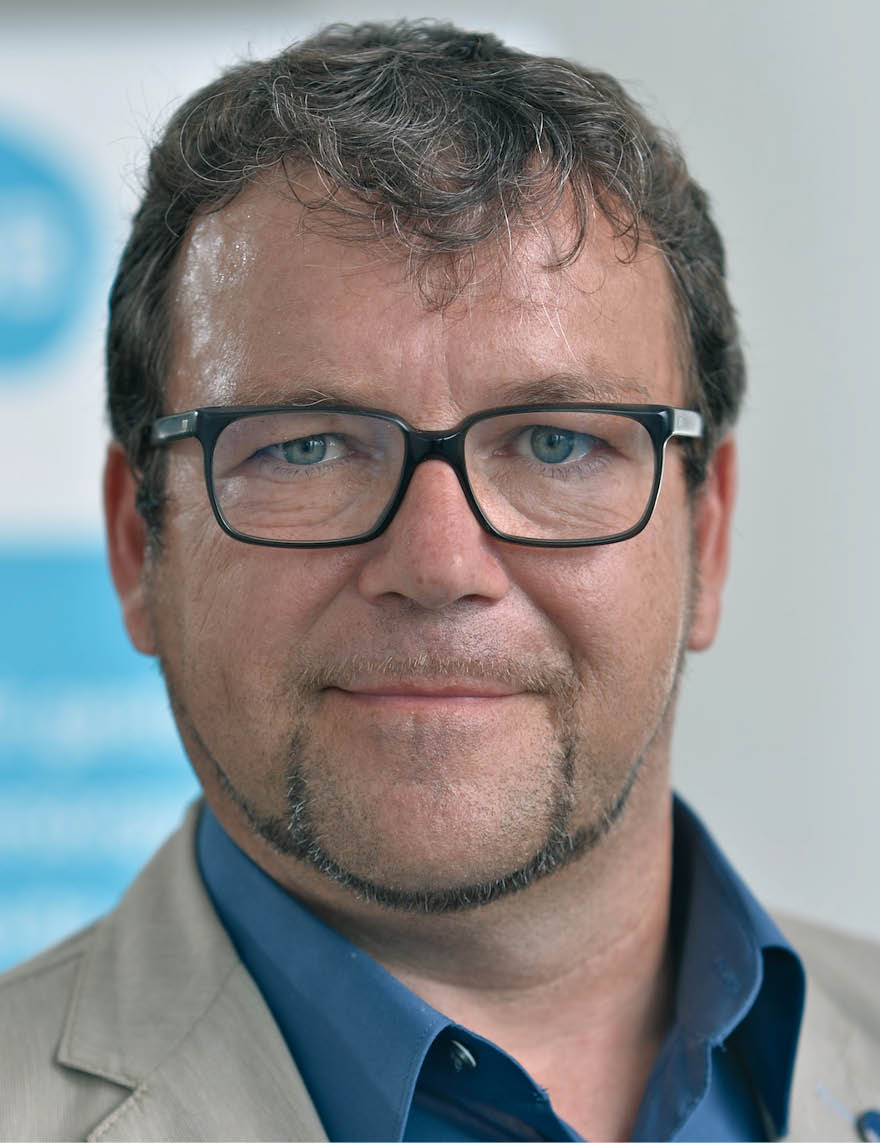
>> Mr. Freiberg, there is good cooperation between associations of statutory health insurance physicians and health insurance companies in many places. What is special about IGiB?
What sets us apart from other partnerships between KVs and health insurance companies is the long-term, close cooperation and not just temporary cooperation on individual topics. We face the challenges of the healthcare system as a whole and not from the perspective of particular interests. This is a commitment to give and take and win-win. Many others don't take this step. The legal form of the civil law partnership GbR creates the necessary obligation for this.
Successful concepts are often copied. Why is IGiB GbR still unique in Germany?
In fact, the former Federal Minister of Health Hermann Gröhe said at the IGiB conference in 2017 that the IGiB could be a nationwide model for successful and sustainable cooperation in the health sector. But we only have a mandate for Brandenburg. In this respect, good solutions need to be adopted by partners in other federal states in order to achieve a supra-regional effect. In this respect, copying isn't bad at all.
Do the partners’ self-interests – some of which are certainly contradictory – always take a back seat?
The special thing is that at IGiB we work across companies. Especially in the early days with completely new topics and participants, it was initially difficult to break out of the company-specific behavior and thought patterns. The employees from the different houses had developed mutual prejudices or rituals when dealing with one another. If necessary, people knew each other from contract negotiations. You sat across from each other at the negotiating table and only had to represent your own interests. We have now completely overcome this with IGiB projects. The various IGiB working groups work for the IGiB. Good teams have now emerged. Employees forget that they do not belong to the same company. In the working groups, ideas are sometimes developed that the employees are absolutely convinced and enthusiastic about - even if they initially do not fit into the existing line of their own company. An identity with the project emerges. Practical elements such as the electronic cooperation and billing platform KAP developed at IGiB, which allows cross-company collaboration, also contributed to this.
How do you attribute the success of IGiB?
We will have been active for ten years in 2019. That's not a long time in the healthcare system. Nevertheless, we are viewed extremely positively by outsiders. We have received the dfG Award several times for our products. In addition, we have been listed as an innovation leader in the Berlin-Brandenburg Health Master Plan for several years in a row and in politics we stand for good ideas and successful innovations. Our congresses and forums are very well attended. 400 experts and decision-makers from all over Germany attended the 2nd IGiB Conference in 2017 alone. And the Federal Minister of Health is the patron. Many people have benefited from the IGiB, not just the partners KVBB, AOK Nordost and BARMER.
Which project successes are you thinking about specifically?
The agneszwei is one of our best-known and most successful models. The highly qualified case manager takes holistic care of often multimorbid patients. In addition, it relieves doctors in the state of Brandenburg of classic delegable tasks. The curriculum has now been adopted by the German Medical Association in the training “Case Management in Outpatient Medical Care” and the new field of activity for medical assistants is therefore available nationwide.
You say “one of our models”. In his reply “Recognize the basics of your own work” (MVF 04/18) to your article “It is time to establish case management” (MVF 03/18), Prof. Hoffmann explained that Agneszwei was based on the AGnES developed in Greifswald concept, but Agneszwei has been adapted to regional and current care requirements, but the design, curriculum, implementation and evaluation of the concept of his knowledge has not yet been published. So what's the situation now?
As can already be read in detail in the MVF article in issue 4/18, agneszwei is a further development of the AGnES concept. It breaks down the restrictions there - such as the limitation to only underserved regions, the use of only general practitioners and the performance of services that can only be delegated. Together with the German Society for Care and Case Management, a training concept was developed in which case management for particularly care-intensive, multimorbid and immobile patients is the focus of Agneszwei's activities. This includes the coordination and monitoring of medically necessary care, always in close coordination with the treating doctor, as well as the organization of disease-related continuous care. To this end, it optimizes the treatment chain by setting up and maintaining a treatment and care network around the patient so that they can remain independently in their own home. The BÄK has integrated the training concept for agneszwei into its curriculum “Case Management in Outpatient Medical Care”, which was published for the first time in 2016. On this basis, the Brandenburg State Medical Association held the second training course in December 2018. And since 2012, agneszwei specialists (so-called case companions from 2017) have been continuously trained every year. There are currently 151 qualified Agneszwei specialists in Brandenburg and an increasing number of case companions in other federal states.
Are there any other projects with your involvement?
Another project with nationwide attention is “Structural migration in the central area of Templin”, or StimMT for short. This innovation fund
The project is so large and complex that we founded our own subsidiary of IGiB GbR and involved numerous other partners - in particular the hospital partner SANA. IGiB StimMT gGmbH is leading the entire project as consortium leader.
It will be essential for the success of this project that cross-sector care works. A network of doctors has recently been founded in Templin. How is this integrated?
The doctor and psychotherapist network “Gesund in Templin eV” is directly involved in the regional project group work on site and the committee work of the project partners. In the project started here in Templin, which is about generally rethinking and changing supply structures, a lot of work and knowledge lies with those who care for the local people every day. The network of doctors and psychotherapists is the linchpin for successfully implementing the project. In addition, the network should be involved as a partner in the discussion on new carrier and operator models.
At some point there will certainly be a discussion about who actually owns the newly built outpatient and inpatient center that was built as part of the publicly funded project. What is your answer? .
The support structure of the future ASZ is an important component of the project, which is still being worked on at the moment.
Has the IGiB provided further impetus?
The on-call practices in Brandenburg were also an idea from IGiB. The first on-call practice in Potsdam and the pediatric on-call practice in Cottbus were pilots, the basis for a nationwide roll-out. They are now part of the standard care system and have been incorporated into the KVBB's on-call service reform. Central elements such as the establishment of the standby
Practices directly in front of the rescue center and joint registration were already included in the basic concept.
What hasn't gone so well in the past ten years?
The patient bus project was certainly not that successful, even if it still exists as a shuttle bus to the KV RegioMed Center in Templin. The idea of ensuring that patients can reach practices even without their own vehicle and in structurally weak regions is the right one. Accessibility to medical care is an important issue. But the IGiB can only provide an impetus for this, since neither the KV nor the health insurance companies are responsible for local public transport and basic services. The “patient bus” must be a public transport option.
What are you currently working on?
Among other things, we are relaunching the polypharmacy project. Drug management is supported digitally. We rely on the ADAM innovation fund project from North Rhine-Westphalia, but go one step further: the patients are accompanied by an agneszwei. Older people in particular have little use for a printed medication plan. This requires personal support in the home environment so that not only the plan is the best possible for the patient, but also the intake remains without avoidable side effects.
Mr. Freiberg, thank you very much for the interview. <<
The interview was conducted by MVF editor-in-chief Peter Stegmaier.