>> The reason why the term health services research suddenly appears in the name of the institute is not least due to the type of funding. The basis for the continued existence of the entire institute in 2003 was institutional funding from Südwestmetall eV, the employers' association of the Baden-Württemberg metal and electrical industry (M+E). In the corresponding cooperation agreement between the Eberhard Karls University of Tübingen, the Tübingen University Hospital, the Medical Faculty and Südwestmetall, the term “Health Management” was already mentioned as a research field of interest.
In terms of content, Monika Rieger's research concept fit very well with what was being sought in Tübingen as part of the appointment process. After her further training in occupational medicine and her habilitation, in 2003 she took over the management of the research department at what was then the Competence Center for General Medicine and Outpatient Care at the Faculty of Medicine at the Private University of Witten/Herdecke. This led not least to her discovering health services research as part of this task. Against the background of her occupational medicine training, she quickly developed project ideas in the area of occupational health care research, for which she was also able to obtain initial third-party funding. An example of this is the cooperation project with the Witten Institute for Nursing Science “Working Conditions in Hospitals”, which was funded by the Federal Institute for Occupational Safety and Health.
Since 2008, the focus of the work at the Institute for Occupational Medicine, Social Medicine and Health Care Research at the University Hospital of Tübingen has been particularly on health care for people of working age. This can certainly be seen as characteristic of the research work carried out here in the area of health services research, since both the operational setting and the collaboration with operational
Doctors as actors in health care are taken into account, as well as the importance of working conditions for maintaining health, including all those measures that are possible in the German social system to maintain the ability to work and earn. Finally, Monika Rieger's team dedicates itself to healthcare workers with an occupational health perspective.
“It is very important to me to emphasize the importance of occupational health care
“To strengthen research,” says Monika Rieger. On the one hand, she focuses on research into working conditions in the healthcare system, including the effects on patient care, but on the other hand, she also focuses on the large field of healthcare for people of working age. What is important for the institute is the now great international visibility, which is reflected, for example, in its participation in the corresponding scientific committees of the International Commission on Occupational Health (ICOH).
There are actually two strong research focuses at the institute: In addition to occupational health care research, the second focus primarily deals with work-physiological research into work-related stress and work design. But when it comes to the implementation of new, for example
When it comes to working procedures in the health service, the teams from both research areas of the institute work closely together. “In my opinion, labor participation and ability to work should be a target variable in the design and evaluation of health care to a much greater extent than before,” explains Monika Rieger with a good sense of mission. That's why being awarded the Joseph Rutenfranz Medal from the German Society for Occupational Medicine and Environmental Medicine in 2019 means a lot to her personally.
However, the picture of the Institute for Occupational Medicine, Social Medicine and Health Services Research at the University Hospital of Tübingen would only be half-painted if one did not take into account what Baden-Württemberg had already done in 2008.
Bergisch state funds would add a competence center for occupational and social medical prevention, rehabilitation and women's health. This competence center was set up as a cooperation project between the Institute for Occupational Medicine, Social Medicine and Health Services Research and the Institute for Women's Health Research. The latter, for example, is a partner in the Mind:Pregnancy project, which is supported by the Innovation Fund with 3.4 million euros.
In 2011, Monika Rieger also took over the management of the new health services research coordination office at the Tübingen Medical Faculty, which was financed until 2017 as part of state funding for the development and expansion of health services research in Baden-Württemberg. She headed this coordination office from 2015 together with Prof. Dr. med. Stefanie Joos, who at that time took over the management of the Institute for General Medicine and Interprofessional Care as a professor and medical director.
At the same time, there were over-
stipulations that university medicine should be more closely linked to health services research and public
to interlink the public health system (ÖGW) and to initiate health services research projects in the ÖGW. The initial funding from the University Hospital and the Medical Faculty of Tübingen as well as from the Ministry of Social Affairs and Integration of Baden-Württemberg made it possible to found the Center for Public Health and Health Care Research Tübingen (ZÖGV) in October 2019 (see MVF 05/19), in which the Coordination point opened up. In the ZÖGV, the University Hospital and the Medical Faculty continue their long-standing activities in the area of health services research and expand these to include research projects on questions from the field of public health. This is intended to methodically strengthen the public health system and health services research
and evidence-based information is generated as a basis for decision-making for politics and care planning in order to ensure needs- and citizen-oriented medical care. “With the center we want to interlink the diverse tasks of the public health service with science on an equal and practical basis,” explained Manne Lucha, Minister for Social Affairs and Integration of the State of Baden-Württemberg, on the occasion of the founding of the ZÖGV. He went on to say that he hoped to attract students to the “interesting and diverse field of public health and thereby make it future-proof”. According to Lucha, Baden-Württemberg is not only taking on a pioneering role nationwide with the opening of this center, but also: “Public health is getting a face with this center!” <<
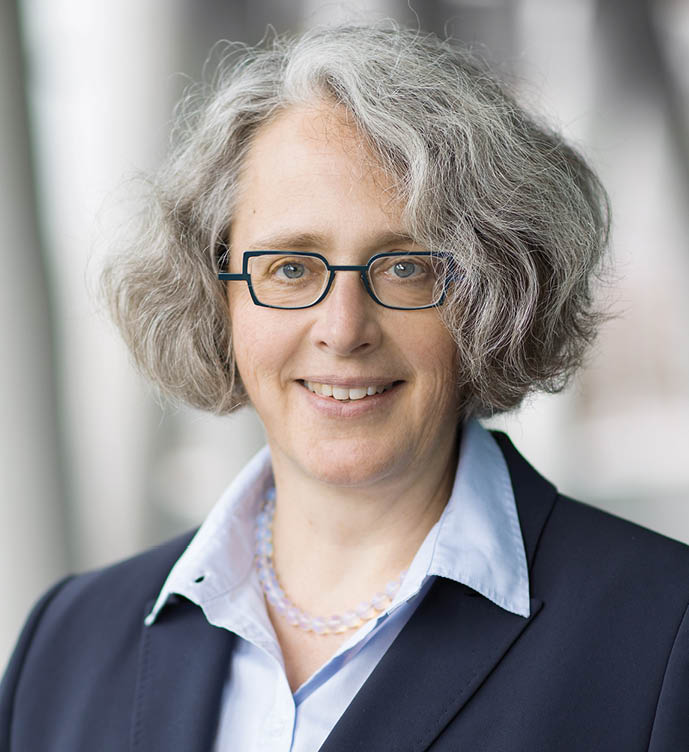
Prof. Dr. med. Monika A. Rieger
has been a university professor for occupational and social medicine and medical director of the Institute for Occupational Medicine, Social Medicine and Health Services Research at the University Hospital of Tübingen since 2009
Stations:
since 4/2008: (initially acting) management of the Institute for Occupational Medicine, Social Medicine and Health Services Research, Tübingen University Hospital.
2007 – 2010: Head of Occupational Medicine and Environmental Medicine, Institute for General Medicine and Family Medicine, University of Witten/Herdecke
2003 – 2007: Head of Research, Competence Center for General Medicine and Outpatient Care, University of Witten/Herdecke
2002: Habilitation and license to teach “Occupational Physiology and Occupational Medicine”, University of Wuppertal
1995 – 2003: Further training in occupational medicine: various clinical phases and scientific activities in Freiburg and Wuppertal
1987 – 1995: Studied human medicine in Freiburg and Innsbruck
Prices:
2002: EW Baader Prize for Occupational Medicine
2019: Joseph Rutenfranz Medal from the German Society for Occupational Medicine and Environmental Medicine