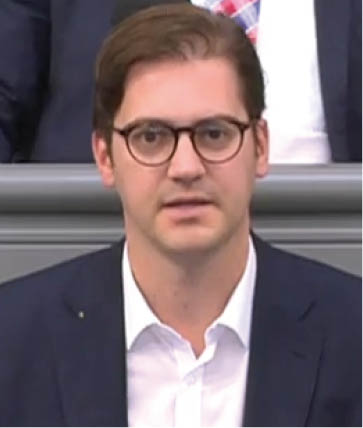
>> MP Pilsinger, who has been working as a part-time doctor in a family doctor's practice in the Munich area since 2018 after completing his studies in addition to his Bundestag mandate, knows what he is talking about when he says: “Telemedical care offers are already making an important contribution to improving the quality of life of patients to improve and avoid hospital stays.” Offers such as telemonitoring or telecoaching could be “a useful supplement to primary care.” Pilsinger, a member of the Health Committee, continued in his Bundestag speech at the beginning of July this year: “I would particularly like to emphasize at this point that with this law we are finally enabling health insurance companies to actively and specifically inform their insured persons about such important care offers .” Especially in the Corona crisis, it has been shown that high-risk patients can particularly benefit from telemedicine offers and digital health applications. That's why, according to Pilsinger, politicians are making it clear with this clarification: “Information from the health insurance companies about life-saving things
Supply offers are not advertising.” With this legal regulation, the legislature has “removed obstacles and released the brakes”; It is now up to the health insurance companies to “actually offer” these new care options to their insured persons and inform them about them.
The Munich doctor and MP explicitly refers to an amendment to SGB V, namely § 68b and § 284. In § 68b, paragraph 2 sentence 1 is inserted as follows: “The health insurance companies can provide their insured persons with information about individually suitable care innovations and “Provide other individually suitable care services and offer individually suitable care innovations or other individually suitable care services.” And in Section 284, under paragraph 1,
Point 19, which currently only regulates the “implementation of offers in accordance with Section 68b”, will in future be supplemented with “the preparation of care innovations, the information of insured persons and the submission of offers in accordance with Section 68b paragraphs 1 and 2”.
Furthermore, Article 1 of the law passed on July 3, 2020 states that with the insertion of Section 68b into SGB V, health insurance companies are given the power to “evaluate data from insured persons in order to promote needs-based care innovations and to provide the insured with individually suitable care offers submit”. However, it is also emphasized at this point that innovative care approaches could only be successful “if they are not placed next to existing care structures, but integrated into everyday care.” Therefore, in order to be able to use synergies with existing care services from the statutory health insurance companies, “the health insurance companies' advisory authority according to Section 68b paragraph 2 will be expanded to include other individual, suitable care services from the health insurance companies in addition to the care innovations”.
In addition, according to paragraph 3, the insured can object to the submission of information and offers by their health insurance company at any time in writing and electronically. If the information or offers are direct advertising, Article 21 GDPR remains unaffected. This paragraph states that every data subject has the right to object.
When Pilsinger says that it is now the turn of the health insurance companies to offer these new care options and provide information about them, he does not just mean the useful, perhaps even life-protecting applications for high-risk patients in the wake of the corona pandemic (see MVF 03/20 ), but also supply options that have been around for much longer. One disease for which such solutions have existed for more than 20 years is chronic heart failure, but there are also telemedicine procedures for other diseases.
One of the protagonists is the Munich doctor and entrepreneur Dr. med. Joseph Ladder. He has founded several of the leading companies in the field of digital healthcare. On the one hand, there is the Society for Patient Aid DGP mbH, which today belongs to SHL Telemedizin GmbH. 15 years ago, Leiter and his colleagues had developed the telemonitoring program “Cordiva” for AOK Nordost called “Curaplan Herz Plus” (see MVF 05/15). On the other hand, there is the somewhat younger Health Care Systems GmbH (HCSG) in Pullach near Munich, which offers the telemonitoring system “mecor” in Germany and Switzerland.
The procedures developed by Leiter and colleagues in these projects have long been incorporated into the guidelines and recommendations of medical-scientific societies. The HCSG is currently working on the next generation of digital applications for chronically ill people, with continued support from Leiter. In April 2020, mecor was also used to provide targeted Covid-19 advice to high-risk patients. The participants' individual risk was determined in a very short time using the mecor medical device software. Afterwards, more than 5,000 patients received individual advice and care within a month. The project is scientifically supported by the German Heart Center at the Technical University of Munich. <<
by: MVF editor-in-chief Peter Stegmaier