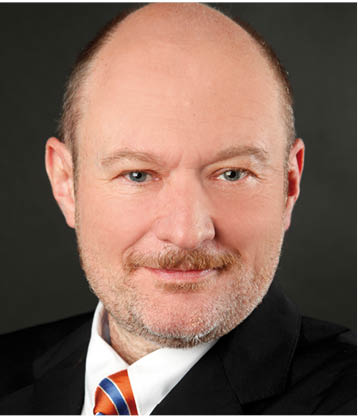
>> After the welcome from Andreas Gerber, CEO of Janssen Germany, trend and futurologist Matthias Horx gave an insight into how, in his opinion, the “coronavirus is changing our society and what future we can build on it”. In this keynote speech, Horx explained that Corona could be seen as a kind of catastrophe, but the pandemic could also be compared to a solar eclipse: an event that darkens something, but the corona of the sun also becomes visible in the umbra. Horx: “I would like to share this visibility with you.”
When we look back on the Corona pandemic in 10 to 15 years, we will see in this rain that this event has changed our society and structure, even in the deep layers. The sociologist Hartmut Roder summed it up when he once said that the corona crisis acts “like climate change for ideas”. One can observe a shock in society, but also a “new normal”. And not always a bad thing, because – according to Horx – 60% of Germans would say in surveys that they would not want to miss the experiences they had during the crisis and the deceleration they experienced. The key questions were: What can we learn from the pandemic? And: How do we want to live in the future?
According to Horx, every crisis has two elements that work against each other: “acceleration and disruption,” such as digitalization, which has gained enormous “escape speed” during the pandemic. A central concept in everything is the concept of trust: it is suddenly about the question: How are we positioned in the world? Never before have so many Germans agreed with what politicians are doing. But trust cannot be bought or demanded, it can only be experienced. But when she rules, things develop in a win-win relationship - especially in the area of health. This also applies to vaccine development.
Nobody knows this better than Dr. Paul Stoffels, MD, Vice Chairman of the Executive Committee and Chief Scientific Officer, Johnson & Johnson. In a live interview with him titled “Where are we in terms of developing a safe and effective vaccine against Covid-19?”, he gave a first-hand update on Janssen’s research activities, including in relation to on Covid-19.
However, his comments have now become outdated, as interim phase 1/2a data for Janssen's Covid-19 vaccine candidate were published in the New England Journal of Medicine (NEJM) in mid-January. The data shows that the vaccine candidate (JNJ-78436735), being developed by Johnson & Johnson's Janssen Pharmaceutical Companies, produces an immune response that lasts for at least 71 days when administered once in participants aged 18-55 years - that is Length of time measured in this study. The data showed that after a single vaccination, neutralizing antibodies against Covid-19 were detected in over 90 percent of study participants on day 29 and in 100 percent of participants on day 57. These neutralizing antibodies remained stable in all participants aged 18-55 years until day 71, the latest time point currently available in this ongoing study.
The phase 1/2a interim analysis would also have shown that this vaccine candidate was generally well tolerated by all study participants. Data on the durability of immune responses in study participants over the age of 65 have been available since the end of January. Longer-term follow-up is planned for up to a year.
The first results of the phase 3 study mentioned by Stoffels, in which around 60,000 test subjects took part, should be available at the end of January/beginning of February. However, since this study depends on the infection process, an exact prediction is not possible. If the single-dose vaccine proves effective based on phase 3 trial data and confirms a good safety profile, the company could submit an application for emergency use authorization to the US Food and Drug Administration (FDA) in February. <<