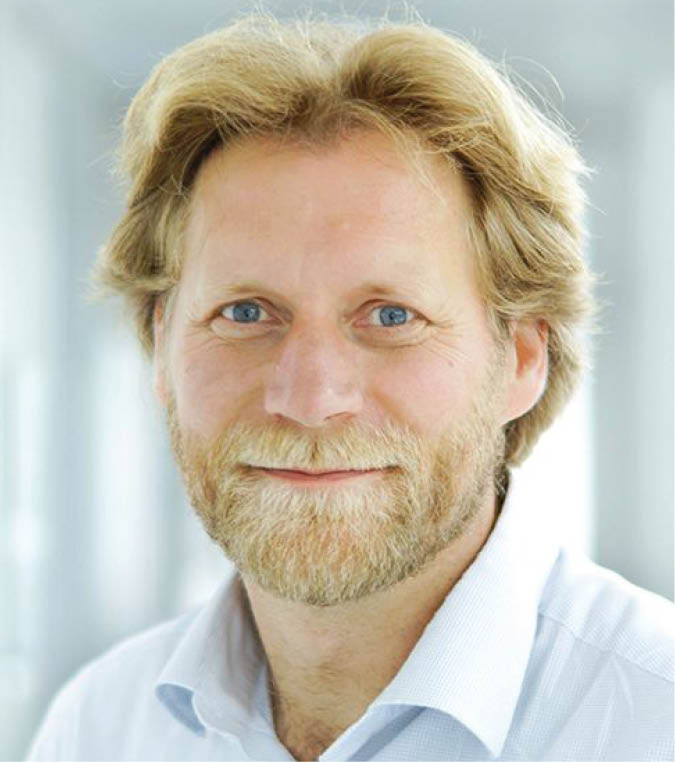
The establishment of the Department of Health Services Research began in 2013 – shortly after the founding of the Faculty of Medicine and Health Sciences in 2012 – with the transfer of Prof. Andreas Hein from the Department of Computer Science to the new faculty. During his doctoral studies and postdoctoral research at Charité and the Fraunhofer IPK, he focused on the development and evaluation of surgical assistance systems (navigation and robotic systems, intraoperative imaging). In Oldenburg, his work then shifted to the design and development of assistance systems for supporting older people in their homes. Key areas of focus were, and continue to be, the monitoring of functional aspects of older people's behavior using sensors in their homes or public spaces (e.g., presence detectors or laser scanners), sensors worn by the individuals themselves (wearables), and sensors in implants (e.g., ventricular assist devices).
The goal is to detect relevant – typically gradual – changes early on and counteract this functional decline through interventions. In addition to signal and image processing methods, machine learning techniques are increasingly being used. These allow, in particular, for individualization to the specific life situation of older adults. While the interventions are initiated and supervised by physicians, therapists, or caregivers, they can be supported by assistive technologies (apps, home automation, service robots). Here, too, the research aims to adapt the technologies to the target group as a whole (usability of apps) and to ensure they fit the individual's life situation and environment.
In addition to numerous technical challenges in developing medical technology solutions directly for older users – rather than for medical or nursing experts – further fundamental questions have arisen and continue to arise regarding the design of such socio-technical systems. Besides individual factors such as technological readiness and acceptance of technical systems that collect, analyze, and – albeit aggregated – communicate data in the private sphere, as well as the general acceptance of dealing with age-related limitations, social (role changes in care institutions and informal care), ethical (avoiding age stereotypes), and economic (effectiveness of technology-based interventions) issues also play a significant role (see also the Eighth Report on Aging by the Federal Government, 2020).
The interdisciplinary Department of Health Services Research offers an ideal environment for the holistic design, implementation, and evaluation of such socio-technical systems. Currently, in addition to the professorship for automation and measurement technology, the following professorships are filled:
• Epidemiology and Biometrics (Prof. A. Timmer, 2014),
• Outpatient care and pharmacoepidemiology (Prof. F. Hoffmann, 2014),
• General medicine with a focus on health services research (Prof. M. Freitag, 2015),
• Organization-related supply-
research (Prof. L. Ansmann, 2017),
• Ethics in Medicine (Prof. M. Schweda, 2018),
• Geriatrics (Prof. T. Zieschang, 2019),
• Artificial Intelligence for Health (Prof. N. Strodthoff, 2021).
Furthermore, there is the junior research group for rehabilitation research (PD AL Brütt, 2016) and – if all goes well, starting next year – the BMBF-funded junior research group „Nutrition and Functionality in Old Age“ with the As-Tra project (Dr. R. Diekmann, 2022). The procedures for filling the professorships „Big Data in Medicine“ and „Health Economics“ are currently underway.
A particularly visible example of interdisciplinary collaboration is the Nursing Innovation Center (PIZ), which has been operating since 2017 as part of the BMBF-funded cluster "Future of Nursing" (https://www.cluster-zukunft-der-pflege.de). Researchers from OFFIS, the Universities of Oldenburg and Bremen, and the Hanse Institute Oldenburg design, develop, and evaluate modern technologies, methods, and concepts to ensure their suitability for the healthcare system and to increase their ethical and social acceptance. In addition to technologies such as robotic systems for the physical relief of caregivers, augmented and virtual reality for nursing education, and targeted information in everyday nursing practice, various laboratories have also been newly established to enable users to experience, discuss, and experiment with these technologies.
>> Why do you work at the DVF?
In my role as group leader, I have the opportunity to advance my research at the interface between geriatrics and digitalization. I studied nutritional and household sciences in Bonn and subsequently earned my doctorate at the Institute for Biomedicine of Aging, Chair of Internal Medicine-Geriatrics at the University of Erlangen-Nuremberg. Through this and my subsequent work at the University Hospital for Geriatrics at the University of Oldenburg, I acquired comprehensive knowledge of the fundamental relationships between nutrition and physical functionality in older adults. At that time, the Assistive Systems and Medical Technology department had a significant need for clinical expertise, both to expand its methodological repertoire to include non-technical procedures and to determine the actual needs of the target group, and to develop and evaluate user-oriented technology.
What are the main areas of focus in your work at the Department of Health Services Research?
The "EFA" group within the Assistive Systems and Medical Technology department develops technical systems (monitoring and assistance systems) specifically for older adults in the areas of nutrition and exercise. Nutrition and exercise play a crucial role throughout life, but especially in old age, as poor nutritional status, insufficient nutrient intake, and reduced physical activity are associated with a range of illnesses, syndromes, and other negative consequences. Staying fit and living independently in one's own home is something almost everyone desires. My research group works closely with the target group—older adults, often over 75, from various living situations such as home, rehabilitation, or nursing homes—to develop technical systems for monitoring and supporting their nutritional and exercise status. This includes monitoring systems that can identify risks early on and assistance systems that provide support in daily life, particularly to enable independent living at home. The specific needs of seniors, who are often less comfortable with technology, must be taken into account. A special feature of my group is its high degree of interdisciplinarity, including physiotherapists, nutritionists, and health science experts.
Scientists, medical technicians, computer scientists, physicians, and engineers. In my view, the perfect combination to develop truly usable and efficient technology for seniors. The EFA group bridges the gap between IT-oriented technical development and the target group of vulnerable older people. I consider this particularly relevant in the current dynamic development of digitalization in healthcare.
The Geriatrics department here at the Department of Health Services Research continues to be an important partner in our research projects, and a number of research projects have already been applied for and successfully carried out with the Automation and Measurement Technology group of Dr. Marco Eichelberg from the OFFIS Institute.
What, in your opinion, distinguishes the Department of Health Services Research?
What I find exciting and challenging is that many members of the department are more like "eccentrics" than traditional healthcare researchers. The challenge now is to meaningfully unite these diverse disciplines under a common focus. We've been working on this together for years, and it's not being imposed from the top down. I enjoy helping shape the development of a young university, an even younger faculty, and a very young department, and contributing my own areas of expertise. I'm met with open arms.
What topics and questions are you currently working on?
In our current projects, we are developing, among other things, an app for geriatric rehabilitation patients designed to sustainably improve their nutrition and exercise habits. The area of "geriatric assessment" and the possibility of using technology to map this assessment, in order to identify potentially increased risks, such as falls, at an early stage—ideally through self-monitoring—also plays a crucial role. If all goes well, I can successfully further develop this project with independent funding for my junior research group, which has already received a positive evaluation from the Federal Ministry of Education and Research (BMBF), for a period of five years starting next year, and evaluate it with a larger cohort.
>> Why do you work at the DVF?
In contrast to Rebecca Diekmann, my focus is on technology development and the analysis of sensor data using signal and image processing as well as machine learning methods. Therefore, I primarily cover the technical aspects within the AMT department. After graduating from high school, I studied physics and, following my studies in 2011, initially worked in automation and measurement technology for non-destructive materials testing. However, since I missed the connection to medicine and people, I decided to pursue a degree in Medical Physics and Technology concurrently and, in 2015, transferred to the University of Oldenburg to the Assistance Systems and Medical Technology department under Prof. Hein. Here, I work on the development of technical assistance systems for both patients and caregivers and collaborate closely with the OFFIS group "Assistive Technologies for Care and Support" headed by Dr. Tobias Krahn.
What distinguishes the DVF for you?
For me, the Department of Health Services Research is characterized above all by its interdisciplinarity. Within our department alone, numerous different professions collaborate. In addition, we maintain close contact with the other departments within the department and also with the groups at the affiliated institute OFFIS. The diverse methodological approaches and different perspectives allow us to consider research questions more holistically and learn from each other's disciplines.
What are your main areas of focus in the Department of Health Services Research?
My research focuses on motion capture and the analysis of movement sequences and reactions to technical systems. In the Robotic Assistance Systems group, we develop, among other things, robotic assistance systems for healthcare. These systems are designed to support caregivers in physically demanding tasks, such as repositioning patients. Here, it is crucial to provide targeted support, understand the situation and environment, recognize activities, and derive and implement cooperative strategies. We also utilize artificial intelligence and machine learning methods in this process. Targeted support is also essential for the development of assistance systems for patients. Remaining resources should be considered and promoted. Furthermore, we investigate how changes, for example in movement patterns, occur in response to a technical system.
What would you personally like to achieve with health services research?
My research aims to contribute to improving the care of people in need of care and to enable patients to live independently in their own homes for as long as possible. Furthermore, I want to support professional and informal caregivers in their work.