>> The wealth of information that can be generated and available is no longer tangible, and big data is one of the industry's magic words. Are we already in the brave new world?
The topic of digital health is part of the metatopic Future of Health, which is driven by two core movements. On the one hand, these are innovative drugs; in addition to antibodies, these include mRNA, cell and gene therapies (the so-called ATMPs). On the other hand, we see the topic of digitalization, which starts with data handling and extends to the use of artificial intelligence. Both core movements have the potential to improve patient care on their own – but especially when they work together. But they also present the industry with completely new challenges.
And now internet giants like Amazon are also developing Amazon Care, a comprehensive healthcare and telemedicine platform that is currently being rolled out in major cities in the USA.
Whenever one of the big mega-companies appears in the healthcare sector, it raises fears, which is entirely understandable. Behind this lies a palpable unease that these mega-companies could influence and sustainably change the healthcare markets – both international and national. However, the change in the healthcare markets is also happening outside of the big players, because digitalization in and of itself will initiate a major change that will change and hopefully improve patient care in the medium to long term.
We still have the HWG and data protection, which together make “direct to consumer” communication and marketing almost impossible in Germany.
Like almost everywhere in the world. Direct to consumer is banned or at least severely restricted in most prescription drug markets worldwide. The most important exception here is the US market. Marketing in the pharmaceutical sector is generally problematic and I think it is right to strictly regulate this market. The opioid crisis in the USA is a good negative example here. On the other hand, patients in the USA have more of an opportunity to obtain information from manufacturers, which makes it easier to provide information about various diseases. This is particularly important for rarer diseases that remain underdiagnosed. But here too, patient organizations, clinics and competence centers as well as health insurers provide very good and neutral information and patients are increasingly turning to them for information. In addition, patients are increasingly finding out more about “Doctor Google”, which certainly causes irritation among some doctors, as unfortunately there is also a lot of misinformation to be found on the internet. In general, patients are becoming more and more autonomous. You are quite capable of asking critical questions and, above all, questioning things.
Won't the role of the doctor change as a result of big data?
She will. Doctors today have a strong focus on diagnostics, which in the long term - certainly not in the next three or four, but rather in ten or twenty years - can be automated to some extent. Probably never completely, but the doctor will increasingly be able to access pre-filtered data, which he can then clarify again with his own diagnosis. The good thing about it is that doctors can now concentrate more on what constitutes the medical profession: the interaction with the patients and their treatment, which no matter how advanced diagnostics will never be able to do in this form.
There are already very exciting approaches here. If we think about the example of Ada Health - as founder Martin Kirsch often says: “Ada is not better than a good doctor, but it is better than a bad doctor or no doctor at all”.
Here we see an important function of digitalization: “Digital health” can reduce the challenges in the area of undersupply.
Why don't you explicitly mention telemedicine here?
We at ADL have decided to speak of “digital health” because when many people think of telemedicine, they imagine medical consultations via video. But “Digital Health” goes much further and offers patients holistic digital care.
Whether telemedicine or “digital health”. Both are ultimately about how data can be made more usable...
... for better treatment, for earlier diagnosis and for the identification of patients with previously underdiagnosed diseases.
The next step would be: How does the right medication get to the right patient after the earliest possible diagnosis?
We know from cancer research that breast cancer, for example, is not the same as breast cancer. But this also applies in other areas, such as migraines or rheumatoid arthritis, where rapid, early drug treatment leads to the disease escalating less severely. Unfortunately, we do not yet fully understand why some medications work very well for some patients and not or hardly at all for others. If you consider how much understanding and knowledge improve treatment success and at the same time reduce costs in the healthcare system, we see a real game changer here. It is important to seize these opportunities. Ultimately, the human body – and therefore medicine – is one big “big data problem” that we are now slowly understanding better. This is particularly relevant for the massively underdiagnosed rare diseases, but also for diseases that have to do with our very complex body systems such as immunological or neurological diseases. We are already seeing progress in some chronic diseases: In the area of diabetes, we are well advanced and are already using digital options very intensively.
The often-sung about closed loop still doesn't really work.
But we are already a lot closer to it than we were a few years ago and see clear potential to use digitally supported systems to optimize treatment and increase the quality of life of patients. This also has a secondary impact on the health economy. Not only does the time in which the affected people can participate more actively in life or work again increase - but the costs that have to be invested in the treatment also decrease. A real win-win situation.
We still have the AMNOG, which is only calculated based on annual therapy costs. And also only the direct, not the tangible costs are considered.
You have to be prepared to take a societal perspective on health if “digital health” is to be financed. Unfortunately, the perspective and “incentives” in our healthcare system are often too focused on the one-year horizon. This is of course not advantageous if you want to offset the costs in the long term, although that would definitely make sense. At the moment the system is still standing in our way. If you want to make progress here, you would also need sufficient relevant data to clearly map the effects on people and the economy. There are already initial attempts by some start-ups to do this. They plan to anonymize the data so that it can be made more usable.
In which countries does data availability work best?
Of course, at the forefront here are the markets that not only allow the most data access, but also have the lowest data protection. First and foremost, this is China - but here we are not talking about players like Amazon, but rather about Tencent, which is one of the most valuable companies in the world and is about half as big as Amazon in terms of market capitalization. There are some really big data giants in China, which is of course primarily due to the fact that they have been able to operate in a huge market of well over a billion people for years. The mega players operating here and the state are investing heavily in big data and, above all, in AI. Of course, the big techs from the USA also have great ambitions, but data availability there is somewhat more strictly regulated - although not as strictly as here.
And now Amazon is trying to enter the healthcare market.
Amazon Care already works in the US market, but cannot be easily transferred to Germany.
If you have to fight through 800 pages of gematik bureaucracy to bring ePA number 17 onto the market in this country, that simply doesn't make any sense.
Not yet. But the first two important components, the electronic patient record - ePA for short - and the e-prescription have already been decided, even if the changeover has been suspended indefinitely due to infrastructure problems - and in order not to overwhelm the doctor's practices. But gradually the problems will decrease and more applications will become established. Not necessarily from foreign companies, but from those that cooperate with them. Cancer, for example, is increasingly seen as a chronic disease in some areas, which is why there are considerations as to whether and how the treatment of cancer patients can be moved into the home using “digital health”. This can provide huge added value for quality of life. The problem here, even in the USA, is not acceptance among patients, but among doctors, for whom this means a lot of extra work. Finally, it is important to install and operate various electronic health record systems from the various US health insurance systems.
That means?
Anyone who relies on an electronic patient file would be well advised to make the interoperability sufficiently permeable so that general practitioners, specialists, pharmacies and hospitals can access the same information and interact sufficiently with one another. The winner or aggregator will then be the one who can at some point implement an electronic patient record as the provider with the widest reach. Only interoperability makes an application within “digital health” an effective method. But this will gradually regulate itself within the Gematik rules.
In any case, it won't be Amazon because it doesn't have ePA in its program.
At least not at the moment. However, an experienced provider from abroad can come up with the idea of doing this at any time. And the prospects are good, provided the system is designed to be sufficiently permeable so that all relevant actors in the ecosystem can actually access the patient's electronic file.
You can certainly trust gematik to ensure that the interfaces are open enough.
gematik must find the right balance: on the one hand, it must set clear guardrails for the elements that are really important (such as data security) and, on the other hand, allow enough flexibility in the system to promote innovative solutions. The former also applies in particular to interoperability: precise regulations are very important here. Ideally, a patient would like to be assured that all available data will be available in the event of an accident or emergency.
However, it is precisely this access that is still missing at the moment.
Exactly, we are seeing approaches from various players, although most of it is still at a pilot level. In fact, we have reached a very exciting stage at the moment: Who is developing what? And above all: who will be in charge in the long term and set the standards? These can be companies that are already active in the market, such as GE Healthcare (1), or new players that will gradually enter the market. It will be exciting to see who invests where. In any case, previously separate areas – such as pharmaceuticals, medtech and health insurance – will become more closely interlinked in the future, as is already the case in the USA today.
What can Germany learn from America or even from Amazon?
It is clear that the requirements are different because there is a very different health insurance market in the USA compared to Germany. Of course, there are completely different levels of data protection. When it comes to leading digital health projects, the USA and China usually come to mind first. But other countries are also worth a look for us, for example the Scandinavian states such as Denmark and Sweden. Both are significantly further along in this area – and are more similar to us in terms of the healthcare system. Electronic health records and e-prescriptions are implemented here in a sensible, transparent form. These are the key components for implementing a digital health solution.
The first steps have now been taken in this area. We have just briefly touched on the e-prescription. How can we support care situations that enable care to be provided more from home or more in virtual space?
In this situation, I like to mention what I hear from colleagues in Stockholm: During Covid times, we were all working from home and when I talked about our ordering processes for medication, they were rather surprised. In Sweden you just quickly scan a code, then you get your medication delivered to your home and it is billed directly to your health insurance company. Treating cancer patients at home is already normal in the Stockholm area. That's exactly the direction we want to go.
But here we face procedural, technical and regulatory challenges. We have to ask ourselves, how do we implement new possibilities? What is the right way, for example, to make data in a sensible form more available for research purposes and for the right evaluation systems? Overall, we have to become a lot faster and set up the right systems here. It must be possible to handle data sensibly and responsibly in order to ensure patient care.
What development is foreseeable in this country?
The following applies to our handling of virtual space and its possibilities: At the moment in Germany we have a very well-balanced system between pharmacies, between health insurance companies, and between health providers based on a one-year rhythm. In order to participate in the latest innovation in virtual space, we need to transform the existing system or supplement it with an alternative supply chain. There is still a lot of work to do here, but we are on the right track. <<
Miss Dr. Thomas, thank you for the interview.
The interview was conducted by MVF editor-in-chief Peter Stegmaier.
literature
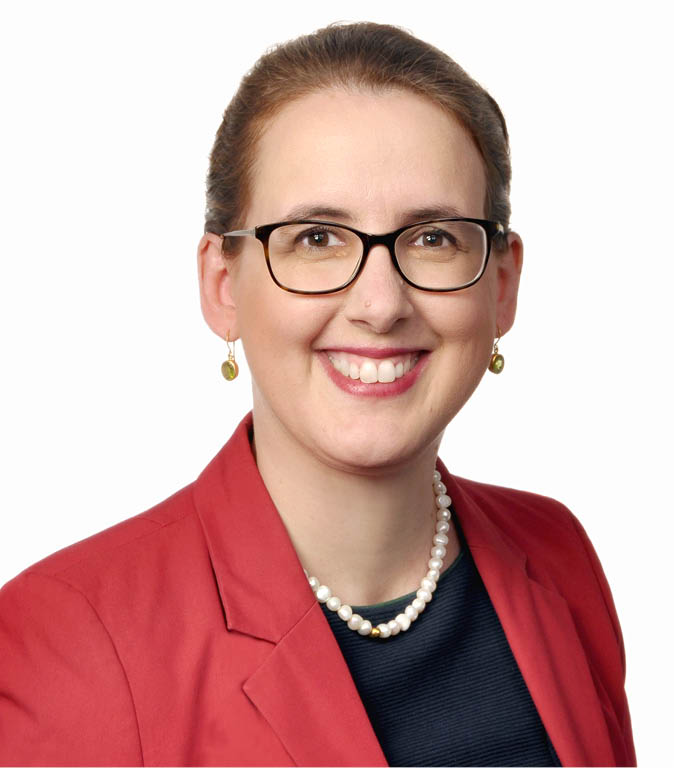
Dr. Franziska Thomas
is a partner at the strategy consultancy Arthur D. Little. From the Frankfurt office, she heads the Healthcare Life Science Practice for Central Europe. Dr. Thomas studied at Harvard University, among others, and holds a doctorate from ETH Zurich in the field of biochemistry. She has been working in the healthcare sector for over 15 years, including 12 years in industry, including at Boehringer Ingelheim. She also brings extensive experience in management consulting. A focus of her work is on topics and developments in the areas of digital health and telemedicine.