>> On your 10th anniversary as impartial chairman of the Federal Joint Committee, let us first not take the usual look back, but rather look forward. At the moment - apart from Corona and the war in Ukraine - the main concern is the increasing financing gap in statutory health insurance companies, which the recently passed Statutory Health Insurance Financial Stabilization Act is unlikely to change much.
That's just one of the worries that bothers me. The fact is that in just a few years we will have even more people of retirement age than before. That's pure demographics. It is already clear today that the pension level will fall to 48 percent by 2030. In addition, there will be more and more people who only receive the minimum wage during their employment - or even less - and who will then receive the aforementioned 48 percent pension on this minimum basis. Accordingly, the resulting health insurance contributions that these people can pay will also decrease. To put it bluntly: it is purely a calculation example, at which point it will almost no longer be worthwhile to collect these contributions at all. In addition, there is already a significant shortage of personnel in all sectors and, of course, in the healthcare sector, which will continue to worsen without a consistent immigration strategy. And if hundreds of thousands of people are missing from work, they will not be able to provide any positive contribution to social insurance. This prospect worries me greatly.
This leaves the 17 billion euros that will be used for financing next year
tion of the legal
Health insurance companies are missing and appear in a slightly different light.
Of course, I would be happy if politicians did something to improve the foreseeable financial
gaps in the communication
to close by the end of the year. And that, for example, the AMNOG reimbursement negotiations will be further developed. However, this does not answer the question of which strategy, which measure
plan we will pursue for the next five, six, seven or eight years. It is high time to discuss relevant solutions and then consistently implement them - because it takes a lot of time to implement the absolutely necessary structural changes in our medical care offering and also in the remuneration system. Instead, one has the impression that the topic of the future is pushed aside very consistently and unfortunately in denial of the facts, based on the motto: The main thing is that the account is fairly balanced at the end of the year.
At the beginning of this year, the reserves of the statutory health insurance funds amounted to 9.9 billion euros, as DAK boss Andreas Storm explained on the occasion of the presentation of an IGES forecast on the rapidly increasing financial gap in health insurance companies. According to this forecast, at the beginning of 2023 the reserves will only amount to 8.3 billion euros. If you now skim off 4 billion euros of this, as provided for in the Statutory Health Insurance Financial Stabilization Act, the reserves only amount to 4.3 billion euros, which means that numerous health insurance funds are likely to slip below the minimum reserve of 20 percent.
There are still options - beyond the use of the reserves that have been built up by the health insurance companies over many years - to use the health fund's liquidity reserves, to increase the general contribution rate in the social security code or even to use additional coverage options through loans, which certainly have high interest rates. But: Anyone who had such a short-term “financial strategy” in their private life would rightly have a worse credit rating with Schufa than someone who thinks ahead and tries with all their might to bring about structurally necessary changes from a position of still existing strength.
Why is it that exactly this is not being done?
Because all politicians – including health politicians – are afraid of telling unpleasant truths. This statement – I say this very explicitly and from my own experience – applies to every party and every government coalition. No previous government - nor the current one - has answered the pressing questions of today and tomorrow.
Now you have been G-BA chairman for ten years, do you want to sit in the executive chair for another ten years?
Absolutely not. You should leave when it's best (laughs) - although of course you have to define when it's best or - to put it another way: when is the right time to change. On the one hand, our so-called banks or sponsoring organizations, on whose trust I depend, do this, and on the other hand, of course, I do it myself. But I definitely won't do another ten years.
Let's take the past period of this decade, sit back, relax and look at what has really changed fundamentally in the system.
The answer is: very little. Certainly some things have been gradually improved, even a bit of tinkering with a lot of small-scale regulation, but unfortunately all without a master plan.
Whose job would it be to think of a master plan for the future of healthcare and then consistently implement it? Should the patients take this into their own hands?
The patients will definitely not do that. The reason for this is simply that it is the natural interest of patients to receive the maximum possible benefits in the respective treatment situation - with the lowest possible contribution payments.
Who then?
I see responsibility absolutely in the political area. If you want to ensure long-term sustainability and financing security in the health system, politicians must strictly keep an eye on the various influencing factors: from demographic developments to digitalization to ever faster medical and technical progress. For me, this rapid progress is the decisive factor because diseases are suddenly treatable that 10 or 15 years ago would almost always have led to the death of patients, even with the best supportive care. In my opinion, politicians must – which they should have done long ago – show in which direction the health system of tomorrow should be further developed.
Where does the path take us?
Politicians have to decide that. And as soon as possible. Actually, immediately. If, for example, politicians want to achieve cost containment above all, cost-benefit ratios could be implemented into the system, as is the case in the Anglo-Saxon world with the so-called QALYs. That would be a very possible option, but one that I consider to be absolutely unacceptable for socio-political reasons. Social insurance is intended to help people especially when the individual's strength is overwhelmed, which can quickly happen in the event of illness with advanced lines of therapy. To then say that solidarity ends at exactly this point because further medical measures would be too expensive is debatable, but for me it is out of the question. The second possible option would be to define what percentage of our gross domestic product we are willing to spend on health, taking into account demographics and medical-technical progress, and how these funds can be raised. Raising funds through labor alone will not work if you look at the increasing marginalization of wages and salaries in the gross domestic product. Therefore, as soon as it has been defined and agreed upon how much society wants to invest in health, politicians will have to think about other financing options.
Where is the personal responsibility?
This is coming now: you have to think about - this is also very uncomfortable for society and politics - whether patients' own contribution should be implemented in the use of potentially inappropriate care offers, because this is the only way to achieve a control effect. For example, if someone with back pain that has been going on for weeks goes to the emergency room of a university hospital instead of to the orthopedist in private practice. However, these are all questions that can only be answered and decided with political and democratic legitimacy. No G-BA chairman can do that, whose democratic legitimacy, granted through the legislature and legal supervision, is already disputed by some constitutional lawyers.
You can always raise your voice.
I do this often enough by pointing out structural problems and suggesting solutions to current political discussions. As an impartial chairman, I naturally also receive a lot of information about possible over- or incorrect regulation from the provision that we as the G-BA play a significant role in shaping. Sometimes there are problems that the G-BA can solve through its guidelines; Much more often, however, these are cases in which our hands as the G-BA are tied and politicians are called upon. Nevertheless - and this is a relatively frustrating conclusion after ten years as G-BA chairman - the pressure in the system is apparently not yet great enough for politicians to recognize the need for action.
She will recognize them.
Recognizing is nice, but in itself it is of relatively little use. Politics needs the will to act and, above all, the courage to act. Because no matter how our primarily structural problems in the health system are addressed and solved: there will always be unpleasant truths. Here we are again in the current situation: Each of the actors is trying to bury their head in the sand and fervently hope that they can somehow save the system for next year. Although I sometimes feel like a lonely warning in the desert, I still have hope that at some point a fundamental discussion will be initiated, which will be anything but easy.
What do you see as the basic problem?
Of course there are several. Let's start with the patients you asked about when it came to personal responsibility. Based on the principle that the patient is at the center of medical care, one can notice very conflicting interests among these same patients. To put it bluntly: As long as you are healthy and happy as an insured person, you will switch health insurance companies to save money because of the 0.1 percent difference in additional contributions. However, at the moment when the same person becomes acutely or chronically ill, the interest is primarily directed towards a maximum range of care, whatever the cost and regardless of whether a service actually makes sense. All of this is understandable from a purely human perspective and ultimately rarely exists in its pure form in these forms. However, the associated behavior leads to imbalances. In addition, payers and service providers try to make medical care as cost-effective as possible. This is not a reproach, but rather the logical consequence of the fact that politicians have placed, above all, the health insurance companies - and of course also the service providers, especially the hospitals - in a competition that is sometimes ruinous. Unfortunately, finding a solution in this situation that makes everyone happy at the end of the day will not work.
With this you have exactly named the so-called benches of the G-BA, although the patients can act without voting rights and everyone else can act with voting rights.
When the G-BA's sponsoring organizations define what constitutes appropriate, economical and expedient care, this is sometimes highly conflictual, especially when the study situation is not flawless, because different interests naturally collide here. However, our clear mission is to design the services that are important for care within an appropriate time frame and despite the potential for conflict inherent in the system. However, the G-BA has no authority whatsoever when it comes to generating and distributing money and also no authority whatsoever when it comes to the question of control - for example through the insured's own contribution. It is the legislature's original task to create the conditions for better care.
If he would accept the task.
I am waiting for the day when our top constitutional lawyers define what decisions the legislature would actually have to make in order to make our health system more resilient in view of medical progress, current crises such as the corona pandemic and the special care needs of war refugees from Ukraine.
Let’s illustrate the whole thing with a concrete example.
Let's take the discussion about the non-invasive prenatal test, or NIPT for short, to detect trisomies 13, 18 and 21 in the unborn child. As the G-BA, the majority of us were of the opinion that a technocratic-looking review of the medical benefits of this test is in no way sufficient, because the test option also touches on fundamental ethical and moral questions of our society. We therefore asked the legislature to give us instructions, which unfortunately they did not do. Ultimately, we had to decide on the medical benefits and reimbursement of costs in accordance with our general mandate - we had no other option.
As you know, the decision was in the direction of reimbursement, so that since July 2022, statutory health insurance companies have been covering the costs of a non-invasive prenatal test for trisomies 13, 18 and 21 in certain situations.
Was this one of the cases in which you had to use your voice as an impartial chairman to make a G-BA decision go one way or the other?
No, the benches actually agreed.
Which happens rarely enough.
This happens a lot more often than you think. Around 90 percent of all decisions are made unanimously. But there are also cases in which, in my role as impartial chairman, I have to cast the decisive majority vote. This act of using the thirteenth vote is not a pleasant task because it always supports one of the conflicting sides, which the other side - understandably - does not appreciate at all. Especially since it usually involves important fundamental questions in which the natural conflicts of interests become obvious.
Would the G-BA be unable to act without the thirteenth vote?
He would be able to act, but the consultation process would take far more time than it does now.
What is the solution?
On the one hand, it is endurance and a high tolerance for frustration: whether it is about new but most expensive active ingredients, minimum quantities or
as is currently the case with the initial assessment procedure in the emergency room. On the other hand, you have to put well-founded suggestions on the table yourself, instead of saying succinctly: “You just have to agree on that” or “You have to do something about that.” Unfortunately, one sees far too often that problems are described and urgent solutions are urged, but no viable ideas are contributed.
What are you personally doing here?
I develop suggestions and put them up for discussion. If they are accepted, I will be happy; If they are not accepted, I acknowledge it – without any bitterness. From my time in active political business, I am only too aware of the imponderables or agendas that lead to political decisions being made or not. And there is always a next state election and always an upcoming federal election that one can easily hide behind.
Do you have endless patience with politics?
Not at all. Because I see that we are losing valuable time that we urgently need to finally politically address the serious structural problems in health care. We still live in a time in which politics can bring about solutions cautiously and over a longer period of time. Knowing that the fundamental decisions required here cannot be made from the hip in three days, or even in a few years.
We have to demonstrate this again with an example.
Let's take the income-independent health bonus that was considered in 2004 under Angela Merkel's chancellorship. In 2009, this was included in the coalition agreement of the government coalition of CDU/CSU and FDP as “employee contributions independent of income” and was even included in the key issues paper of the Ministry of Health under Philipp Rösler in 2010. That was the end of it and the idea, which was good in itself, died a hero's death after long discussions. The example shows very well how complex such structural innovations are, especially when they affect financing. Against this background, once again: It is high time for fundamental changes. If you want them.
Then we all hope for heavenly enlightenment. But let's go back to your thirteenth vote as impartial chairman, which you can imagine as a kind of hammer: Where did you have to hammer the nail in with that?
This has happened several times. Sometimes I did it right and sometimes I did it wrong, but unfortunately you can only know that in hindsight.
Where did you make the right decision?
Let's take a case where at the end of the day it turned out that I was right, even though the issue was quite controversial at the time the decision was made. It was the drug review of Sofosbuvir from 2014, better known under the trade name “Sovaldi”. The innovative active ingredient, which is used in combination with other drugs to treat chronic hepatitis C in adults, triggers around one billion euros in additional spending in statutory health insurance.
The corresponding G-BA decision at least acknowledged an indication of considerable additional benefit compared to the appropriate comparative therapy for treatment-naïve patients with chronic hepatitis C virus infection.
That's exactly what it's about: The additional benefit for this active ingredient was proven in certain hepatitis C patients, but not in all. There were differences between the eight patient groups examined. In addition, the active ingredient was significantly more expensive than the appropriate comparative therapy with interferon, which was full of side effects and had only a relatively moderate response in patients.
What is the problem if there is enough evidence?
Because you can mercilessly interpret evidence from different perspectives. Unfortunately, approval studies can be said well or badly, for example by not being prepared to recognize a high cross-over rate. For example, the Institute for Quality and Efficiency in Healthcare, IQWiG, argued at the time that an important approval study could not be recognized because too much cross-over had taken place.
However, what the ethics committee expressly requested.
Exactly. The reason for the explicitly desired possibility of a cross-over was that affected patients in the control group cannot continue to be treated with interferon for a year and be exposed to the most serious side effects, while patients in the intervention group leave the hospital after twelve weeks - recover mind you.
This required a health care policy decision that ultimately boils down to the question: How much should healing cost?
At that time, some of the stakeholders said: “Of course we want to improve care, but unfortunately the study is not usable.” While the other, equally large part, said that the results of the studies – there were several of them – were absolutely convincing. It was par. That's why my vote ultimately had to decide whether we followed the IQWiG recommendation. I didn't make a lot of friends by acknowledging the additional benefits.
Because the decision made with your vote cost the statutory health insurance system a lot of money.
Sure, of course. Thank God the decision was right, because sofosbuvir is now the standard therapy in two- and three-dose combinations. Sure, it was expensive, but it didn't end the world. Incidentally, this also applies to the discussion about the emergency levels for hospitals, which I would like to cite as a second example. Here too I think I made the right decision with my vote. Here too, the intended success occurred in the form of a structural adjustment aimed at. We now have around 1,200 hospitals that participate in emergency care because they meet clear structural criteria.
Where were you wrong?
The use of my thirteenth vote on the PPP directive, which regulates staffing in psychiatry and psychosomatics, was probably wrong. At that time, we had to make a decision based on relatively thin evidence, as the specially commissioned report ultimately could not be used. We then tried to compensate for these evidence problems somewhat through expert discussions and then – using my voice – moderately increased the minimum staffing requirements in certain areas. But that alone wasn't the decisive point. What was more serious was that we implemented relatively labor-intensive station-related documentation requirements - they were intended to provide information about the actual personnel ratio and were the basis for later being able to sanction non-compliance with the minimum requirements. Since then, this decision on the PPP directive has been a constant source of anger, which is expressed, for example, in a considerable number of letters, some of which are identical, from different corners of the republic. This shows that senior administrative directors of hospitals in particular are very organized.
are powerful. It should be acknowledged, however, that we seem to have gone a bit far over the target with the well-intentioned directive, which is intended to regulate compliance with the minimum staffing requirements and thus ensure there are sufficient staff on the wards.
Overshooting the mark is not wrong.
True. But if the desired goal cannot be achieved due to the shortage of personnel that can be observed everywhere, such a regulation is unfortunately of little use. We will therefore probably have to extend the transitional regulations implemented in the resolution from year to year.
You can see from the current agreement between the university hospitals and the nurses that documentation is explicitly required from the nurses in order to point out grievances and then be able to sanction them.
That will also be correct in this case. However, here we are in the area of quality assurance, which is faced with the big problem that more and more indicators change more or less in the decimal range, but - this is my bitter conclusion in this area - this also remains largely without consequences. You have been following the healthcare system for decades now: Have you ever noticed that a facility somewhere was closed in a timely manner to protect patients due to a quality assurance measure implemented by the G-BA and the resulting documentation?
That would be new to me.
We conducted structured dialogues, had forms after forms filled out and reported, and included more and more service areas with more and more indicators in quality assurance. What changes? Nothing! Once a year, the quality report informs the astonished public that, for example, in 2019 we evaluated 221 indicators in 24 quality assurance procedures and that no particular need for action was identified for 95 percent of these indicators. As an impartial chairman of the G-BA who is not fundamentally involved in quality assurance, I now ask myself the question: What is the point if we spend a lot of effort collecting and evaluating so many indicators that have not changed at a high quality level for ten years?
Your solution approach?
If I were to consider five new indicators, I would remove at least ten that have not changed.
Or the majority of the 95 percent of indicators for which virtually nothing changes, but take a much closer look at the 5 percent with volatile results.
You say it so simply. I'm far from naive. I wasn't like that when I came to the G-BA ten years ago because I learned from my previous positions how such things work. The key point is: quality assurance must be able to effect change to achieve better care. However, this can only be achieved if unannounced samples are taken at irregular intervals in the areas where quality defects can be suspected, loosely based on the Gospel of Matthew 24:42: “So be vigilant! For you do not know on what day your Lord is coming.”
Or, to paraphrase Matthew, who also said: “Not one stone will be left upon another; everything will be torn down.” Is old-style quality assurance stillborn?
At least it seemed that way for some time. But last year we took a very important step forward by identifying three service areas in which we want to try to implement a kind of “quality assurance light”. However, the “light” only applies in the sense that we remove a lot of unnecessary documentation effort and indicators, but instead measure seven or eight hard, risk-adjusted indicators that can be tracked very quickly and thus react to measurement results in a timely manner.
Sounds quite logical.
Logically yes, but leaving it out is unfortunately also fraught with uncertainty. There may be so-called statistical outliers in terms of mortality or infections that cannot be measured if one limits oneself to fewer indicators.
Omission is also a form of decision-making courage that you demand from politicians.
That's right. We have to say goodbye to the idea of trying to create absolute security through fully comprehensive quality measurement. Quality assurance - rethought - should help to improve care in a relatively timely manner and to make changes where it is right and important. That's exactly what we're piloting now.
Which in turn means: We start in mid-2022 and have already wasted 10 or 15 years of time. Since when has the G-BA quality assurance existed or the cross-sector quality assurance that was introduced before? Since 2009!
Health services research is not entirely innocent of this.
Just get out the criticism, we're just among ourselves, so to speak.
In my view, the point is that what politics and the G-BA need as a basis for decision-making and what science does are not always congruent. This is mainly because science - which is certainly inherent in the system and just as certainly typically German - wants to optimize studies and results with enormous effort until almost the desired 100 percent is achieved. However, as science tries to increase the level of evidence - which is of course an honorable claim - a lot of energy is being used in the form of budgets and manpower. Ultimately, the resulting accuracy does not help much at the decision-making level. I don't mean to speak out against scientific accuracy in any way, but in my first job after successfully completing my legal studies, working as a water and waste law consultant, I learned that 95 percent of the desired success can be achieved with relatively few resources but the last five percent consume almost endless resources while only generating relatively little added value.
There is also the equally important factor of time.
Exactly. If you want to achieve 100 percent from the outset, you have to live with the consequence that 95 percent accuracy may be achieved after just 2 years, but 100 only after 20 or 25. This means that perhaps a quarter of a century later, paradise on earth can be created. But so much has happened in the meantime that the result will remain a waste. This applies to many areas, but particularly to quality assurance. Long story short: We set off in the early 1900s of the 21st century, inspired by the idea of improving health care through quality assurance. Then we had to discover that 95 percent of the measurements and results are actually undisputed, but the remaining delta of 5 percent is highly controversial.
Which means that in the discussions held in the G-BA plenum on quality assurance, which I regularly follow, the impression often arises that health insurance companies and patients want quality assurance, but DKG, KBV or the KZBV do not.
That is absurd. Of course, these three banks also want quality assurance. However, in the eyes of the service providers who ultimately have to carry out the documentation work, the desired result must be in proportion to the effort. If quality assurance does not explicitly offer added value for patients beyond a certain point, then we have to limit the survey quantities because the human resource is limited.
Quality assurance is nothing more than the attempt to make structural or procedural problems visible and controllable. But what use is it if the goal is not clear, there is no vision of a sustainable, resilient health system, and there is no “master plan” that has often come up in our conversation? In other words: What do you explicitly expect from health services research, which is the only scientific field that researches the Pfaffian “last mile”?
As someone who has not had an academic career, it is not my place to criticize science, including health services research. However, I note that health services research certainly deals with topics such as future hospital structures or options for outpatient care. That's a good thing, because this is about big and important questions that deal with structural problems.
Where is the problem then?
It is also a fact that, as chairman of the innovation committee in the health services research section, I have to state very specifically that we sometimes receive very qualified applications that we only rejected because they address problems that can be described as “small-small”. It's really nice when I get scientific evidence that it helps to encourage a potentially mentally impaired patient or addict or dementia sufferer to stick to their appointments by having them picked up or sending them a taxi. This may all be right and necessary, but it is almost self-explanatory. Do you really have to support something like this with scientific evidence? Let’s be honest: Such “small-small” research approaches really don’t help our health system move forward! I would like health services research to think more in the direction of cross-sector care, beyond the detailed questions that arise everywhere, which may in and of themselves be quite correct. Or at least attempt to pilot and evaluate new cross-sector and cross-professional solutions in certain smaller care settings.
More Templins, so to speak?
This was not a health services research project, but one from the area of “new forms of care”, but at least one that was evaluated by health care researchers. Here, too, be honest: what was done and discovered was not the big innovation that made the earth shake. If certain outpatient services are provided in a hospital, that is good for the hospital and good for the patients - and if certain specialist medical capacities are covered that are no longer available in the outpatient setting, that is even better. But this is not a completely new finding. But at least it has been clearly scientifically proven that such settings work, thus putting an end to the gut-controlled phantom discussions. Which is also a value in itself.
What is the problem with health services research?
The healthcare researchers are making it too easy for themselves. So far I miss the “big hit” in the applications. Because exactly these approaches that would really catapult us forward are missing, the money available for health services research was not fully distributed in several award tranches. This has of course been criticized several times by healthcare researchers, but that is their own fault. What is the use of exploring the third decimal place in a mini-detailed problem, so to speak? Nothing, I say, because that brings us back to the same construction site as quality assurance. Promoting useless projects that we don't think are productive from the outset doesn't achieve enough.
Were there no major projects in the health services research part of the innovation fund?
But already. Unfortunately, project proposals that involved larger approaches to thinking were usually formulated so superficially that it was not even clear what the hypothesis being pursued was. Apparently there are major deficits in health services research.
Of which politics is not entirely innocent.
That is also true. Health care research was consistently underfunded before the Innovation Fund's millions in funding were available. Of course, there were funding opportunities before that too. Overall, one can say that before the innovation fund for health care research there was relatively little money and therefore unfortunately also relatively little capacity to even think about the really structural questions. That's why I hope that the community of healthcare researchers uses the time and the many millions that the innovation fund is massively distributing to build up and expand skills, manpower, methods and theories that will enable them to quickly answer structurally important questions formulate them and put them into working hypotheses.
Wouldn't it make sense to implement a well-staffed think tank that - let's say - defines the five most important structural questions that health services research then has to clarify with appropriately adequately budgeted innovation fund projects in order to improve care?
Then the German Society for Health Services Research would no longer have the opportunity to regularly criticize me in press releases (laughs). So far, however, I have not noticed any prioritization catalog coming from health services research that could then be subjected to social and political discourse. The fact that this works can be seen, for example, in the S3 guidelines of the Association of Scientific Medical Societies (AWMF), which have recently been supported separately in the Innovation Fund.
MVF will - gladly with partners - push this prioritization catalog forward with its December congress. Would you be there?
I always like to be involved in such fundamental considerations, because here you get the chance to help make things better or more plausible. And to critically discuss and question the problems that plague us all. But to come back to the prioritization catalog: the example of the S3 guideline development supported by the Innovation Fund shows very clearly how something like this can be set up. The Innovation Committee has entered into a joint project with the AWMF, which has the sole aim of promoting the development of guidelines. The Federal Ministry of Health defines the relevant care areas after prior consultation with the AWMF and us. At the end of the day, however, the Innovation Committee decides what is funded and fits into a kind of “master plan guidelines”. Such a setting can also be imagined in health services research together with the Federal Ministry of Health and the German Network for Health Services Research.
Which would relieve the burden on you as head of the Innovation Committee, because instead of many smaller projects, there would be fewer but more important projects.
If the Innovation Committee in the area of health services research only receives 10 applications instead of 186, that will also make my life a lot easier. But above all, the impact of health services research would certainly be much greater than that of many “small-small” projects. So: If there were such an initiative and if health services research could agree on a few but pressing topics that neither the G-BA nor the Innovation Committee will specify, I would be happy. But you shouldn't waste a decade on this - as is the case with quality assurance.
We are still young, Professor Hecken: We can do it.
The crucial point is that such an initiative does not become a non-starter, true to the motto: If you don't know what to do next, set up a working group. Here too, time is of the essence, this time for reasons inherent in the system: the innovation fund will soon be made permanent through corresponding legal changes. A new approach to health services research must be incorporated into this change in the law because it cannot be easily implemented into the existing structures. With this in mind, this is not a ten-year project, but rather a one-year project. <<
Thank you for the interview.
The interview was conducted by MVF editor-in-chief Peter Stegmaier.
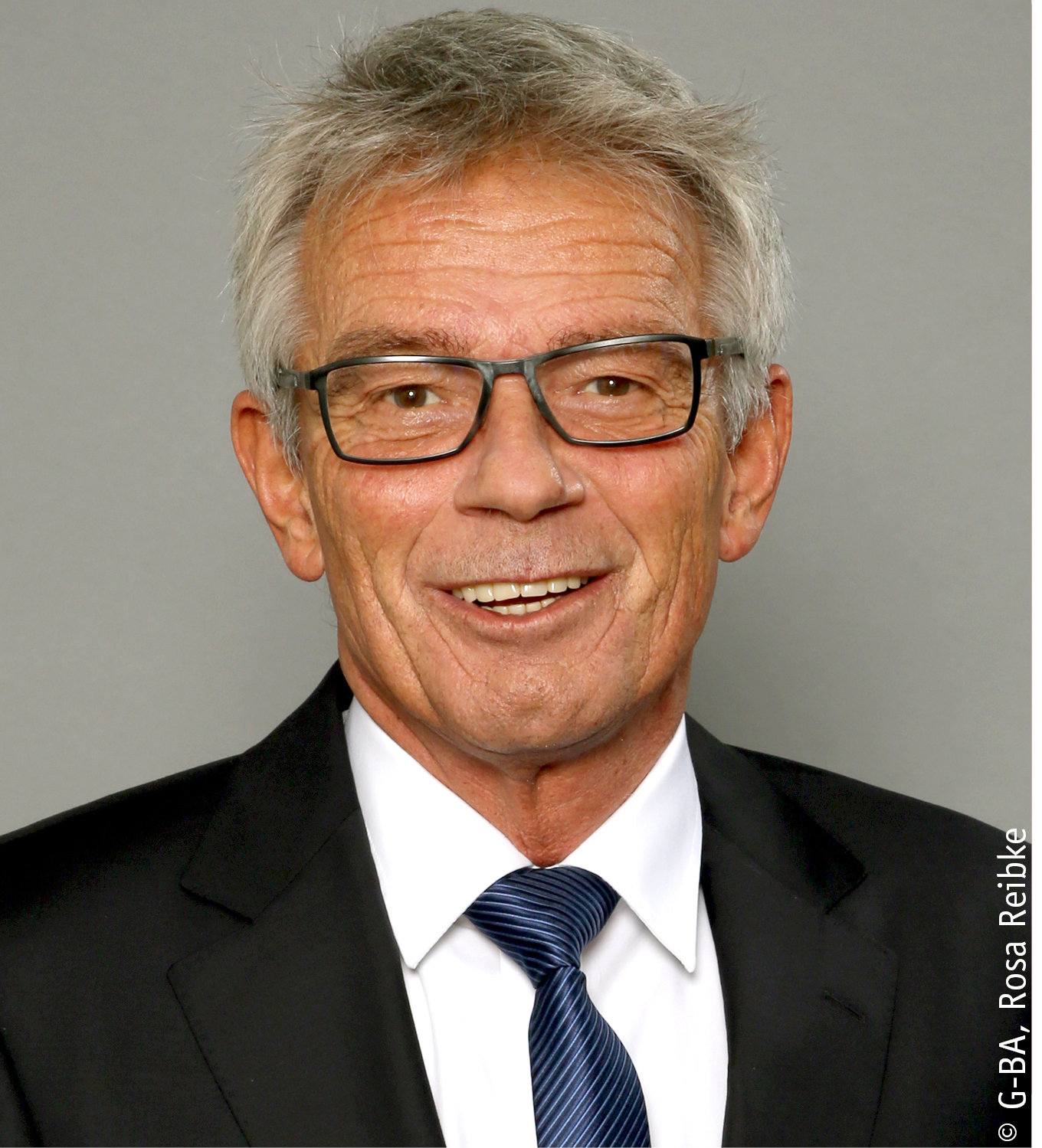
Prof. Josef Hecken
has been the impartial chairman of the Federal Joint Committee since July 2012 and chairman of the Innovation Committee at the G-BA since October 2015. Also in 2015, he was awarded the title of professor by the Saarland government in recognition of his achievements in science and research. Since 2018, he has been teaching at the Leibniz University of Hanover and the Medical Faculty of Heidelberg and is a lecturer in the master's program in pharmaceutical law at the Faculty of Law at the University of Marburg.
Before his appointment as impartial chairman of the G-BA, Hecken was, among other things, President of the Federal Insurance Office (2008-2009), Minister for Justice, Health and Social Affairs of Saarland (2004-2008) and from 2008 also for Labor and at the same time Chairman of the Health Committee and Deputy Chairman of the Legal Affairs Committee of the Bundesrat.