


Mental illnesses in the Corona year: peak days of absence from work
22.02.2021 09:55
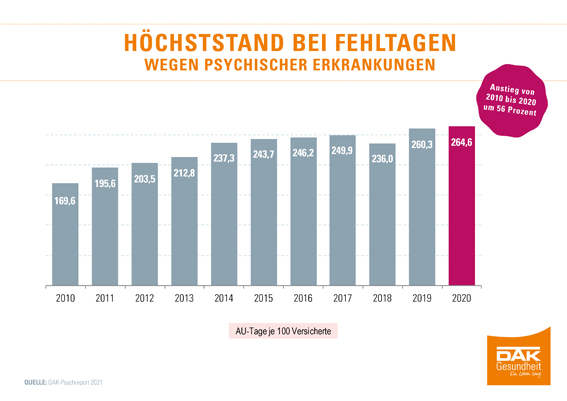
There have never been as many days lost from work due to mental illnesses as in the Corona year 2020. They reached a new high of around 265 days lost per 100 insured people. Compared to 2010, this represents an increase of 56 percent. The increase in the number of employed people last year mainly affected women, while absenteeism among men remained almost at the previous year's level. A mental illness case lasted an average of 39 days in 2020 - longer than ever before. This emerges from the current psychological report from DAK-Gesundheit.
When comparing diagnoses, depression was the most important cause of sick leave. At eight percent, there was the greatest increase in adjustment disorders compared to the previous year.
For the Psychreport, the Berlin IGES Institute evaluated data from more than 2.4 million employees insured with the health insurance fund. All absences for which a certificate of incapacity for work with a psychological diagnosis was sent to the cash register were received. A key result: The number of days absent is higher than ever before and the average duration of a mental illness has reached a record level. “Our current analysis shows how people with mental problems in particular are suffering from the pandemic restrictions and stress,” says Andreas Storm, CEO of DAK-Gesundheit. “It is worrying that those affected are on sick leave for longer and longer periods during the crisis, especially women. The aim must be to stop the trend and help those affected with suitable offers and care concepts. This is particularly important in times of crisis like the corona pandemic.”
The Psych report shows how the ratio of short to long-term cases of mental illness has changed in 2020: there was a significant decrease of one fifth in short sick leave of up to a week. However, sick leave of more than two weeks increased, even more significantly among women than among men. For years, women have had more days of absence than men because of psychological problems. Under pandemic conditions, absenteeism among them increases even further, while among men it remains almost at the same level as the previous year. In 2020, DAK-insured employees were absent an average of 3.4 days due to a mental illness, compared to 3.3 days in 2019. Men averaged 2.0 days in both years.
With 106 days of absence per 100 insured people, depression continues to cause by far the most days of absence, but in 2020 it is more or less at the same level as the previous year. Under pandemic conditions, adjustment disorders become more important: Last year, this second most important diagnosis accounted for 64 days per 100 insured people, eight percent more than in the previous year. Adjustment disorder refers to a reaction to a stressful life event, such as a bereavement. This can be expressed in negative changes in the mood or in disorders of social behavior.