


Pharmaceutical market in Germany in 2020: Focus on innovations and the impact of the pandemic
23.02.2021 11:14
A recent analysis of pharmaceutical supply in Germany for 2020 reveals significant impacts of the COVID-19 pandemic on hospitals and medical practices. The supply of innovative medications for the treatment of serious illnesses remains a crucial pillar of therapeutic care. The cost-cutting measures implemented by health insurance funds have resulted in savings exceeding those of the previous year.
German pharmaceutical market 2020: Impact of the COVID-19 pandemic
In 2020, sales in the entire German pharmaceutical market – including both hospital and pharmacy segments – increased by almost 7 million euros to €49.5 billion (based on manufacturer's selling prices without any deductions in the pharmacy segment, and calculated prices in the hospital segment). This figure also includes vaccines and diagnostics. The quantity measured in units (tablets, capsules, sachets, injections, etc.) declined slightly (-0.6 million euros) to 97.5 billion euros.
A separate analysis shows comparable increases in value for both sectors, between 6 and 7 %. However, the volume of medication consumed in hospitals decreased by 10 %, while sales in the pharmacy market stagnated. These developments are related to the COVID-19 pandemic, as hospitals postponed surgeries, among other things, to keep beds available for COVID-19 patients. This also reduced the demand for certain medications. Consequently, all of the highest-volume drug groups in the hospital market experienced declines.[1]
In the pharmacy sector, the monthly market development in particular shows clear effects of the pandemic, especially during the first lockdown in the spring, but also afterwards, when fewer patients visited doctors' offices due to concerns about infection. In an effort to reduce contact, there were also fewer visits to pharmacies, which benefited mail-order pharmacies.[2]
Overall, the pharmacy market recorded a sales increase of 27 % in March (sales: +24 %), while the number of dispensed drug packs decreased in the following months (e.g. April/May: -17 %/-18 %) because stocks were reduced.[3]
Statutory Health Insurance Market: Growth through Innovations
In 2020, drug expenditures (including diagnostic tests) amounted to[4]The total expenditure on prescription drugs in statutory health insurance amounted to €43.9 billion (based on pharmacy retail prices less mandatory discounts and reimbursement amounts according to Section 130 of the German Social Code, Book V). This represents an increase of 5.1 billion euros compared to the previous year. The number of packages dispensed decreased by 2.2 billion euros. This development can be explained, among other things, by the increased prescription of larger packages, which in some cases reduced the frequency of visits to doctors and pharmacies. Prescription drugs were prescribed in N3 packages by 3 billion euros, while N1 packages decreased by 10 billion euros and N2 packages by 5 billion euros. Furthermore, N3 prescriptions increased by 13 billion euros, particularly for patented and therefore generally more expensive medications. For generic drugs, however, the increase was only 3 billion euros.
A look at the leading drug groups reveals that they often include innovative preparations for treating serious illnesses such as cancer or multiple sclerosis. The "COVID-19 year" of 2020 was by no means solely defined by the pandemic. Rather, the Committee for Medicinal Products for Human Use (CHMP) recommended one and a half times as many new drugs for approval to the European Medicines Agency (EMA) as in the previous year.[5] This is reflected in the market figures.
The highest-selling category of monoclonal antibodies (MABs), used in cancer therapy, comprises over 70 % drugs, both in terms of value and quantity, introduced between 2015 and 2020. In the second-largest group, protein kinase inhibitors, also indicated for oncological diseases, the volume of drugs introduced during these years exceeds 50 %, while the value exceeds 40 %. For other leading groups, the proportion of products launched in the last six years is also in this range. Most of these categories have experienced low double-digit growth in both value and quantity, indicating corresponding therapeutic needs.
Of the drugs newly introduced in 2020, elexacaftor in combination with tezacaftor and ivacaftor for the treatment of cystic fibrosis is the most popular. Upadacitinib for the treatment of moderate to severe active rheumatoid arthritis in adult patients ranks second. Siponimod for the oral treatment of adult patients with secondary progressive multiple sclerosis follows in third place.
Higher savings in statutory health insurance than in the previous year
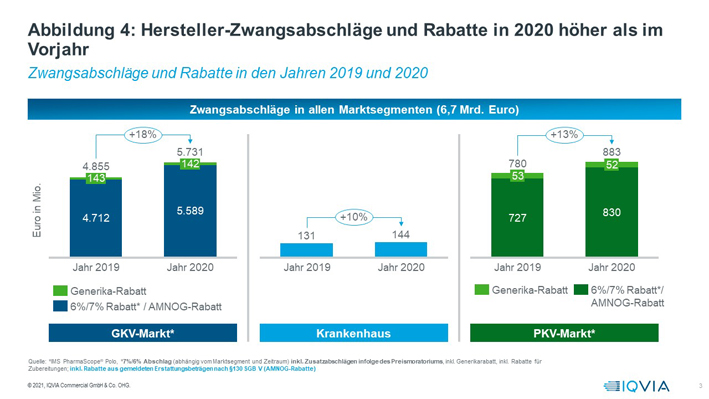
Despite so much innovation, the savings of the statutory health insurance funds (GKV) have continued to rise. Savings resulting from mandatory manufacturer discounts and rebates on reimbursement amounts totaled €5.731 billion in 2020 (2019: €4.855 billion). The lion's share, over €3.9 billion, is attributable to the "AMNOG rebates." These figures do not yet include savings from rebate agreements, which have not yet been published for the full year 2020. Extrapolating these savings based on the first three quarters of 2020, a volume of over €4.7 billion can be expected.[6]
Private insurers will benefit from calculated savings of over €880 million in 2020 due to manufacturer discounts. This applies to the discounted segment of hospitals.[7] An additional €144 million was spent on discounts. Pharmacy discounts to statutory health insurance funds remain stagnant at just over €1 billion.[8] In total, the mandatory discounts from the three market segments thus amount to 6.7 billion euros.
[1] See IQVIA Pharmaceutical Market Report 2020, page 15, under: www.iqvia.com/de-de/locations/germany/publikationen/marktbericht?utm_source=Presse&utm_medium=E-Mail&utm_campaign=Marktbericht-Feb21
2 See also IQVIA Pharmaceutical Market Report 2020, page 23: ibid.
3 See also IQVIA Pharmaceutical Market Report 2020, page 17: ibid.
4. Without vaccines, as they are a different cost center
5 Source: https://pharmakotherapie.blog/2020/12/30/acalabrutinib-bempedoinsaeure-crisaborol-arzneimittelneuzulassungen-2020/
6 Calculation: Savings volume in the first three quarters of 2020: 3.562 billion euros, divided by 9, multiplied by 12. Data source for the savings figures for the first three quarters: KV 45.
7 Outpatient clinic outside budget
8 See also IQVIA Pharmaceutical Market Report 2020, page 5: ibid.