


By 2035, there will be a shortage of around 11,000 general practitioners in Germany
27.05.2021 16:02
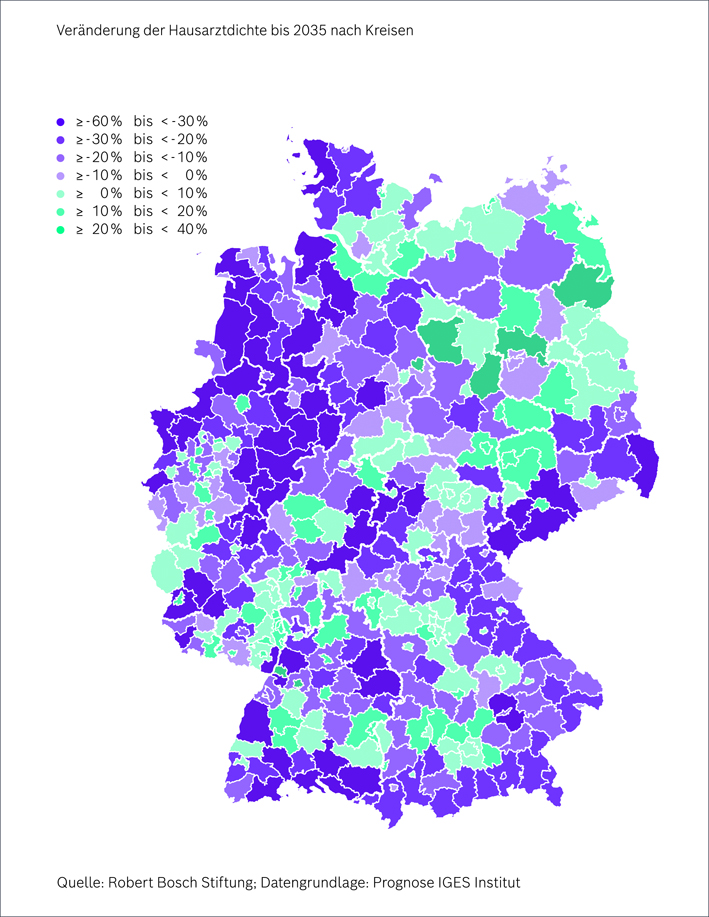
In 2035, there will be a shortage of around 11,000 general practitioners nationwide. A study by the Robert Bosch Foundation now wants to show for the first time which cities and districts will be particularly affected by the shortage of family doctors. Around 40 percent of all districts will therefore be undersupplied or at risk of undersupply, as the Berlin IGES Institute calculated on behalf of the foundation for the study "Health centers for Germany. How a new start in primary care can succeed". It could become particularly difficult for citizens in Lower Saxony, North Rhine-Westphalia, Saxony and Baden-Württemberg to find a family doctor in the future. In some districts, the number of general practitioners will decline by around 50 percent by 2035.
“In extreme cases, patients in underserved districts must expect not to have a single general practitioner in their area,” says Hans-Dieter Nolting, healthcare researcher and managing director of the IGES Institute. While the shortage of family doctors has so far been known to be a problem primarily in rural regions, urban areas will increasingly be affected in the foreseeable future. In some medium-sized cities there will be around 20 percent fewer general practitioners in 2035, as the forecast shows.
Reasons for the shortage of family doctors
The reasons for the impending gap in care are the age structure of the currently practicing general practitioners and the professional orientation of the next generation of doctors. By 2035, almost 30,000 general practitioners would retire due to age. The vacant family doctor positions would not be filled in equal numbers by junior doctors and immigrant doctors. On the one hand, this is because few young doctors decide to become family doctors. On the other hand, young doctors increasingly prefer employee relationships and part-time models instead of individual practices and want greater multi-professional collaboration.
At the same time, the population's need for medical care and support is changing. Demographic change is leading to a shift in the spectrum of illnesses and there will be more older people with chronic and multiple illnesses. They often need individual support in all areas of life that goes beyond medical care. It is therefore not enough to simply increase the number of general practitioners.
Suggested solution: The establishment of regional health centers
In order to meet the challenges, the study authors recommend restructuring the supply system as quickly as possible. The so-called primary care – i.e. the level at which people first come into contact with the health system – plays a key role. “An important building block is the establishment of local, comprehensive health centers in which multi-professional teams of doctors and nurses with other health professions treat patients according to their needs and, ideally, know their family and living circumstances,” says Doris Schaeffer, Professor of Health Sciences at the Bielefeld University. Primary care centers could also make a contribution to getting the cost development in the healthcare system under control, as they are closely integrated into the municipalities, enable efficient service provision and focus on prevention.
The 13 PORT centers (patient-oriented centers for primary and long-term care), whose development the Robert Bosch Foundation has been supporting since 2017, show what such health centers could look like. “In the PORT centers we see how well-coordinated health care is implemented for citizens, combined with prevention and health promotion offers that are tailored to regional characteristics. At the same time, they offer attractive working conditions for nursing and medical staff,” says Bernadette Klapper, Head of Health at the Robert Bosch Foundation. A whole model region is currently being created in the Reutlingen district with the two PORT centers Hohenstein and Hülben as well as other facilities. According to projections, with 1,000 locations across Germany, comprehensive primary care through health centers based on the PORT concept could be possible.
Handover of the future agenda to Jens Spahn
The proposal to strengthen primary care is part of an agenda for the healthcare system in Germany that the Robert Bosch Foundation is promoting in its “Neustart! Reform workshop for our healthcare system” was developed together with citizens and health experts over three years. The future agenda is to be handed over to Federal Health Minister Jens Spahn at a press conference on June 17th.