


TK-Monitor patient safety: Six out of ten people fear infection in the hospital
13.09.2022 12:50
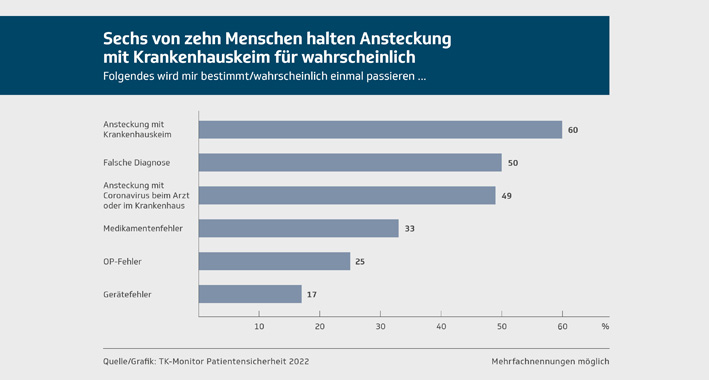
60 percent of people believe it is likely that they will become infected with a dangerous germ during hospital treatment. 50 percent assume that they will receive an incorrect diagnosis themselves. And 49 percent of people also think it is likely that they will become infected with the coronavirus in the doctor's office or clinic. This is the result of the “TK Monitor Patient Safety 2022” from the Techniker Krankenkasse (TK). The deputy chairman of the TK, Thomas Ballast, says: “Our representative survey shows that people are very aware of the risks in the healthcare system. Unfortunately, the results also show that we need to make the contact points and support offers for those affected even better known.”
The study shows that concern for patient safety is widespread. Many respondents therefore consider it likely that they will experience a medication error (33 percent), a surgical error (25 percent) or a device error (17 percent). 53 percent of those who suspect that they have made a mistake in the past ten years attribute the mistake to outpatient treatment, 33 percent to inpatient treatment, and 15 percent to outpatient treatment in the hospital. “This means that more than half of the suspected errors relate to the outpatient area. This clearly shows that we need measures for patient safety not only in the clinics, but also increasingly in the practices,” says Ballast. “These patient concerns should be a reason and obligation for all those involved in the healthcare system to continually work to improve patient safety.”
28 percent remain silent
Those surveyed say that the first point of contact if they suspect something is another doctor (42 percent) or the treating doctor (30 percent). In 2002, over half of those affected kept their suspicions to themselves. In this year's survey, 28 percent of those affected said they remained silent and did not report their suspicions. When asked why, more than half of those who remained silent said “it’s no use.” Almost as many said they didn't know who to turn to. Ballast: “All actors in the healthcare system are required to make contact points better known. We have already developed an online guide for our insured persons, which they can use to easily describe their specific suspicions.”
73 percent say: I can improve security myself
The TK patient safety monitor also shows that many patients are aware of their own influence. 73 percent of those surveyed say that they can help ensure safe care in the hospital or practice. The deputy chairman of the TK board: “Anyone who dares to express concerns or correct errors may be able to prevent damage, for example if you are addressed with the wrong name because there is a patient mix-up. Paying attention can also help to recognize and avoid errors, for example if a patient notices when the medication is being dispensed that the pill is a different color than before.”
Politics must create the conditions for hardship funds
In order to provide better support and strengthen the victims of treatment errors, the TK is calling for the establishment of a patient compensation and hardship fund, which is also provided for in the current federal coalition agreement. In the survey, only 8 percent of people who suspected a medical error stated that they had suffered major financial loss as a result. 18 percent of those affected stated that they had suffered minor financial damage. Ballast: “The results show that a hardship fund would only be used in a few cases. However, it is particularly important in these cases.” Politicians now have the task of implementing this project and clarifying necessary details such as performance requirements, decision-making processes, verifiability, forms of organization, connection and financing.